
The hypothesis of seafloor spreading was proposed by H. Harry Hess in 1960. Using sonar technology, Hess mapped the ocean floor and identified the Mid-Atlantic Ridge, a major underwater mountain chain.
He also observed that:
- Temperatures near the mid-ocean ridges were higher than those farther away
- This heat was likely caused by magma rising from beneath the Earth’s crust
Hess suggested that this upwelling magma creates new oceanic crust. His idea strongly supported the earlier Continental Drift Theory proposed by Alfred Wegener (1912), reinforcing the concept that Earth’s surface is dynamic and constantly changing.
Convection Current Theory
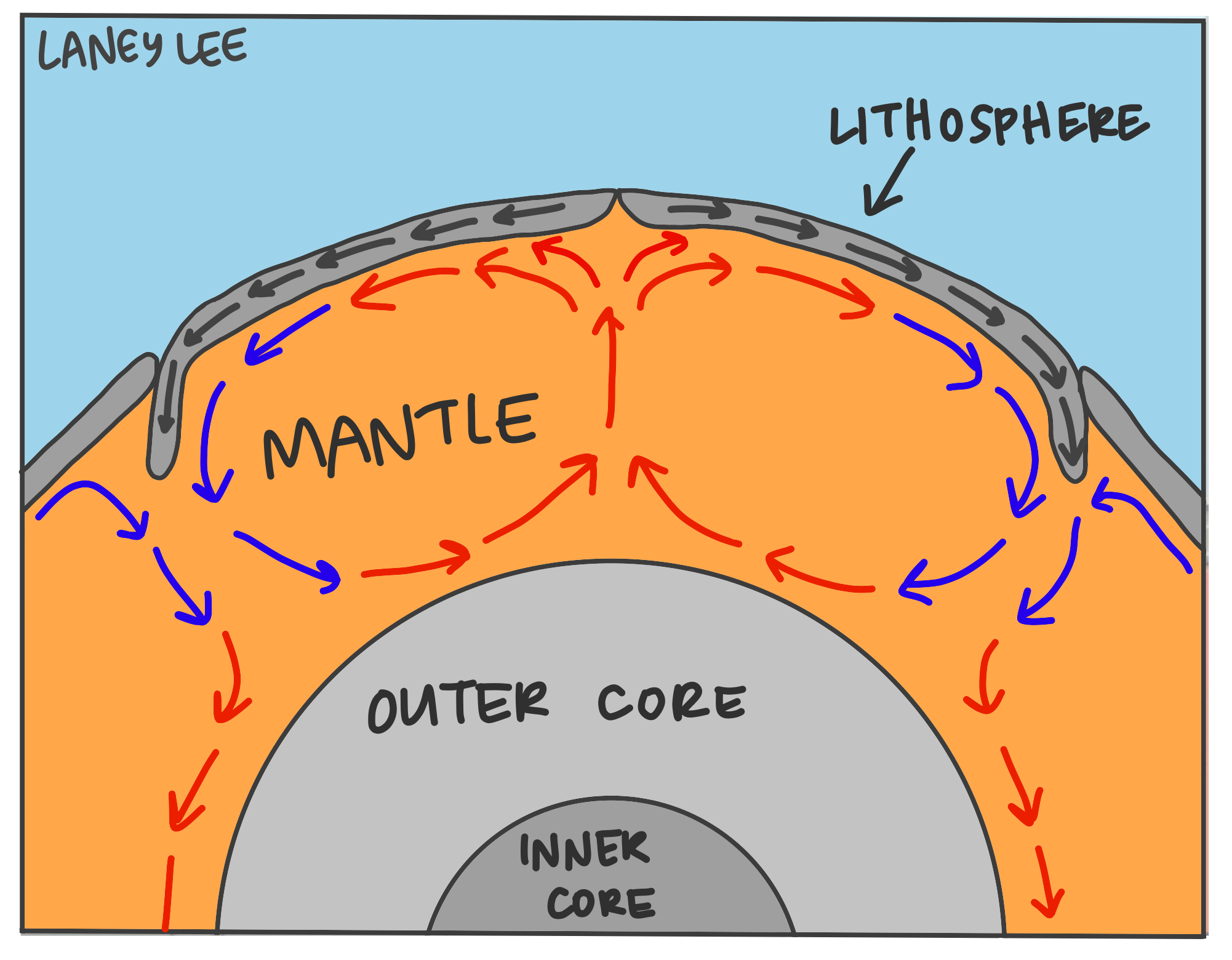
The Convection Current Theory forms the core mechanism behind seafloor spreading.
- Proposed by Arthur Holmes in the 1930s
- It explains the movement of material within the Earth’s mantle
Key concepts:
- Heat generated by radioactive elements creates temperature differences within the mantle
- These differences lead to the formation of convection currents
Working of convection currents:
- Rising currents (upwelling limbs):
- Lead to the formation of mid-ocean ridges
- Cause divergence of tectonic plates
- Descending currents (downwelling limbs):
- Form deep-sea trenches
- Result in convergence of tectonic plates
Thus, the movement of magma within the mantle drives the motion of lithospheric plates, making convection currents a fundamental force in plate tectonics.
Paleomagnetism
Paleomagnetism is the study of the Earth’s past magnetic field, recorded in rocks, sediments, and archaeological materials.
Key principles:
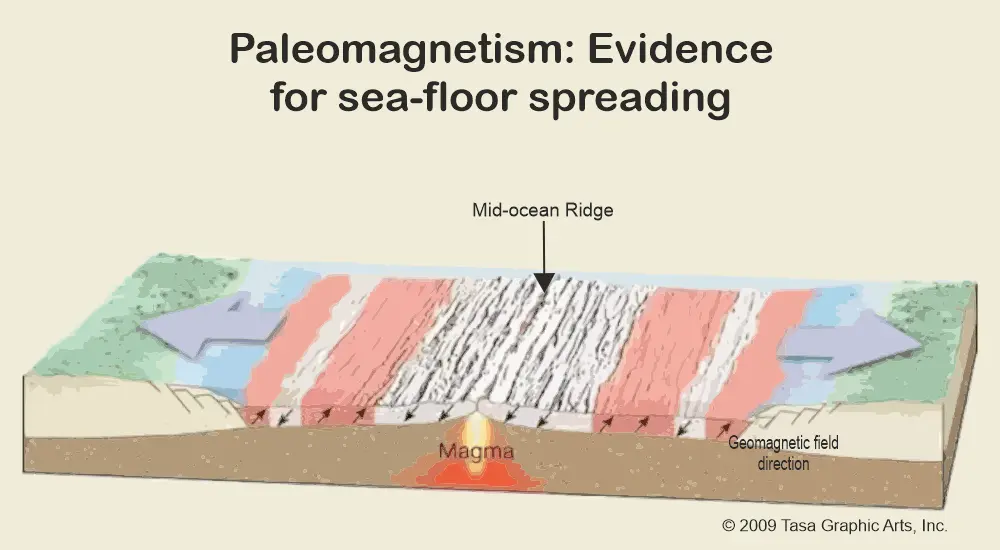
- Rocks, especially basalt formed from underwater volcanic activity, contain magnetic minerals
- As molten rock cools and solidifies, these minerals align with the Earth’s magnetic field
- This alignment becomes permanently recorded in the rock
Important observations:
- The Earth’s magnetic field has reversed multiple times in geological history
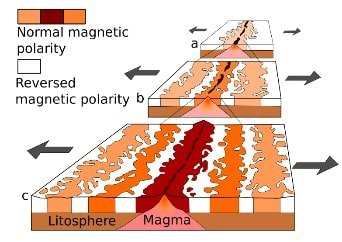
- These reversals are preserved in rocks as patterns of normal and reversed polarity
Evidence from ocean floors:
- Rocks on either side of mid-ocean ridges show alternating magnetic stripes
- These stripes are:
- Parallel to the ridge
- Symmetrical on both sides
- Alternating between normal and reversed polarity
Process explanation:
- Magma rises through cracks at the ridge and solidifies
- Each new rock band records the current magnetic polarity
- As plates move apart:
- Older rocks shift away from the ridge
- New rocks form at the center
This creates a striped pattern, providing strong evidence for seafloor spreading.
Additional significance:
- Helps determine past positions of tectonic plates
- Played a major role in reviving continental drift theory and developing plate tectonics
Sea Floor Spreading theory
Seafloor spreading is the process through which new oceanic crust forms at mid-ocean ridges and gradually moves outward.
Main features:
- Magma rises from the mantle through cracks in the ocean crust
- It cools and solidifies, forming new crust
- Older crust is pushed away from the ridge over time
Mechanism:
- Driven by convection currents in the mantle
- Occurs mainly at divergent plate boundaries
Key outcomes:
- Continuous addition of new material to the ocean floor
- Gradual expansion of ocean basins
Mid-Ocean Ridge:
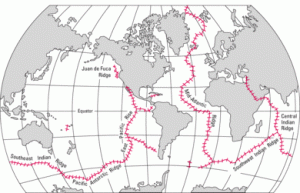
- The longest mountain chain on Earth
- Located underwater
- Marks zones where tectonic plates are moving apart
Evidence for Seafloor Spreading
The theory is supported by multiple lines of evidence:
- Evidence from Molten Material
- Evidence from Magnetic Stripes
- Evidence from Drilling Samples
- Subduction
- Deep-Ocean Trench
Evidence from Molten Material
- Formation of pillow-shaped rocks indicates repeated volcanic eruptions
- These rocks form when molten material cools rapidly underwater
Evidence from Magnetic Stripes
- Ocean floor rocks display alternating magnetic patterns
- These patterns record geomagnetic reversals
- Provide strong proof of continuous crust formation and movement
Evidence from Drilling Samples
- Core samples reveal:
- Youngest rocks near mid-ocean ridges
- Older rocks farther away
- Confirms outward movement of oceanic crust
- Core samples reveal:
Subduction
- Process where oceanic crust sinks back into the mantle
- Occurs at convergent plate boundaries
- Balances the creation of new crust
Deep-Ocean Trench
- Formed at subduction zones
- Represent deep underwater valleys where crust bends downward into the mantle
Distribution of Earthquakes and Volcanoes along the mid-ocean ridges
Observations along Mid-Ocean Ridge:
- Higher temperature gradients near ridges indicate rising magma
- Earthquake distribution shows:
- Shallow-focus earthquakes at mid-ocean ridges
- Deep-focus earthquakes near subduction zones (e.g., Alpine-Himalayan belt, Pacific margins)
- Alignment of geological features parallel to coastlines suggests gradual widening of ocean basins
Seafloor spreading solved many of the unsolved problems
The theory helped resolve several geological questions:
- Explained why:
- Young rocks are found at mid-ocean ridges
- Older rocks occur farther away
- Clarified:
- Why sediment layers are thinner near ridges
- Provided strong evidence supporting:
- Continental drift
- Development of the plate tectonic theory
Overall, the concept of seafloor spreading significantly advanced our understanding of Earth’s dynamic processes and confirmed that the planet’s surface is continuously evolving.