
Air Mass
- An Air Mass is a large body of air that has similar temperature, humidity, and pressure conditions throughout its horizontal extent.
- It can extend over thousands of kilometers and remain relatively uniform.
- The uniformity develops because the air mass stays over a particular region for a long time and absorbs the characteristics of that region.

Source Region of Air Mass
- The source region is the place where an air mass forms and acquires its physical properties.
Conditions required for a good source region:
- The surface should be extensive and uniform (like deserts, oceans, ice sheets).
- The atmosphere should be stable, meaning there is less vertical mixing.
- Winds should be light, so the air can remain over the region long enough.
- Examples:
- Deserts → produce hot and dry air masses
- Oceans → produce moist air masses
- Polar regions → produce cold air masses
Classification of Air Masses
Air masses are mainly classified based on moisture content and temperature.
A. Based on Moisture
1. Continental Air Mass (c)
- Forms over land areas
- Has low moisture content (dry air)
- Leads to clear skies and low rainfall

2. Maritime Air Mass (m)
- Forms over oceans or seas
- Contains high moisture
- Responsible for cloud formation and rainfall

B. Based on Temperature
1. Tropical (T)
- Originates in low latitudes
- Hot or warm in nature
2. Polar (P)
- Originates in high latitudes
- Cold air mass
3. Arctic/Antarctic (A)
- Forms in extreme polar regions
- Very cold and dense
4. Equatorial (E)
- Forms near the equator
- Very hot and highly humid

C. Combined Classification
- Air masses are usually described by combining moisture + temperature symbols:
| Type | Meaning | Nature |
|---|---|---|
| cT | Continental Tropical | Hot and Dry |
| mT | Maritime Tropical | Warm and Moist |
| cP | Continental Polar | Cold and Dry |
| mP | Maritime Polar | Cold and Moist |
| cA | Continental Arctic | Extremely Cold and Dry |
Properties of Air Mass
An air mass is mainly characterized by:
- Temperature – determines whether it is hot or cold
- Humidity – determines moisture content
- Pressure conditions
- Stability
Stability of Air Mass:
- Stable Air Mass:
- Air does not rise easily
- Leads to clear and calm weather
- Unstable Air Mass:
- Air rises easily due to convection
- Leads to clouds, rainfall, storms
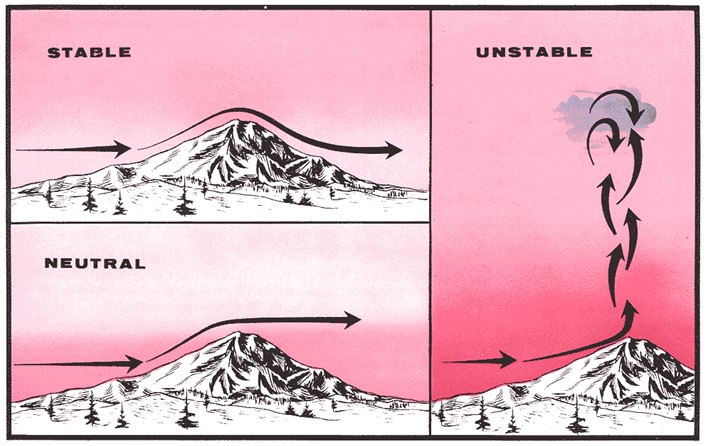
- Stable Air Mass:
Modification of Air Mass
- When an air mass moves away from its source region, it undergoes modification.
Causes of modification:
- Heating or cooling of the surface
- Gain or loss of moisture
- Mixing with other air masses
Result:
- Changes in:
- Temperature
- Humidity
- Stability
Example:
- A cold, dry air mass (cP) moving over warm ocean water becomes warmer and more humid
Air Masses Affecting India
Air masses play a crucial role in shaping India’s climate.
1. Maritime Tropical (mT)
- Comes from Indian Ocean
- Warm and moisture-laden
- Responsible for Monsoon rainfall
2. Continental Tropical (cT)
- Originates from Thar Desert
- Hot and dry
- Causes heat waves (Loo winds) in North India
3. Continental Polar (cP)
- Comes from Central Asia
- Brings cold waves during winter
4. Maritime Polar (mP)
- Associated with Mediterranean region
- Leads to Western Disturbances, causing winter rainfall in North India
Interaction of Air Masses – Fronts
- When two different air masses meet, they do not mix easily.
- The boundary between them is called a Front.
Types of Fronts:
1. Cold Front
- Cold air pushes under warm air
- Causes sudden weather changes
- Leads to heavy rainfall, thunderstorms
2. Warm Front
- Warm air rises over cold air
- Causes gradual weather change
- Leads to light, continuous rainfall
3. Occluded Front
- Cold front overtakes warm front
- Produces complex weather conditions
4. Stationary Front
- No movement of air masses
- Leads to prolonged weather conditions

Role of Air Masses in Weather Systems
- Air masses are the basic building blocks of weather.
- They are involved in:
- Formation of cyclones and anticyclones
- Development of monsoon systems
- Occurrence of storms and rainfall
- Example:
- Interaction of warm moist air (mT) and cold dry air (cP) leads to temperate cyclones
Link with Jet Streams
- Jet streams are fast-moving winds in the upper atmosphere.
- They influence:
- Movement of air masses
- Formation of fronts
- Example:
- The Subtropical Jet Stream affects the onset and withdrawal of the Indian Monsoon.