
What is the Atmosphere?
- The atmosphere is the blanket or envelope of gases that surrounds the Earth. It acts as a protective boundary between outer space (which is empty and harsh) and the biosphere (the region where life exists).
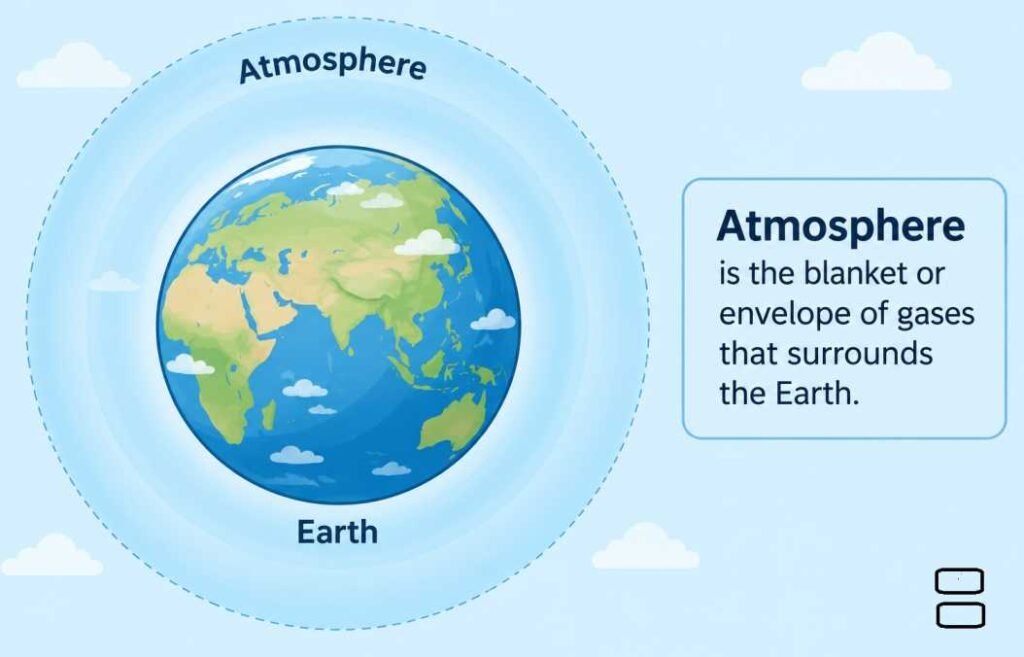
- The atmosphere is not static or still. It is a dynamic system, meaning the gases within it are constantly moving, mixing, and changing. These gases are arranged in different layers, which are classified based on their composition (what they are made of) and temperature (how hot or cold they are).
- It is important to understand that the gases present today were not simply left over from the time Earth was formed. Instead, they developed gradually through several processes, such as:
- Volcanic eruptions, which released gases from deep inside the Earth
- Hot springs, which emitted gases and steam
- Chemical breakdown of rocks, which released new substances
- Activities of living organisms, which changed the composition over time
- The atmosphere is extremely important for life. Without it, Earth would be lifeless and barren, similar to the Moon.
- Some key roles of the atmosphere include:
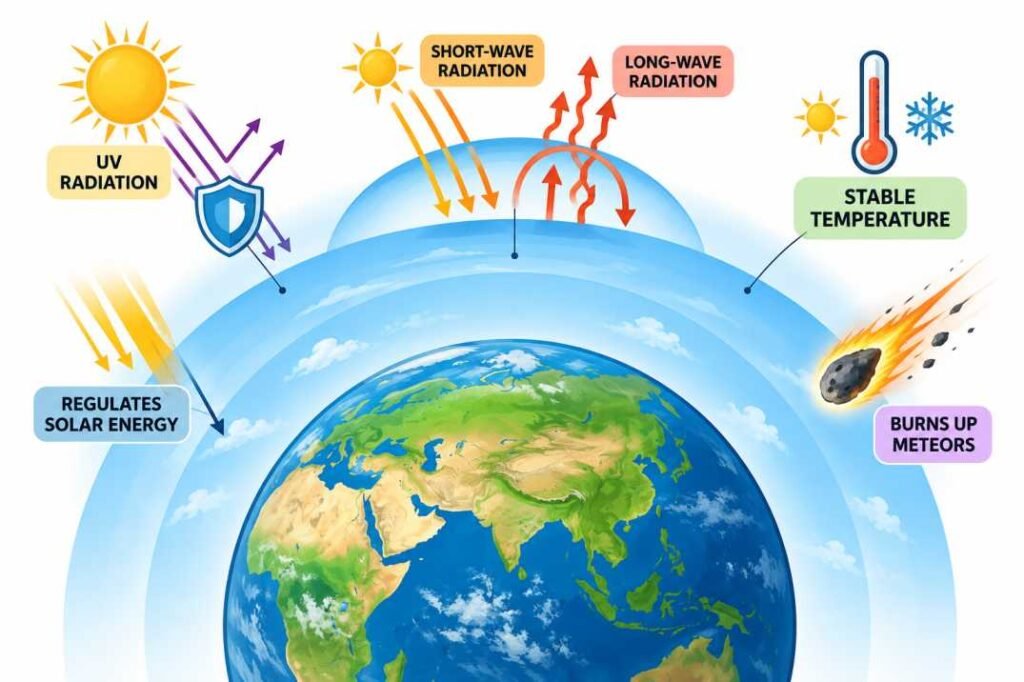
- It protects Earth from harmful solar radiation, especially ultraviolet rays
- It acts like a greenhouse, allowing short-wave radiation from the Sun to enter while trapping long-wave radiation from Earth, keeping the planet warm
- It helps maintain a stable temperature, preventing extreme heat during the day and extreme cold at night
- It regulates solar energy, allowing only certain types of radiation to reach the surface
- It burns up meteors (space rocks) before they can hit the Earth, mainly in the upper layers
- All living organisms require a specific range of temperature and safe radiation levels to survive. The atmosphere ensures these conditions are maintained.
Composition of the atmosphere
- The atmosphere is made up of different gases, water vapour, and tiny particles. These components exist mostly as neutral (uncharged) particles.
- In simple terms, the atmosphere contains:
- Gases – the main component
- Water Vapour – moisture present in the air
- Particulates – tiny solid or liquid particles
- It also contains a large number of aerosols, which are fine particles suspended in the air.
Gases
- The major portion of the atmosphere is made up of gases. The two most abundant gases are:
- Nitrogen (78%)
- Oxygen (21%)
- Together, they make up about 99% of clean, dry air. The remaining 1% consists of other gases.
- Important gases and their roles:
- Oxygen (O2)
- Essential for breathing and survival of living organisms
- Supports combustion (burning)
- Combines with other elements to form important compounds
- Nitrogen (N2)
- A relatively inactive (inert) gas
- Helps control combustion by diluting oxygen
- Plays a key role in forming proteins and organic compounds
Carbon Dioxide (CO2)
- Present in a very small amount (about 0.038%)
- Released during burning of fuels and respiration
- Used by plants during photosynthesis to make food
- Acts as a heat-trapping gas, helping regulate Earth’s temperature
Important note:
- Increasing CO2 levels (due to burning fossil fuels like coal and oil) can lead to global warming and climate change
- Argon (Ar)
- Makes up about 0.93% of the atmosphere
- It is an inert gas, meaning it does not react easily
- Ozone (O3)
- A special form of oxygen with three atoms instead of two
- Found mainly between 20–25 km above Earth’s surface
- Plays a crucial role in absorbing harmful ultraviolet (UV) radiation
- Oxygen (O2)
- Other gases present in very small amounts include:
- Neon, helium, hydrogen, xenon, krypton, methane, etc.

Water Vapour
- Water vapour is the gaseous form of water present in the atmosphere. Its amount varies from 0% to 5%, depending on location and temperature.
- Sources of water vapour include:
- Oceans, seas, rivers, lakes
- Soil moisture
- Plants (through transpiration)
- Important characteristics:
- The amount of vapour is higher in warm regions (like near the equator) and lower in cold regions (towards the poles)
- It decreases with height above the Earth’s surface
- Over 90% of water vapour is found within the first 5 km of the atmosphere
- Water vapour is responsible for many weather phenomena:
- Clouds
- Fog
- Rainfall
- Snow
- Dew and frost
- It also plays a role in heating the Earth:
- It allows sunlight (short-wave radiation) to pass through
- It traps heat radiated from Earth (long-wave radiation), keeping the lower atmosphere warm
Particulate Matter
- Particulate matter refers to tiny solid or liquid particles suspended in the atmosphere.
- Examples include:
- Dust and sand particles
- Pollen grains
- Smoke and soot
- Salt particles from oceans
- Microorganisms
- Ash from volcanic eruptions
- Functions of particulate matter:
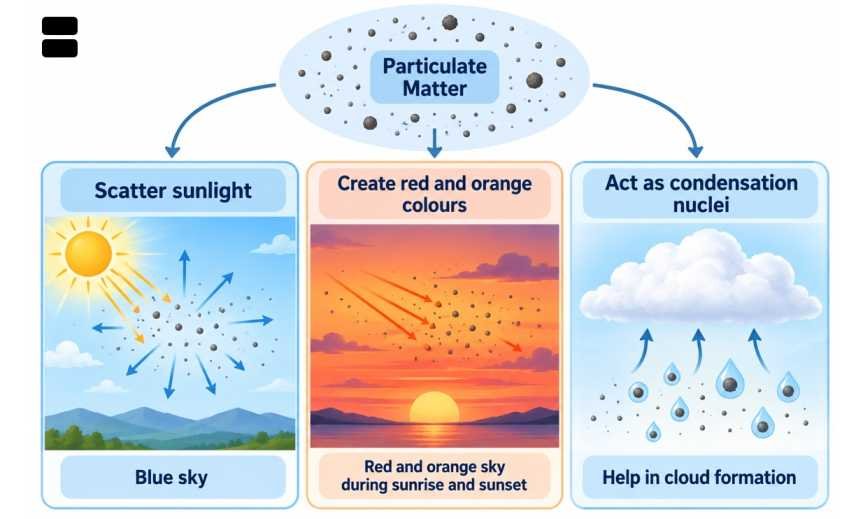
- They scatter sunlight, which causes the blue color of the sky
- They create beautiful red and orange colors during sunrise and sunset
- They help in cloud formation by acting as condensation nuclei (surfaces on which water vapour condenses)
- A hygroscopic nucleus is a tiny particle (like dust or salt) that attracts water vapour, helping droplets to form.
Structure of the Atmosphere
The atmosphere is divided into layers based on differences in composition, temperature, pressure, and density.
Based on Composition:
The atmosphere is broadly divided into two main layers:
- homosphere
- heterosphere
Homosphere
- The homosphere is the lower part of the atmosphere where the composition of gases remains uniform.
- It includes three regions:
- Troposphere
- Stratosphere
- Mesosphere
- Key features:
- Air composition is similar throughout
- Air becomes thinner with height
- Extends up to about 80 km
Heterosphere
- The heterosphere is the upper part of the atmosphere where gases are separated based on their weight.
- Lighter gases rise higher
- Heavier gases remain below
- It includes:
- Thermosphere
- Exosphere
- Key features:
- Begins above 80 km
- Extends up to about 10,000 km
- Considered the transition to outer space
- The heterosphere is the upper part of the atmosphere where gases are separated based on their weight.
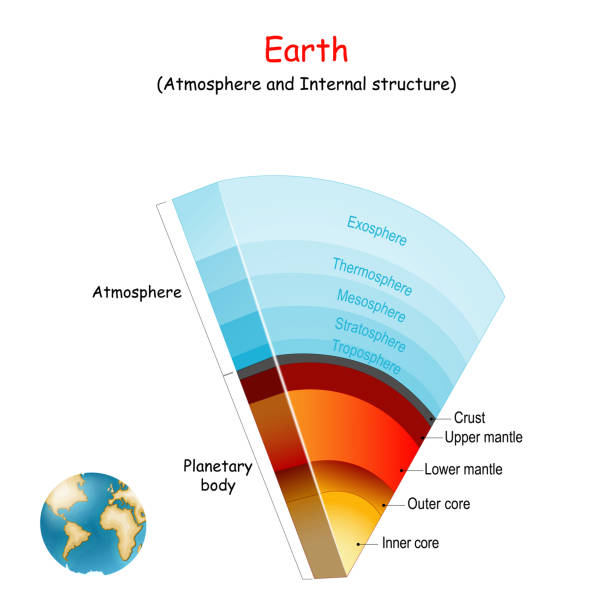
Based on Change in temperature
- The atmosphere can also be divided into five layers based on temperature changes:
- Troposphere
- Stratosphere
- Mesosphere
- Thermosphere (Ionosphere)
- Exosphere

Troposphere:
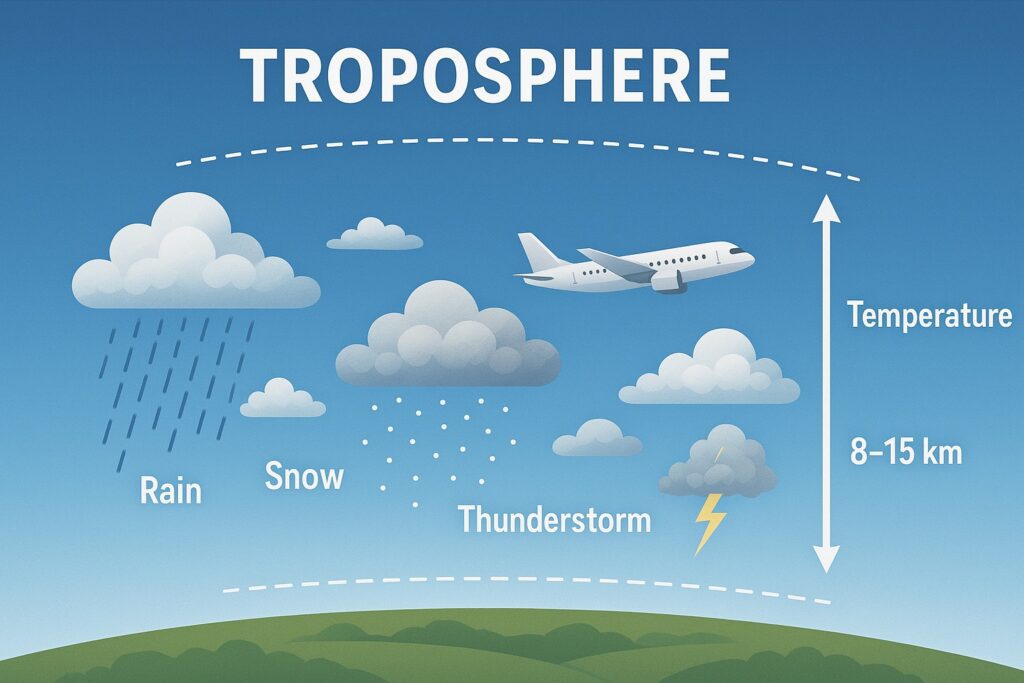
- The troposphere is the lowest layer and the one closest to Earth’s surface.
- Extends up to:
- 18 km at the equator
- 13 km at mid-latitudes
- 8 km at the poles
- Key features:
- Contains 75–80% of the atmosphere’s total mass
- All weather phenomena (rain, storms, clouds) occur here
- Temperature decreases with height at a rate of about 5°C per km (called the lapse rate)
- Ends at the Tropopause, where temperature becomes constant
- This layer is also called the convective region, as warm air rises and cool air sinks here.
Tropopause
- The tropopause is the boundary between the troposphere and stratosphere.
- Temperature remains almost constant
- Acts as a limit for weather activity
- The tropopause is the boundary between the troposphere and stratosphere.
Stratosphere:
- The stratosphere lies above the troposphere and extends up to 50 km.
- Key features:
- Temperature first stays constant, then increases with height
- This increase is due to the presence of ozone, which absorbs UV radiation
- Almost no weather disturbances, making it ideal for aircraft travel

![Layers and altitudes of stratosphere (Source: [3]) | Download Scientific Diagram](https://www.researchgate.net/profile/Sanja-Bauk-2/publication/340813629/figure/fig1/AS:884535310970888@1587901060856/Layers-and-altitudes-of-stratosphere-Source-3_Q320.jpg)
Mesosphere:
- The mesosphere extends from 50 km to 80 km.
- Key features:
- Temperature decreases sharply, reaching around -90°C
- Meteors burn up in this layer due to friction
- Marks the upper limit of the homosphere
Thermosphere:
- The thermosphere lies above the mesosphere.
- Key features:
- Temperature increases rapidly with height
- Contains the ionosphere, which is important for communication
- Satellites and space stations orbit in this layer
- Despite high temperature, it feels cold due to very low air density
- Auroras (northern and southern lights) occur here
Ionosphere:
- The ionosphere is a region within the thermosphere (between 80–400 km).
- Key features:
- Contains charged particles (ions)
- Reflects radio waves, enabling long-distance communication
- Formed by absorption of cosmic rays and solar radiation
Exosphere
- The exosphere is the outermost layer of the atmosphere.
- Key features:
- Extends beyond 400 km into space
- Air is extremely thin and sparse
- Contains light gases like hydrogen and helium
- Gradually merges into outer space
- Temperature increases here because it is directly exposed to the Sun, but due to extremely low density of air, it does not feel hot.
