
Desert Landforms : Erosional and Depositional
Table of Contents
ToggleDesert
A desert is a type of landscape where very little rainfall (precipitation) occurs. Because of this lack of water, it becomes difficult for plants and animals to survive, making deserts harsh and sparsely populated environments. The absence of vegetation leaves the ground exposed, allowing natural forces like wind and water to easily wear it away, a process known as denudation.
Around one-third of the Earth’s land surface is either arid (extremely dry) or semi-arid (moderately dry). This includes not only hot deserts but also very cold regions near the poles, which are sometimes called cold deserts.
Deserts can be classified based on:
- Amount of rainfall received
- Temperature conditions (hot or cold deserts)
- Causes of desert formation (natural or human-induced)
- Geographical location
Important characteristics of deserts:
- About one-fifth of the world’s land consists of deserts
- True deserts are extremely dry regions where almost no vegetation grows
- The main causes of dryness include:
- Low and irregular rainfall
- High temperatures
- Rapid evaporation of water
Location of Deserts around the World
Most deserts are located between 15° and 30° latitude north and south of the Equator. These are known as tropical or trade wind deserts.
Reasons for their location:
- They lie in the trade wind belt, especially on the western sides of continents
- Winds passing over cold ocean currents lose moisture, creating a drying (desiccating) effect
- As a result, clouds do not easily form, and rainfall remains very low
Types of desert
Hamada/Rocky Desert
- These deserts consist of large stretches of bare rock surfaces where wind has removed sand and dust.
- Key features:
- Rocks are smooth, polished, and hard
- Surface is highly infertile
- Very little loose material remains
Reg/Stony Desert
- These deserts are covered with pebbles and gravel that the wind cannot easily carry away.
- Important points:
- Surface is made up of small stones and coarse materials
- Easier to travel compared to sandy deserts
- Often used for grazing animals like camels
Erg/Sandy Desert
- Also called a “sea of sand”, these deserts are dominated by sand dunes.
- Characteristics:
- Large areas covered by moving sand dunes
- Sand is shaped and arranged by wind direction
- Continually changing landscape
Badlands
- Badlands are areas with deep gullies and ravines formed mainly due to water erosion.
- Features:
- Land is highly eroded and uneven
- Not suitable for agriculture or settlement
- Often leads to abandonment by people
Mountain Deserts
- These deserts occur in highland regions, such as plateaus and mountain ranges.
- Key characteristics:
- Surface is rugged with uneven peaks
- Presence of wadis (dry valleys)
- Slopes are shaped by frost action and erosion

Mechanism of Desert/Arid Erosion
Weathering
- Weathering is the process by which rocks break down into smaller pieces. In deserts, it plays a major role despite low rainfall.
- How it works:
- Even small amounts of rain enter rock cracks and trigger chemical reactions
- Extreme temperature changes (hot days and cold nights) cause rocks to expand and contract
- This leads to cracking and breaking of rocks
Freeze-thaw process:
- Water enters cracks and freezes at night
- Ice expands, widening the cracks
- Repeated cycles break rocks into fragments called scree
Another process:
- Outer layers of rock heat and expand faster than inner layers
- This causes peeling or flaking, known as exfoliation
Action of Wind
- Wind is a powerful agent in deserts because:
- There is little vegetation to hold soil together
- Surface materials are loose and dry
Main types of wind action:
- Deflation
- This involves the removal of loose particles by wind.
- Fine dust and sand can travel long distances
- Leads to formation of deflation hollows (depressions in land)
- Abrasion
- Abrasion is like natural sandblasting.
- Wind carries sand that hits rock surfaces
- Rocks become scratched, polished, and worn down
- Most effective near the ground where sand concentration is highest
- Abrasion is like natural sandblasting.
- Attrition
- This occurs when particles collide with each other in the wind.
- Particles become smaller and smoother
- Eventually form rounded sand grains
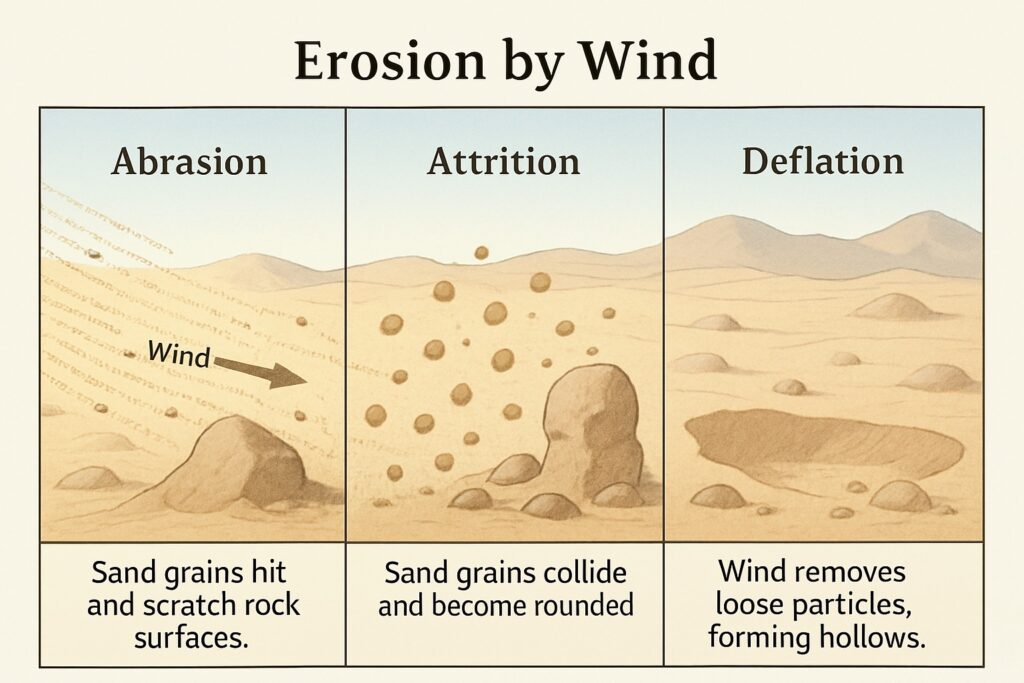
Desert Landforms by Wind Erosion
Rock pedestals/Mushroom rocks
- These are formed when wind erosion wears away softer rock layers faster than harder ones.
- Base gets eroded more, creating a narrow bottom and wider top
- Results in a mushroom-like shape

Messa and Butte
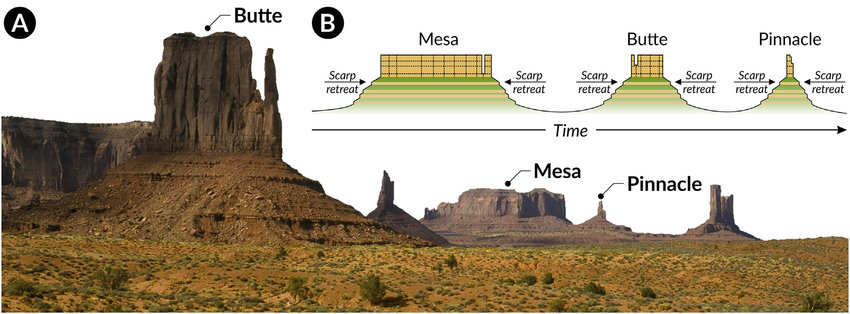
- A mesa is a flat-topped landform with steep sides, formed due to resistant rock layers protecting softer rocks below.
- A butte is a smaller version of a mesa formed after continued erosion.
| Feature | Mesa | Butte |
|---|---|---|
| Size | Large | Smaller |
| Shape | Flat top, steep sides | Same but more isolated |
| Formation | Less eroded | More eroded |
Zeugen
- Zeugen are ridge-like landforms created when softer rock beneath a hard layer is eroded.
- Wind removes softer rock faster
- Hard rock remains as raised ridges
- Deep grooves form between them
Yardangs
- Yardangs are long, narrow ridges formed when alternating bands of hard and soft rocks are eroded by wind.
- Aligned in the direction of wind flow
- Soft rock is removed, leaving sharp ridges

Isenberg (Island Mountain)
- These are isolated hills rising abruptly from flat desert surfaces.
- Have steep sides and rounded tops
- Often made of hard rocks like granite
- Remnants of eroded plateaus

Ventifacts & Dreikanter
- Ventifacts are rocks shaped by wind-driven sand abrasion.
- Have smooth, polished surfaces
- When three flat faces form, they are called dreikanter
- These often create a desert pavement, a surface covered with closely packed stones.

Deflation Hollows
- These are depressions formed by wind removing loose material.
- May reach the water table, forming oases
- Can be enlarged by wind swirling action

Deserts Landforms by wind deposition
- Wind carries materials and deposits them when its energy decreases.
- Fine dust can travel thousands of kilometers
- Coarser sand settles within deserts
- Examples:
- Dust from the Sahara can travel to Europe
- Deposits in China form thick layers known as loess
Dunes
- Dunes are heaps or hills of sand formed by wind deposition.
- Types of dunes:
- Active dunes: constantly moving
- Fixed dunes: stabilized by vegetation

Barchan:
- Crescent-shaped dunes
- Form where wind blows from one direction
- Have a gentle windward slope and steep leeward slope
- Move forward over time and may threaten settlements

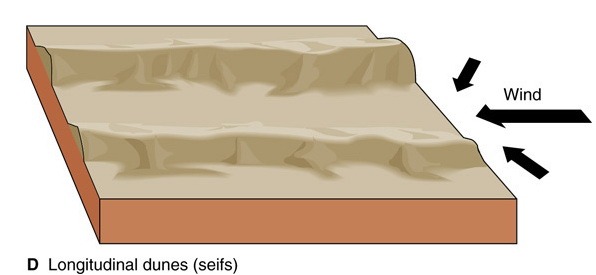
Seifs or Longitudinal Dunes:
- Long, narrow ridges of sand
- Run parallel to wind direction
- Formed by combined action of main winds and side winds

Loess
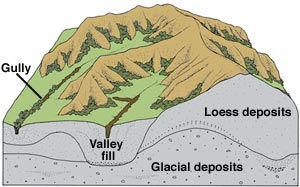
- Loess is a fine, yellow, wind-deposited soil.
- Key properties:
- Rich in minerals and often fertile
- Highly porous, allowing water to seep in easily
- Can form thick deposits over large areas
- Major deposits are found in:
- Northwest China (Hwang Ho basin)
- Parts of Europe and North America
Landform of water actions in desert
- Although deserts are dry, they do receive occasional heavy rainfall.
- Effects of sudden rain:
- Causes flash floods
- Carries large amounts of debris and sediments
- Forms gullies and ravines
Temporary lakes(Playas):
- Form in low-lying depressions
- Contain salty water due to evaporation
- Dry surfaces form alkali flats
Bajada & Pediment
- The floor of the desert depression is made up of two features viz. Bajada & Pediment.
- Bajada
- A bajada is formed when several alluvial fans merge together.
- Made of sediments deposited by streams
- Common in areas with frequent flash floods
- A bajada is formed when several alluvial fans merge together.
- Pediment
- A pediment is a gently sloping rock surface at the base of mountains.
- Formed by erosion and sheet flooding
- Gradually expands as mountains wear down
- Leads to formation of flat plains (pediplains)
- A pediment is a gently sloping rock surface at the base of mountains.
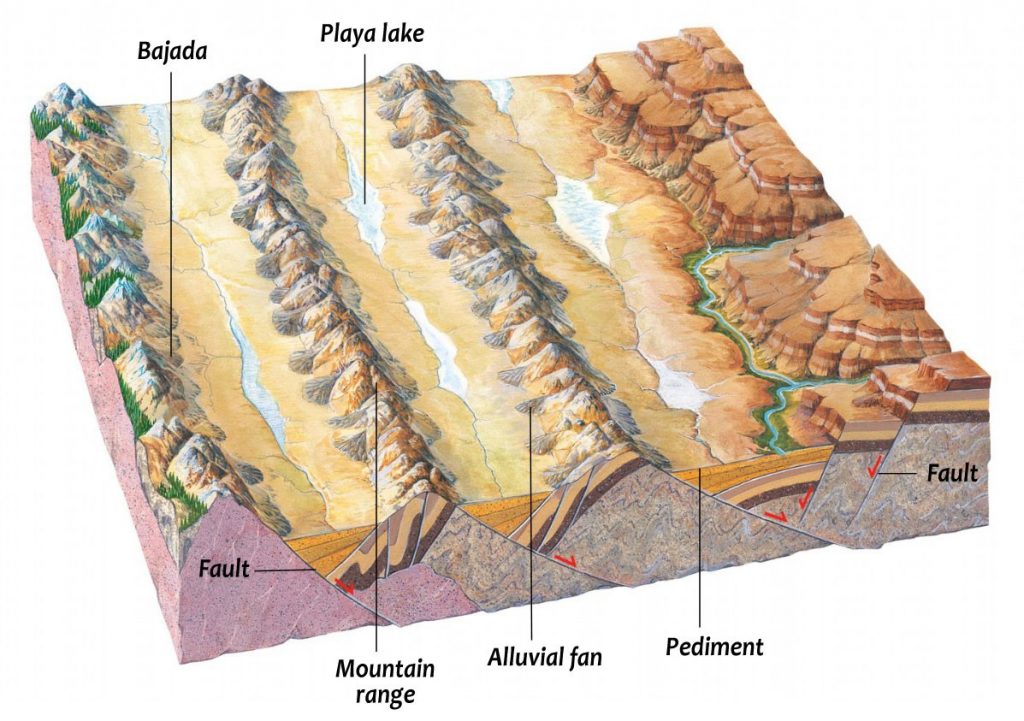
Alluvium fans
- Alluvial fans are fan-shaped deposits of sediments formed where a stream leaves a valley and enters a flat area.
- Material spreads out as water loses speed
- Common at the base of wadis (dry valleys)
Canyons/Gorges
- Canyons (or gorges) are deep, narrow valleys formed by rivers cutting down into rock over long periods.
- Created by continuous vertical erosion
- Example: The Grand Canyon in the United States, formed by the Colorado River over millions of years
Let us know any further suggestions ,we at sudurbhai.com will be happy to hear from you in our comment section below !