
Volcanism:
- Volcanism refers to the process in which molten rock (magma) from inside the Earth rises and erupts onto the surface. This process is driven by the internal heat of the Earth and is closely linked to tectonic activity and the rock cycle.
- When magma reaches the Earth’s surface, it is called lava, and the event is known as a volcanic eruption
- Most volcanoes are located along tectonic plate boundaries, where plates either move apart (diverge) or collide (converge)
- A large number of volcanoes are found beneath oceans, making them less visible but highly significant
Types of Volcanic Eruptions
- Volcanic eruptions vary widely depending on several factors:
- Chemical composition of magma
- Temperature
- Viscosity (thickness or resistance to flow)
- Gas and water content
- Presence of groundwater
- Below are the main types of volcanic eruptions explained clearly:
- Hydrothermal eruption
- Involves the release of steam, ash, and gases, but no magma
- Caused by the heating of underground water systems
- Phreatic eruption
- Occurs when magma heats surrounding water, leading to a sudden explosion
- Produces steam and ash, without direct lava flow
- Phreatomagmatic eruption
- Happens when magma directly interacts with water
- Results in violent explosions due to rapid steam formation
- Strombolian and Hawaiian eruption
- Hawaiian eruptions: Characterized by gentle lava fountains and flowing lava
- Strombolian eruptions: Feature bursting explosions caused by gas bubbles in lava
- Vulcanian eruption
- Short but highly explosive eruptions
- Can send ash clouds up to 20 km into the atmosphere
- Subplinian and Plinian eruptions
- Subplinian eruptions: Moderate explosions reaching up to 20 km
- Plinian eruptions: Extremely powerful, with ash columns rising 20–35 km or more
- Hydrothermal eruption
Types of Volcanoes
Volcanoes are classified into four main types based on their shape, structure, and eruption style:
| Type of Volcano | Key Characteristics | Lava Type | Eruption Style |
|---|---|---|---|
| Cinder Cones | Small, steep, cone-shaped | Fragmented lava | Mild to moderate |
| Composite Volcanoes | Tall, layered, steep sides | Viscous lava + ash | Explosive |
| Shield Volcanoes | Broad with gentle slopes | Fluid basaltic lava | Non-explosive |
| Lava Domes | Rounded, steep mounds | Very thick lava | Slow but can be explosive |
Cinder Cones
- Formed from small lava fragments (cinders) ejected from a single opening
- These fragments accumulate around the vent, creating a cone-shaped hill
- Usually have only one major eruption
- Can appear independently or on the sides of larger volcanoes
Composite Volcano
- Also known as stratovolcanoes
- Made up of alternating layers of lava, ash, and rock debris
- Have steep slopes and tall conical shapes
Formation process:
- Ash and cinders accumulate
- Lava flows over them and solidifies
- This cycle repeats, forming layered structures

Shield Volcano
- Have a broad, shield-like shape with gentle slopes
- Formed by low-viscosity (thin) lava that flows over long distances
- Key features:
- Eruptions are generally non-violent
- Lava spreads widely before cooling
- Common locations:
- Oceanic regions such as island chains
Lava Domes
- Formed when lava is too thick to flow easily
- Lava piles up near the vent, creating a steep, dome-shaped structure
Characteristics:
- Built by slow eruptions
- Can form inside craters of earlier volcanoes
- May lead to explosive eruptions, though lava does not travel far
Categories of Volcanoes
Volcanoes are also classified based on their activity level:
- Active volcanoes
- Currently erupting or likely to erupt in the future
- Around 600 active volcanoes exist worldwide
- Most are located in the Pacific “Ring of Fire”, a region with intense tectonic activity
- Dormant volcanoes
- Not erupting at present but have erupted in the past
- May erupt again in the future
- Extinct volcanoes
- Considered inactive permanently
- No expected future eruptions
- Active volcanoes

Volcanic Mountains
Volcanic mountains are landforms created due to volcanic activity on the Earth’s surface. They form when molten material (magma) from inside the Earth erupts through cracks and reaches the surface as lava.
- The lava cools and solidifies layer by layer
- Repeated eruptions gradually build up height, forming a mountain
Examples of volcanic mountains:
- Mount Kilimanjaro (Tanzania)
- Mount Fuji (Japan)
- Mount Merapi (Indonesia, Sumatra region)
- Mount Mayon (Philippines)
- Mount Agung (Indonesia, Bali)
- Mount Cotopaxi (Ecuador)
Volcanic Landforms
Volcanic activity creates different types of landforms depending on where the magma cools—either below the Earth’s surface or above it.
Extrusive landforms
- When magma reaches the surface and solidifies, it forms extrusive landforms
- These include features like volcanic mountains, lava plateaus, and volcanic cones.
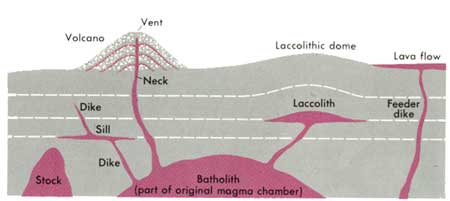
Intrusive Forms
- When magma cools beneath the Earth’s surface, it forms intrusive landforms
- The cooled material becomes igneous rock
- Key concept:
- If cooling occurs inside the crust, rocks are called plutonic rocks
- If cooling occurs on the surface, they are called volcanic rocks
- Intrusive forms develop in various shapes depending on how magma moves and solidifies underground.
Important note:
- Rocks formed through both intrusive and extrusive processes are called igneous rocks
Major intrusive Landforms includes ;
Batholiths
- Batholiths are very large masses of cooled magma formed deep inside the Earth’s crust
- They often take the shape of huge dome-like structures
Key characteristics:
- Formed at great depths
- Become visible on the surface only after erosion removes overlying layers
- Usually composed of granite
Laccoliths
- Laccoliths are dome-shaped intrusive bodies with a flat base
- They are connected to a magma source by a pipe-like channel
Features:
- Resemble surface volcanic domes but are located below the surface
- Act as local sources of magma
Example insight:
- The Karnataka Plateau shows dome-shaped hills formed by such structures
Lopolith
- A lopolith forms when magma spreads horizontally along weak layers inside the crust
- It develops a saucer-shaped structure, which is concave upward (like a bowl)
Phacolith
- A phacolith is a wavy-shaped mass of intrusive rock
- It forms in folded rock structures, specifically:
- At the top of anticlines (upward folds)
- At the bottom of synclines (downward folds)
Key point:
- These structures are connected to magma sources below
Sills
- Sills are horizontal sheets of intrusive igneous rock
- They form when magma spreads parallel to existing rock layers
Classification:
- Thick layers → called sills
- Thin layers → called sheets
Dykes
- Dykes are vertical or steeply inclined intrusions
- They form when magma fills cracks or fractures in rocks and solidifies
Key characteristics:
- Usually cut across existing rock layers
- Form wall-like structures
Geographical importance:
- Commonly found in regions like western Maharashtra
- Act as pathways (feeders) for volcanic eruptions
Example connection:
- Dykes played a major role in the formation of the Deccan Traps, one of the largest volcanic regions in India