
Earthquake
An earthquake is a sudden shaking or trembling of the Earth’s surface. This happens when energy stored inside the Earth’s outer layer (lithosphere) is suddenly released. When this energy is released, it travels in the form of seismic waves, which cause the ground to shake.
To understand it simply, imagine stretching a rubber band and then letting it snap. The stored energy is suddenly released—similarly, the Earth releases energy during an earthquake.
Earthquakes can occur due to several reasons:
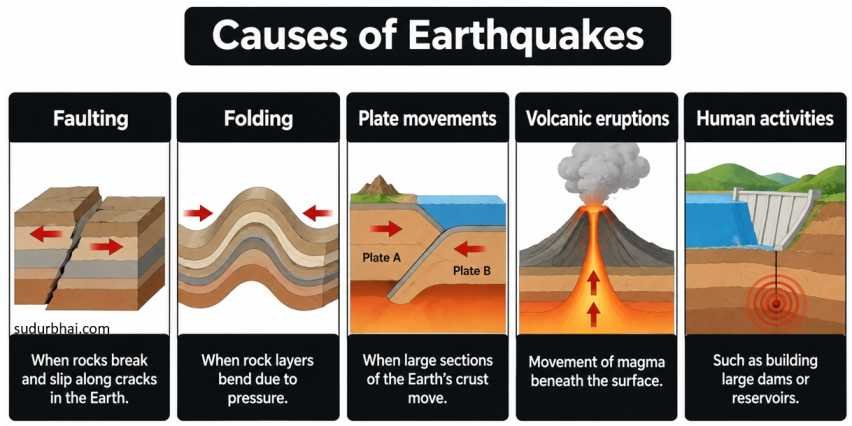
- Faulting – when rocks break and slip along cracks in the Earth
- Folding – when rock layers bend due to pressure
- Plate movements – when large sections of the Earth’s crust move
- Volcanic eruptions – movement of magma beneath the surface
- Human activities – such as building large dams or reservoirs
Earthquakes are considered one of the most dangerous and unpredictable natural disasters:
- Small tremors happen frequently and usually go unnoticed.
- Large earthquakes can cause massive destruction, especially in cities with dense populations.
Terminology Used in the Study of Earthquakes
To understand earthquakes clearly, let’s look at some important terms in simple language:
- Earthquake intensity – How much damage or effect an earthquake causes at a place
- Earthquake magnitude – The amount of energy released during the earthquake
- Richter Scale – A tool used to measure magnitude
- Mercalli Scale – A method to measure intensity based on damage and human experience
- Fault – A crack in the Earth’s crust where movement occurs
- Focus (Hypocenter) – The starting point inside the Earth where the earthquake begins
- Epicenter – The point on the surface directly above the focus
- Seismic waves – Energy waves that travel through the Earth
- Seismograph – A machine that records earthquake vibrations
Focus and Epicenter
- The focus is the exact point inside the Earth where the earthquake starts.
- The epicenter is the point on the Earth’s surface directly above the focus.
Important points to remember:
- The strongest shaking is usually felt near the epicenter.
- As you move farther away, the intensity of shaking gradually decreases.
Spread of the Seismic Waves
When an earthquake occurs, energy spreads out from the focus in all directions in the form of seismic waves.
- These waves travel through the Earth’s interior and across its surface.
- As they move, they cause the ground to shake, sometimes gently and sometimes violently.
Richter scale
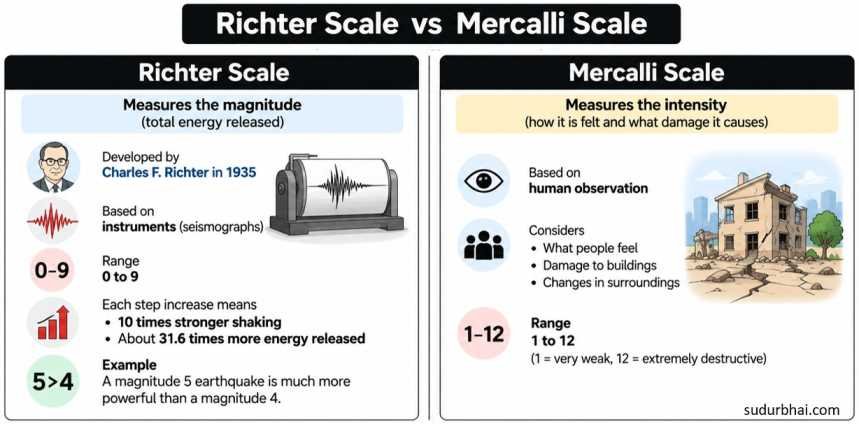
The Richter Scale is used to measure the magnitude, which means the total energy released by an earthquake.
Key points:
- Developed by Charles F. Richter in 1935
- Values range from 0 to 9
- Each step increase means:
- 10 times stronger shaking
- About 31.6 times more energy released
Example for better understanding:
- An earthquake of magnitude 5 is not just slightly stronger than magnitude 4—it is much more powerful.
Mercalli scale
The Mercalli Scale measures the intensity, meaning how the earthquake is felt and what damage it causes.
Key points:
- Ranges from 1 (very weak) to 12 (extremely destructive)
- Based on:
- What people feel
- Damage to buildings
- Changes in surroundings
Comparison for clarity:
| Feature | Richter Scale | Mercalli Scale |
|---|---|---|
| Measures | Energy released | Damage and effects |
| Range | 0–9 | 1–12 |
| Based on | Instruments | Human observation |
Seismic Waves
Seismic waves are the energy waves produced when rocks break or move inside the Earth.
- These waves are what actually cause the ground to shake.
- They are recorded using instruments called seismographs.
There are two main types of seismic waves:
- Body waves – travel through the inside of the Earth
- Surface waves – travel along the Earth’s surface
Body waves
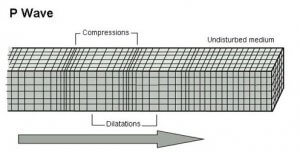
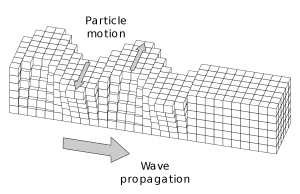
Primary waves ( P-waves)
- Also known as longitudinal waves
- These are the fastest waves, so they arrive first
Easy explanation:
- They move like sound waves, by pushing and pulling particles
Key features:
- Can travel through:
- Solids
- Liquids
- Gases
Secondary waves ( S-waves)
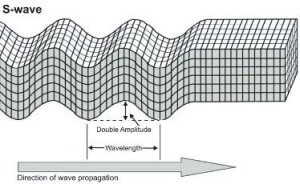
- Also called transverse waves
- Slower than P-waves
Easy explanation:
- They move the ground up and down or side-to-side
Key features:
- Can travel only through solid materials
- Arrive after P-waves, creating a delay
Surface Waves
Surface waves move along the Earth’s surface and are responsible for most of the damage during an earthquake.
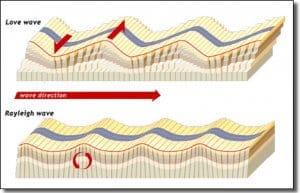
Love Waves (L-waves)
- First kind of surface waves
- Named after A. E. H. Love
- Fastest among surface waves
Key features:
- Move the ground side-to-side
- Cause strong horizontal shaking
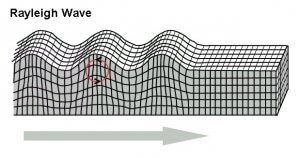
Rayleigh waves
- Other kind of surface waves
- Named after Lord Rayleigh
Easy explanation:
- Move like water waves in the ocean
Key features:
- Cause both:
- Up-and-down motion
- Side-to-side motion
- Responsible for most of the strong shaking felt by people
- Cause both:
Earthquake Predicting
Earthquake prediction means trying to determine:
- When an earthquake will occur
- Where it will occur
- How strong it will be
However, in reality:
- Exact prediction is very difficult
- Scientists use:
- Past earthquake data
- Monitoring instruments
- Study of tectonic plates
Classification of earthquake
On basis of causative factors
Earthquakes can be grouped based on their causes:
- Natural earthquakes
- Volcanic – caused by volcanic activity
- Tectonic – caused by movement of tectonic plates (most common)
- Isostatic – due to adjustment in the Earth’s crust
- Plutonic – caused by deep internal forces
- Artificial earthquakes
- Caused by human activities like:
- Mining
- Dam construction
- Explosions
- Caused by human activities like:
- Natural earthquakes
On basis of depth of focus
This classification depends on how deep inside the Earth the earthquake starts:
- Shallow focus: 0–50 km (most dangerous)
- Intermediate focus: 50–250 km
- Deep focus: 250–700 km
On basis of human casualities
Based on the impact on human life:
- Moderate: deaths less than 50,000
- Highly hazardous: 51,000–100,000 deaths
- Most hazardous: more than 100,000 deaths
World Distribution of Earthquakes
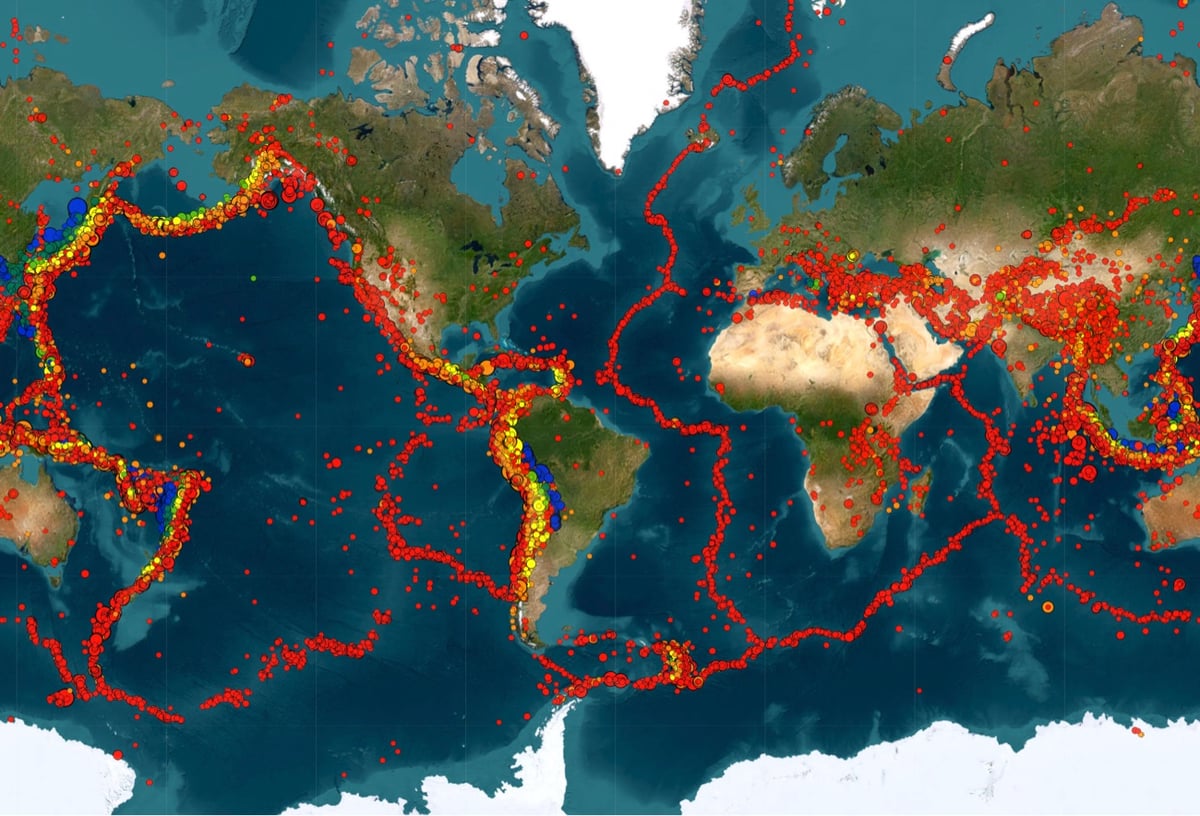
Earthquakes do not occur randomly; they are mainly concentrated in specific regions of the world.
Major earthquake zones:
- Circum-Pacific Belt (Pacific Ring of Fire)
- The most active region in the world
- Around 70% of earthquakes occur here
- Mediterranean–Himalayan Belt
- Includes regions like:
- Southern Europe
- The Himalayas
- Parts of Asia
- About 20% of earthquakes occur here
- Includes regions like:
- Other regions
- Occur inside tectonic plates
- Found along mid-ocean ridges
Earthquake Causes
Earthquakes mainly occur due to imbalance or disturbance (disequilibrium) within the Earth’s crust. When this balance is disturbed, energy builds up and is suddenly released, causing the ground to shake.
This imbalance, also known as isostatic imbalance, can happen due to both natural processes and human activities.
(a). Natural Reasons
Natural causes are the most common reasons behind earthquakes. These are processes that occur within the Earth without human involvement.
- Volcanic eruption
When molten material (magma) moves beneath or erupts from the Earth’s surface, it creates pressure and vibrations that can trigger earthquakes. - Faulting and folding
When rocks break (faulting) or bend (folding) due to internal forces, energy is released, leading to earthquakes. - Upwarping and downwarping
The Earth’s crust may rise (upwarp) or sink (downwarp) due to internal pressure changes, causing instability. - Gaseous expansion and contraction
Gases trapped inside the Earth may expand or contract due to temperature and pressure changes, creating stress in rocks. - Plate Movement
The movement of tectonic plates is the most important cause of earthquakes. Plates may collide, separate, or slide past each other. - Landslides
Sudden movement of large masses of rock or soil down slopes can also generate vibrations similar to earthquakes.
(b). Man-made/Anthropogenic Reasons
Human activities can also disturb the natural balance of the Earth’s crust and trigger earthquakes. These are called induced earthquakes.
- Deep underground mining
Removing large amounts of material from beneath the Earth weakens rock structures. - Blasting using explosives
Dynamite and other explosives used in construction can create shock waves. - Underground tunneling
Creating tunnels disturbs the natural stability of rocks. - Nuclear explosions
Underground nuclear tests release massive energy, causing seismic disturbances. - Reservoir Induced Seismicity (RIS)
Large reservoirs can trigger earthquakes due to the pressure of stored water.
Example: The Koyna Reservoir earthquake (1967) - Hydrostatic pressure
Water stored in dams and artificial lakes increases pressure on underlying rocks.
Plate tectonics provides the most scientifically accepted explanation for the occurrence of earthquakes and volcanoes.
There are 3 types of plate boundaries along which earthquake occurs
Earthquakes mainly occur at the boundaries where tectonic plates interact:
- Convergent boundaries (plates collide)
- Divergent boundaries (plates move apart)
- Transform boundaries (plates slide past each other)
Earthquake prone areas in India
Earthquakes do not occur uniformly across India. Some regions are more vulnerable (prone) than others.
- Mild earthquakes happen frequently but are usually not harmful.
- Strong earthquakes are less common but can cause large-scale destruction.
Key observations:
- Areas near plate boundaries, especially convergent boundaries, are more earthquake-prone.
- The region where the Indian Plate meets the Eurasian Plate is highly vulnerable.
Examples:
- The Himalayan region is one of the most earthquake-prone areas in India.
- The Peninsular region is generally stable but can still experience earthquakes occasionally:
- Koyna earthquake (1967)
- Latur earthquake (1993)
Seismic Zones in India
Indian scientists have divided the country into four seismic zones based on earthquake risk:
Zone | Risk Level | Description |
Zone II | Low risk | Stable regions with minimal earthquake activity |
Zone III | Moderate risk | Occasional earthquakes |
Zone IV | High risk | Frequent and stronger earthquakes |
Zone V | Very high risk | Dangerous earthquake-prone areas |
Zone VI | Ultra-high risk | Most dangerous earthquake-prone areas |
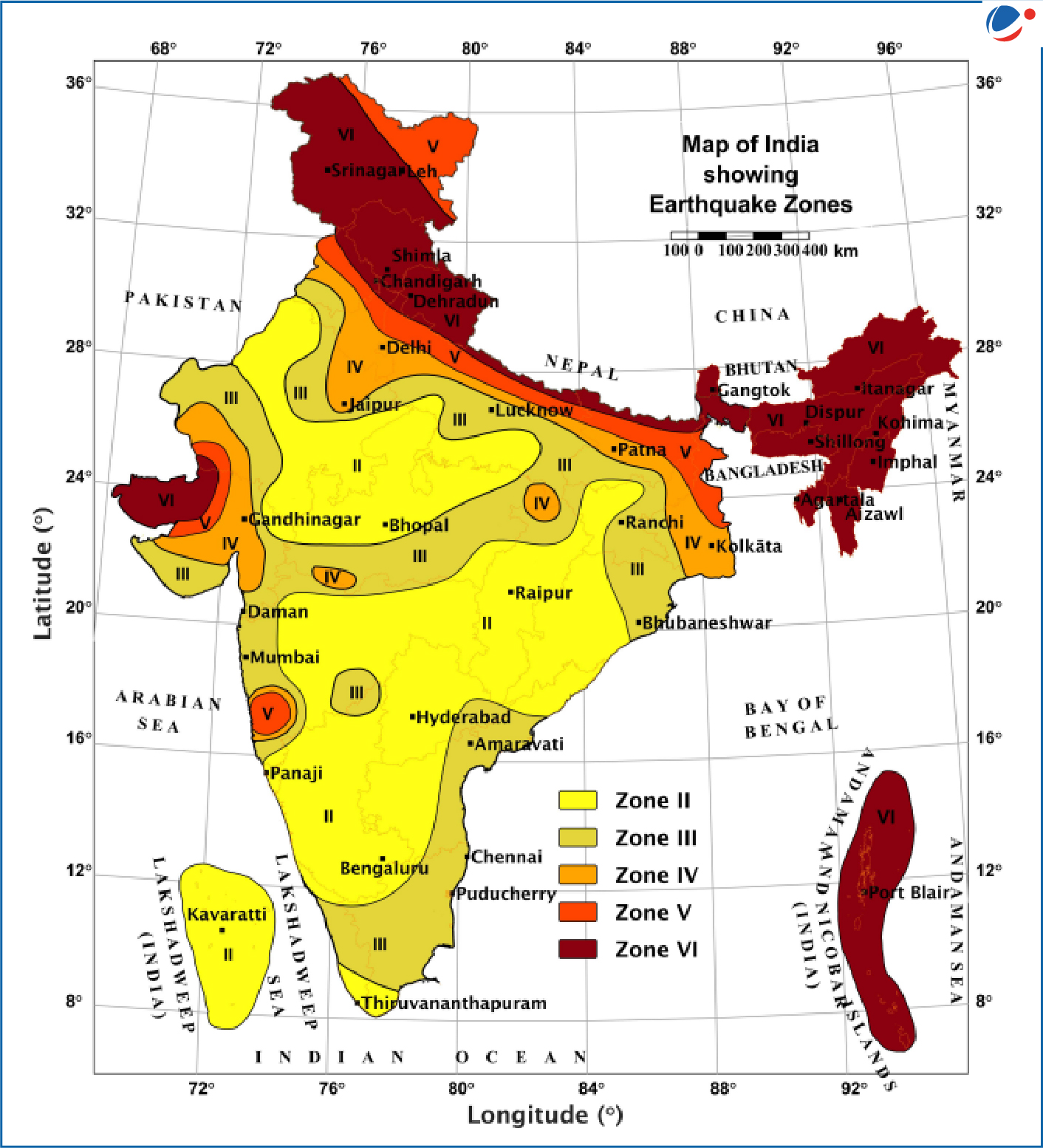
Ultra high-risk regions (Zone VI):
- Entire Himalayan belt
- North-East India
- Parts of Northern Gujarat
- Andaman & Nicobar
High-risk regions (Zone IV & V):
- Entire Himalayan belt
- North-East India
- Parts of:
- Punjab
- Haryana
- Uttar Pradesh
- Delhi
- Gujarat
Moderate risk areas:
- Northern plains
- Western coastal regions
Low risk areas:
- Most of the Peninsular India
Consequences of Earthquake
Earthquakes can have serious effects on both nature and human life. These impacts depend on the magnitude, depth, and location of the earthquake.
Damage to human life and property
- Ground shaking causes collapse of buildings, roads, and bridges
- Poorly designed structures are more vulnerable
Example:
- Nepal Earthquake (2015)
- Magnitude: 7.8
- Depth: 8.2 km
- Impact:
- Around 8,000 deaths
- Economic loss of about 10 billion USD
- Severe damage in Kathmandu due to unplanned urban construction
Landslides and Avalanches
- Earthquake vibrations can make slopes unstable
- This leads to:
- Landslides (falling rocks and soil)
- Avalanches (falling snow and ice)
Examples:
- Nepal Earthquake (2015) caused avalanches near Mount Everest
- Sikkim Earthquake (2011) caused landslides and damage to infrastructure
Floods
Earthquakes can indirectly cause floods:
- Damage to dams and reservoirs
- Landslides blocking rivers, leading to water accumulation and sudden flooding
Example:
- Assam Earthquake (1950)
- Blocked the Dihang River
- Caused flash floods upstream
Tsunami
A tsunami is a series of large sea waves caused by sudden displacement of water, usually due to undersea earthquakes.
- Occurs when the sea floor shifts
- Leads to massive and destructive waves
Example:
- Indian Ocean Tsunami (26 December 2004)
- Caused by an earthquake near Sumatra
- Result of subduction of the Indian Plate
- Around 2.4 lakh deaths across several countries
Fukushima Nuclear Accident
- The Tohoku Earthquake (Japan, 2011) triggered a tsunami with waves up to 10 meters high
- This damaged the Fukushima Daiichi Nuclear Plant
- Resulted in:
- Nuclear meltdown
- Release of radioactive material
- Global environmental concern
Earthquake Management
Earthquake management involves planning and using resources effectively to reduce damage and save lives before, during, and after an earthquake.
It includes both preparedness and recovery measures.
Risk Recognition
- Identifying areas that are more prone to earthquakes
- Helps in planning and minimizing damage
Earthquake monitoring system/Early warning system
- Exact prediction of earthquakes is still very difficult
- Scientists use monitoring systems to detect early signs
Example:
- Japan’s Early Warning System
- Sends alerts using fast electronic signals
- Helps people take quick action before shaking begins
Structural Solution
One of the biggest causes of death during earthquakes is the collapse of buildings.
Key points:
- Over 95% of deaths occur due to unsafe structures
- Earthquake-resistant buildings can significantly reduce damage
- However, such construction is often expensive
Possible solutions:
- Strengthening existing buildings (seismic retrofitting)
- Prioritizing important structures like:
- Hospitals
- Schools
- Bridges
- Creating and using earthquake hazard maps to guide construction