
Continental Drift theory
Continental Drift theory was put forward by Alfred Wegener, a German meteorologist, polar explorer, astronomer, and geologist. He is widely regarded as the father of continental drift.
In 1912, Wegener introduced his revolutionary idea in a lecture, proposing that continents are not fixed but move across the Earth’s surface over long periods of time.
Continental drift refers to the gradual movement of continents across the ocean floor, a process that takes millions of years to occur.
According to Wegener:
- All present-day continents were once joined together as a single landmass called Pangaea (meaning “all Earth”)
- This supercontinent was surrounded by a vast ocean known as Panthalassa (meaning “all water”)
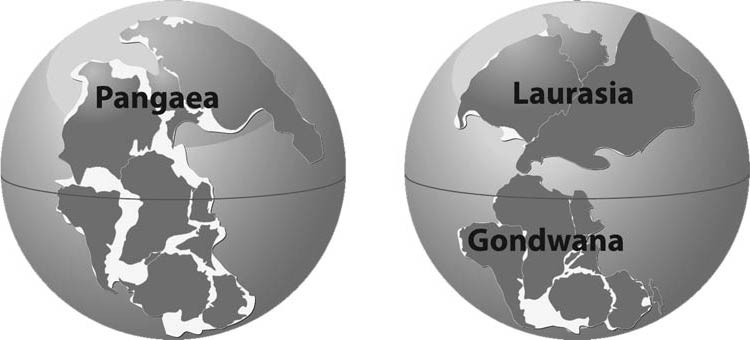
Over time, Pangaea broke apart into two major landmasses:
- Laurasia (northern part)
- Gondwanaland (southern part)
These eventually fragmented further into the continents we see today. Wegener suggested that continents are constantly moving or drifting, a concept that later contributed to the development of the plate tectonic theory.
Various Stages of Continental Drift Theory
The evolution of continental drift can be understood in several stages:
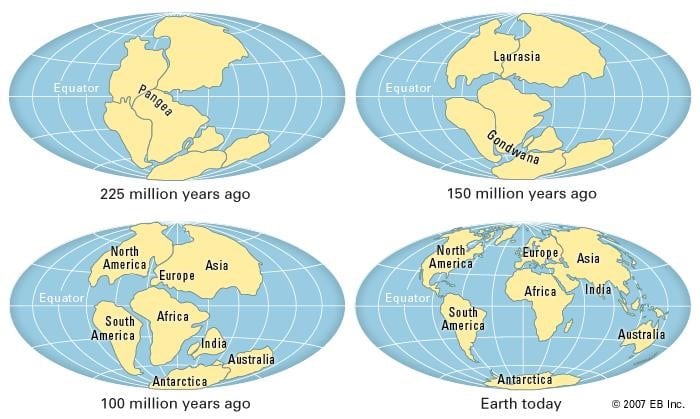
- First Stage (Carboniferous Period)
- A single supercontinent, Pangaea, existed
- It was surrounded by the global ocean Panthalassa
- Second Stage (Jurassic Period, ~200 million years ago)
- Pangaea began to split
- It divided into:
- Laurasia (north)
- Gondwanaland (south)
- Third Stage (Mesozoic Era)
- The Tethys Sea developed between Laurasia and Gondwanaland
- This sea gradually widened over time
- Fourth Stage (~100 million years ago)
- North and South America moved westward
- Formation of the Atlantic Ocean
- Development of major mountain ranges:
- Rocky Mountains
- Andes Mountains
- Fifth Stage (Orogenetic Stage)
- Period of intense mountain-building activity
- Formation of major ranges like:
- Himalayas
- Alps
- These mountains formed due to the folding of Tethys Sea sediments
Forces responsible for Continental Drift
Wegener proposed two main forces to explain continental movement:
- Equatorward Movement
- Caused by a combination of:
- Gravitational force
- Pole-fleeing force (due to Earth’s rotation causing centrifugal force)
- Buoyancy force
- This movement is influenced by the Earth’s equatorial bulge
- Caused by a combination of:
- Westward Movement
- Attributed to tidal forces generated by Earth’s rotation
However, these explanations were later considered inadequate, becoming a major criticism of the theory.
Evidence in support of the Continental Drift Theory
Several types of evidence support Wegener’s hypothesis:
- Matching of Continents (Jig-Saw Fit)
- Coastlines of South America and Africa appear to fit together
- Similar alignment observed among Africa, Madagascar, and India
Continental Jigsaw fit
- Geological Similarities
- Rock formations on opposite sides of the Atlantic show strong resemblance
- Example:
- Appalachian Mountains (North America) align with Hercynian Mountains (Europe)
- Similar rock structures found in Brazil and West Africa
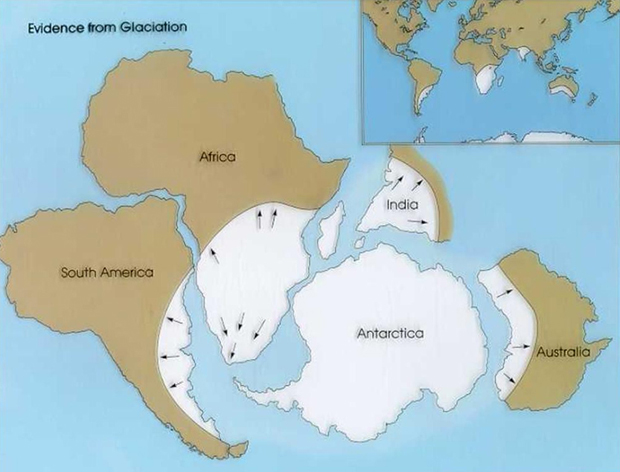
- Permo-Carboniferous Glaciation
- Evidence of ancient glaciation found in:
- South America
- Africa
- India
- Australia
- Suggests these regions were once connected and located near the South Pole
- Evidence of ancient glaciation found in:
- Fossil Distribution
- Identical fossils found across continents now separated by oceans
- Example:
- Mesosaurus, a freshwater reptile, found in both Africa and South America
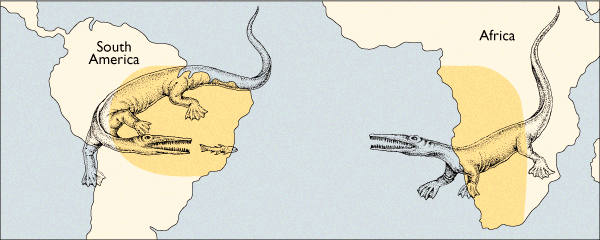
Similarity of Fossils along different continents
- Mesosaurus, a freshwater reptile, found in both Africa and South America
- Paleoclimatic Evidence
- Presence of coal deposits in cold regions
- Indicates these regions were once located in tropical climates
- Biological Evidence
- Migration patterns of animals suggest earlier land connections
- Example:
- Lemmings show migration routes that imply previously connected landmasses

Criticism of Continental Drift Theory
Despite its significance, the theory faced strong opposition due to several limitations:
- Unconvincing explanation of forces
- Proposed forces were insufficient to move massive continents
- Gravitational argument issues
- If lunar or solar gravity were strong enough, they would disrupt Earth’s rotation
- Unrealistic rotational requirements
- Required speeds would have caused the atmosphere to escape into space
- Lack of historical geological data
- Limited knowledge of pre-Carboniferous periods
- Directional limitation
- Could not clearly explain why drift occurred mainly westward and northward
- Incorrect assumptions
- Suggested sial (continental crust) floated over sima (oceanic crust)
- Modern understanding shows lithosphere moves over the asthenosphere
- Mountain formation explanation flawed
- Theory of mountain formation by friction was inconsistent
- Incomplete explanation
- Failed to explain:
- Oceanic ridges
- Island arcs
- Failed to explain:
The Continental Drift Theory was initially rejected by most scientists and remained controversial for many years after Wegener’s death in 1930.
Later developments introduced the concept of convection currents in the mantle, which provided a more convincing explanation for continental movement. Unfortunately, Wegener did not live long enough to incorporate this idea into his theory.
Although the original theory is no longer accepted in its initial form, its core concept of moving continents laid the foundation for modern theories such as:
- Plate tectonics
- Seafloor spreading
Thus, Wegener’s work remains a milestone in Earth science, fundamentally shaping our understanding of the planet’s dynamic nature