
The Earth can be understood in two main ways: mechanically and chemically.
- The mechanical (rheological) classification focuses on physical behavior (solid or liquid states). It divides the Earth into:
- Lithosphere
- Asthenosphere
- Mesospheric mantle
- Outer core
- Inner core
- The chemical (compositional) classification, which is more widely used, categorizes the Earth into:
- Crust
- Mantle (further divided into upper and lower mantle)
- Core (subdivided into outer core and inner core)

Sources to study the earth’s interior (Different Layers of the Earth)
The understanding of Earth’s interior comes from two broad categories of sources:
- Direct sources
- Indirect sources
1. Direct sources
- Surface rock
- Volcanoes
- Mining Projects
- Drilling Projects
- Deep Ocean Drilling Project
- Integrated Ocean Drilling Project
2. Indirect sources
- Temperature and pressure variation
- Seismic activities
- Meteorites
- Gravitation
- Magnetic field
Direct Sources of Earth’s Interior
Direct sources include materials that can be physically accessed or observed on or near the Earth’s surface:
- Earth’s Surface: Rocks found on the surface provide valuable insights into the composition of the upper layers. By studying them, scientists infer the nature of materials present at shallow depths.
- Volcanoes: Materials expelled during volcanic eruptions originate from deep within the Earth. These materials help scientists analyze the composition of deeper layers, although their exact depth of origin is uncertain.
- Mining and Drilling Activities: Samples obtained from mining and drilling operations reveal:
- Increasing temperature and pressure with depth
- Gradual rise in density from surface to interior
Indirect Sources of Earth’s Interior
Since direct observation is limited to shallow depths, scientists rely on indirect methods to explore deeper regions:
- Meteorites: Though not from Earth, meteorites are believed to have a composition similar to planetary material. Studying them provides clues about Earth’s internal structure.
- Gravitational Force: Variations in gravity across different regions indicate uneven distribution of mass within the Earth.
- Magnetic Field: Magnetic surveys reveal the distribution of magnetic materials and help in understanding internal composition.
- Seismic Studies: Analysis of seismic waves helps determine whether internal layers are solid or liquid. Findings show:
- Mantle: behaves plastically (semi-solid)
- Outer core: liquid
- Inner core: solid
Structure of the Earth’s interior
The Earth’s interior consists of concentric layers, broadly divided into:
- Crust
- Mantle
- Core
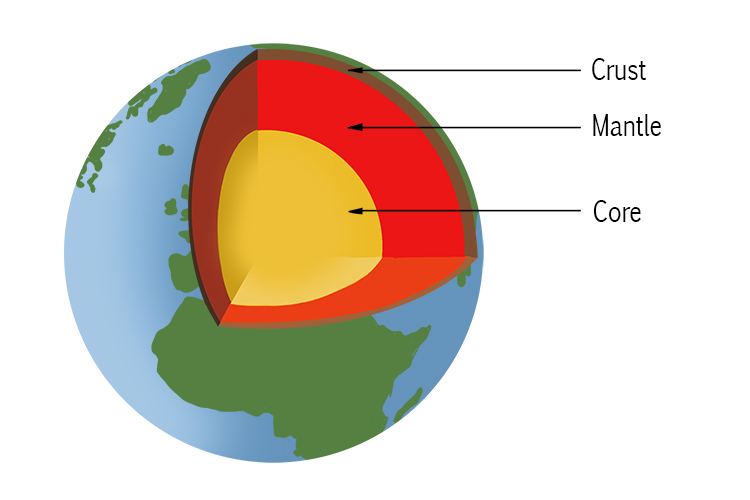
Crust, Mantle and Core of Earth
Crust
The crust is the outermost and thinnest layer of the Earth.
- Thickness ranges between 30–50 km
- Oceanic crust: thinner (5–30 km)
- Continental crust: thicker (50–70 km), reaching up to 100 km in mountainous regions like the Himalayas
- Makes up less than 1% of Earth’s mass and about 1% of its volume
Temperature and Composition:
- Temperature increases with depth:
- Up to 30°C per km in upper layers
- Reaches 200°C to 400°C near the crust-mantle boundary
- Structure:
- Upper layer: sedimentary rocks
- Middle layer: igneous and metamorphic rocks
- Lower layer: basaltic and ultrabasic rocks
- Composition differences:
- Continental crust: lighter silicate minerals (felsic, e.g., granite)
- Oceanic crust: denser basaltic rocks (mafic)
- Boundary with mantle: Mohorovicic (Moho) Discontinuity (Seismic Discontinuities)
The most abundant elements of the Earth’s Crust
| Element | Approximate % by weight |
|---|---|
| Oxygen (O) | 46.6 |
| Silicon (Si) | 27.7 |
| Aluminum (Al) | 8.1 |
| Iron (Fe) | 5.0 |
| Calcium (Ca) | 3.6 |
| Sodium (Na) | 2.8 |
| Potassium (K) | 2.6 |
| Magnesium (Mg) | 1.5 |
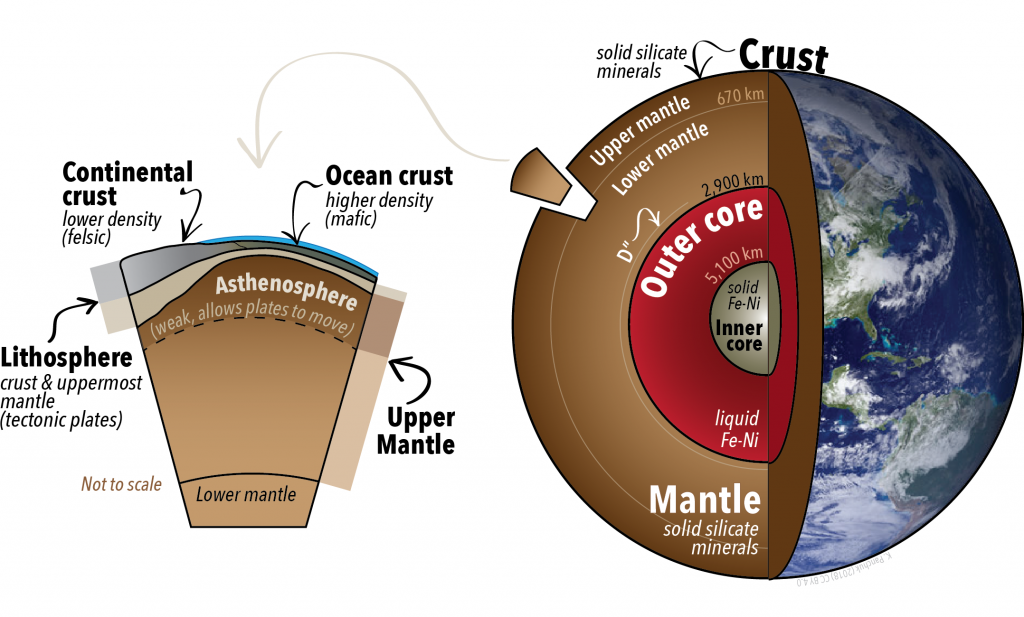
Lithosphere
The lithosphere is the rigid outer shell of the Earth.
- Thickness: 10–200 km
- Includes:
- Entire crust
- Uppermost mantle
Key features:
- Divided into tectonic plates
- Plate movement leads to:
- Earthquakes
- Mountain building (folding)
- Faulting
- Driven by:
- Residual heat from Earth’s formation
- Radioactive decay of elements like uranium and thorium
Asthenosphere
The asthenosphere lies just below the lithosphere.
- Depth: ~80 to 200 km
- Characteristics:
- Soft and plastic in nature
- Allows lithospheric plates to move over it
- Source of magma during volcanic activity
- Plate interactions:
- Plates may diverge, converge, or slide past each other, causing major geological changes
Mantle
The mantle lies beneath the crust and extends to a depth of about 2,900 km.
- Accounts for:
- 83% of Earth’s volume
- 67% of its mass
- Accounts for:
Structure:
- Upper mantle (includes asthenosphere)
- Lower mantle (solid and denser)
Physical properties:
- Density:
- Upper mantle: 2.9–3.3 g/cm³
- Lower mantle: 3.3–5.7 g/cm³
- Composition:
- Rich in silicates of iron and magnesium
- Major elements: oxygen, silicon, magnesium
- Temperature:
- From ~200°C near crust to ~4000°C near core
- Density:
Dynamic behavior:
- Heat differences create convection currents
- These currents drive tectonic plate movement
- Earthquakes can occur up to 670 km depth, especially in subduction zones
Core
The core is the innermost layer, composed mainly of iron and nickel (NiFe).
- Depth: 2900 km to 6400 km
- Accounts for:
- 16% of Earth’s volume
- 32% of its mass
- Density: 5.5 to 13.6 g/cm³
- Boundary with mantle: Gutenberg Discontinuity, marked by a sharp density increase
The core is divided into:
- Outer Core
- Inner Core
.png)
Outer Core
- Depth: 2900–5100 km
- State: Liquid
- Composition: iron, nickel, and lighter elements
Key role:
- Generates Earth’s magnetic field through fluid motion (dynamo effect)
Inner Core
- Depth: from 5100 km to Earth’s center
- State: Solid due to immense pressure
Key features:
- Can transmit shear (S) waves
- Rotates slightly faster than Earth’s surface
- Extremely high temperature but remains solid due to pressure
Earth’s Layers- Seismic Discontinuities
A discontinuity is a boundary where seismic wave behavior changes significantly.
Major discontinuities include:
- Conrad Discontinuity: between upper and lower crust
- Mohorovicic (Moho) Discontinuity: between crust and mantle (~35 km depth)
- Repetti Discontinuity: between upper and lower mantle
- Gutenberg Discontinuity: between mantle and outer core (~2900 km)
- Lehmann Discontinuity: between outer and inner core
Earth’s Chemical Composition
The Earth has an approximate mass of 5.97 × 10²⁴ kg and is primarily composed of the following elements:
- Iron – 32.1%
- Oxygen – 30.1%
- Silicon – 15.1%
- Magnesium – 13.9%
- Sulfur – 2.9%
- Nickel – 1.8%
- Calcium – 1.5%
- Aluminum – 1.4%
The remaining 1.2% consists of trace elements, completing the Earth’s overall chemical composition.