
The major domains of the Earth are a fundamental concept in Geography. The Earth’s surface is a dynamic and interconnected system where different components meet and interact continuously.
These components include:
- Solid part (Lithosphere)
- Gaseous part (Atmosphere)
- Liquid part (Hydrosphere)
- Living part (Biosphere)
These domains are not separate; instead, they overlap and influence each other, creating the environment we live in.
The Four Domains of the Earth
- Lithosphere: The solid outer layer of the Earth
- Atmosphere: The layer of gases surrounding the Earth
- Hydrosphere: All forms of water present on Earth
- Biosphere: The zone of life where land, water, and air interact
Lithosphere
The lithosphere is the outermost solid layer of the Earth, consisting of the crust and the upper part of the mantle.
Key features:
- It is divided into large sections called tectonic plates
- These plates are constantly moving, causing phenomena like earthquakes and volcanoes
- It has rigid mechanical properties, meaning it is hard and solid
- The uppermost layer is called the pedosphere, where soil forms and supports life
- It interacts with the atmosphere, hydrosphere, and biosphere
- Thickness: Approximately 100 km
Continents
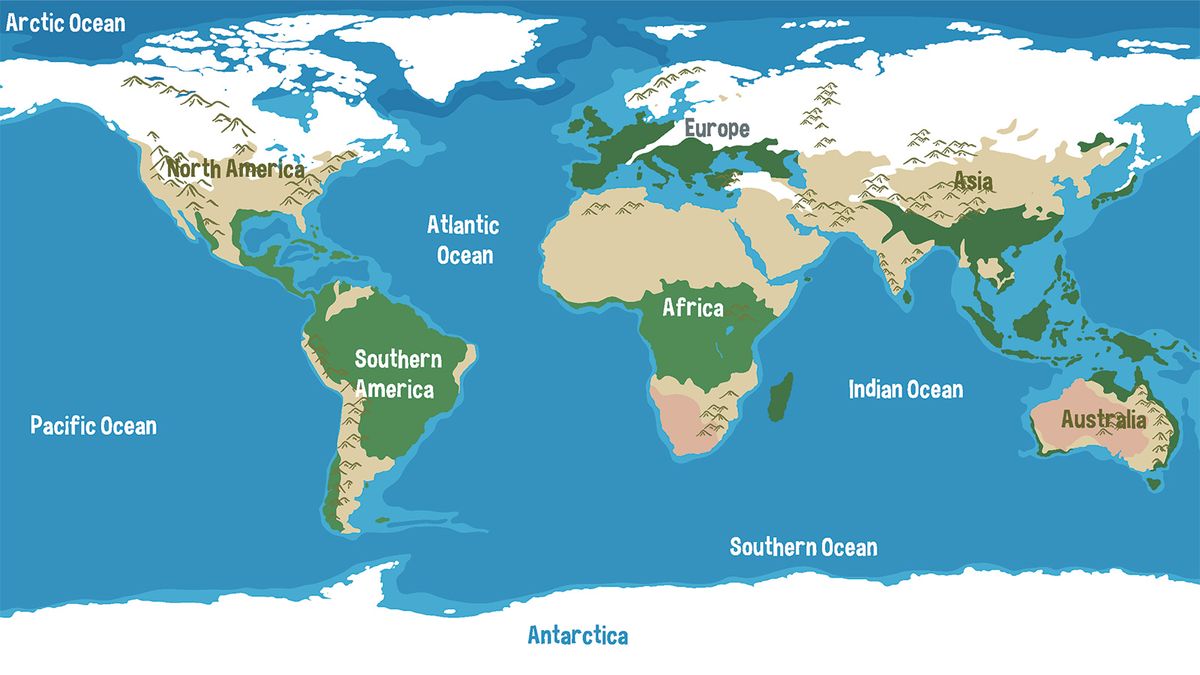
The Earth’s landmass is divided into seven major continents, separated by large water bodies.

Asia
- The largest continent, covering about one-third of Earth’s land area
- Located mainly in the Eastern Hemisphere
- The Tropic of Cancer passes through it
- Separated from Europe by the Ural Mountains
Europe
- Smaller than Asia and located to its west
- The Arctic Circle passes through it
- Surrounded by water on three sides
Africa
- The second-largest continent
- Mostly lies in the Northern Hemisphere
- Unique because the Equator, Tropic of Cancer, and Tropic of Capricorn all pass through it
North America
- The third-largest continent
- Located in the Northern and Western Hemispheres
- Connected to South America by the Isthmus of Panama
- Surrounded by the Atlantic, Pacific, and Arctic Oceans
South America
- Mostly located in the Southern Hemisphere
- Bordered by the Pacific Ocean (west) and Atlantic Ocean (east and north)
Australia & Oceania
- The smallest continent
- Lies entirely in the Southern Hemisphere
- Surrounded by oceans, often called an island continent
Antarctica
- Located completely in the Southern Hemisphere
- Contains the South Pole
- Covered by thick ice sheets throughout the year
Atmosphere
The atmosphere is the layer of gases that surrounds the Earth and makes life possible.
Key points:
- Composed mainly of:
- Nitrogen (78%)
- Oxygen (21%)
- Other gases (1%) such as carbon dioxide and argon
- Extends up to about 1,600 km above Earth’s surface
- Held in place by Earth’s gravity
- Responsible for weather and climate changes
- Composed mainly of:
Layers of the Atmosphere
The atmosphere is divided into five layers:
- Troposphere (lowest layer; weather occurs here)
- Stratosphere
- Mesosphere
- Thermosphere
- Exosphere (outermost layer)
Additional fact:
- Air density is highest at sea level and decreases with altitude
Hydrosphere
The hydrosphere includes all water present on Earth, making it essential for life.
Key facts:
- About 71% of Earth’s surface is covered by water
- Only 29% is land
- Around 97% of water is in oceans and is salty
- A very small portion is available as freshwater
Forms of water in the hydrosphere:
- Oceans and seas
- Rivers and lakes
- Glaciers and ice caps
- Underground water
- Water vapor in the atmosphere
Oceans
Oceans form the largest part of the hydrosphere and are interconnected.
Movements of ocean water:
- Waves
- Tides
- Ocean currents
Major Oceans (largest to smallest)
- Pacific Ocean
- Largest ocean
- Surrounded by Asia, Australia, North America, and South America
- Atlantic Ocean
- Second largest
- S-shaped
- Lies between the Americas (west) and Europe & Africa (east)
- Indian Ocean
- Named after India
- Roughly triangular in shape
- Bounded by Asia, Africa, and Australia
- Southern Ocean
- Surrounds Antarctica
- Arctic Ocean
- Smallest ocean
- Located around the North Pole
- Connected to the Pacific Ocean by the Bering Strait
Biosphere – The Domain of Life
The biosphere is the life-supporting zone of Earth where land, water, and air come together.
Key features:
- It is a thin layer where all living organisms exist
- Includes both:
- Plants (plant kingdom)
- Animals (animal kingdom)
- Makes Earth unique as the only known planet supporting life
Interaction of the Domains
All four domains are closely connected:
- The lithosphere provides land and minerals
- The hydrosphere supplies water
- The atmosphere provides air and regulates climate
- The biosphere includes all living organisms

These domains continuously interact, shaping Earth’s environment and supporting life.