
Agriculture in Assam
Table of Contents
ToggleIntroduction
- Assam is primarily an agrarian in nature with almost 70% of rural population directly dependent on agriculture as a source of income.
- Factors influencing agricultural growth in Assam :
- Fertility of land.
- Abundance of water
- Assam has achieved self-sufficiency in rice, the staple crop, but we still have a shortfall in overall requirement of oilseed, pulses and wheat.
- Assam has a surplus production of fruits and vegetables, but almost 40% of the crop is lost because of post harvest losses.
- Assam lags behind the rest of the country in all the key indicators of agricultural productivity.
- Assam farmers faces increase in productivity cost due to increase in input costs.
- Geopolitical situations resulting in further increasing of pressure from the developed world to reduce subsidies permissible under the “green box” of WTO’s Agreement on Agriculture.
- Assam is already facing stiff competition from countries like Sri Lanka and Kenya in Tea, one of Assams major agriculture based industry.
- Brahmaputra silt impacts Assam’s land productivity:
- Fine silt deposition during flood – boosts fertility.
- Heavy sand-silt casting from floods buries fields, rendering them barren for 2-5 years.
Physiographic Factors Affecting Agriculture in Assam
Assam’s agriculture is largely controlled by :
- Relief and Topography
- Soil Types of Assam
- Climate and Rainfall Pattern
- River System and Floods
Assam has a diverse physiography, which strongly influences cropping pattern, irrigation, and productivity.
Major Physiographic Divisions
Brahmaputra Valley
Barak Valley
Hills of Karbi Anglong & North Cachar Hills
Impact of Relief and Topography on Agriculture of Assam
(a) Brahmaputra Valley
Broad alluvial plains
Gentle slope → suitable for wet rice cultivation
High soil fertility due to annual silt deposition
Prone to floods and erosion
Crops: Rice (Sali, Ahu), jute, oilseeds, vegetables
(b) Barak Valley
Narrow but fertile valley
Heavy rainfall
Waterlogging in low-lying areas
Crops: Rice, pulses, tea
(c) Hill Regions
Steep slopes
Thin and less fertile soils
Practice of Jhum (shifting cultivation)
Crops: Millets, maize, tubers
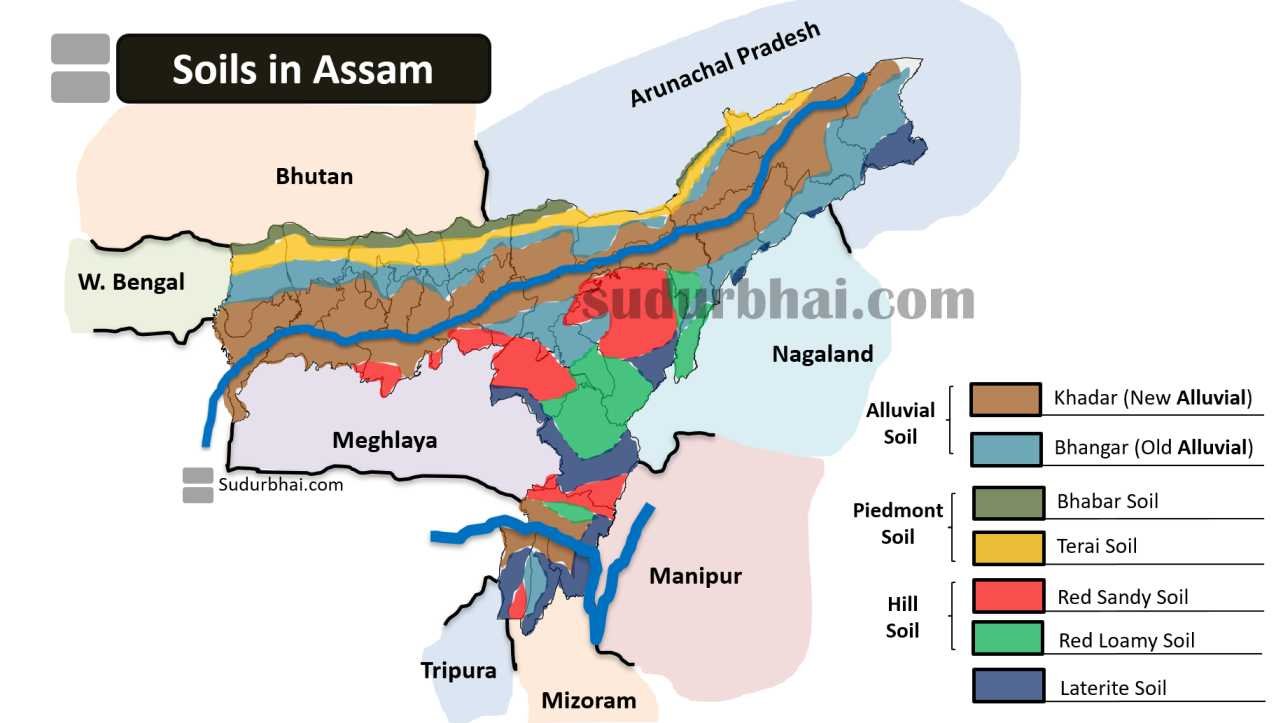
Assam soils are mostly young alluvial soils, but vary spatially.
Major Soil Types and their impact on Agriculture of Assam
(a) Alluvial Soil
Found in Brahmaputra & Barak Valleys
Formed by river deposition
Rich in potash, low in phosphorus
Suitable crops: Rice, jute, sugarcane, oilseeds
(b) New Alluvial (Khadar)
Highly fertile
Found along riverbanks
Frequently renewed by floods
(c) Old Alluvial (Bhangar)
Less fertile
Located away from active floodplains
(d) Red and Lateritic Soil
Found in hill areas
Acidic, low fertility
Suitable crops: Tea, rubber, pineapple
(e) Peaty and Marshy Soil
Low-lying areas
High organic content but waterlogged
Assam experiences a humid subtropical monsoon climate, ideal for water-intensive crops.
Key Climatic Features
Average Rainfall: 200–300 cm annually
Monsoon Season: June to September
High humidity: 75–90%
Moderate temperatures
Impact of Climate on Agriculture of Assam
Positive Impacts
Supports multiple rice crops
Ideal for tea cultivation
Long growing season
Negative Impacts
Excess rainfall → floods & waterlogging
Delayed monsoon affects sowing
Climate variability impacts yield
Major River Systems
Brahmaputra and its tributaries (Subansiri, Manas, Dibang)
Barak River System
Role of Rivers in Agriculture of Assam
Positive Role
Deposit fertile alluvial silt
Recharge groundwater
Natural irrigation source
Negative Role: Floods
Annual floods damage standing crops
Riverbank erosion reduces cultivable land
Sand deposition lowers soil fertility
Flood-Prone Areas
Lower Brahmaputra Valley
Char (river island) areas
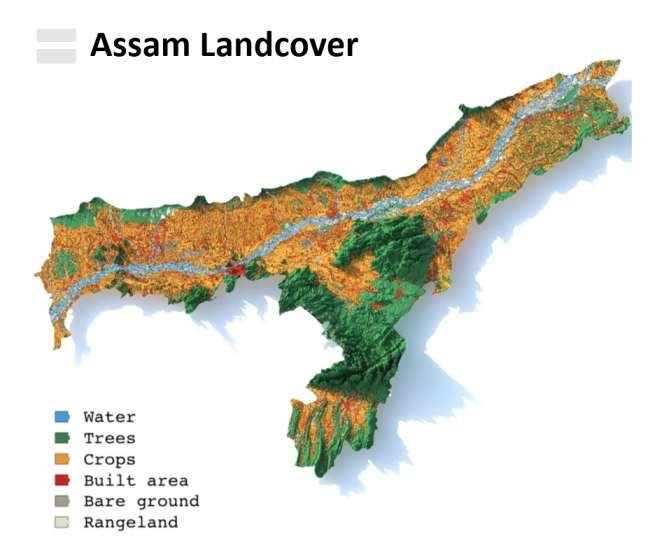
Assam Land Use Data
Category | % of Reporting Area |
Total Geographical Area | 100% |
Forest Area | 23.36% |
Area Not Available for Cultivation | 32% (incl. forests/non-agri) |
Net Area Sown | 35.05% |
Total Cropped Area (Gross) | ~140% intensity |
Area Sown More Than Once | Gross- Net |
Culturable Waste Land | 1.88% |
Note :
- Out of the above net area sown, 3 to 5 lakh hectares are affected by flood to various degrees annually.
- Forest Area : Forest Area generally refers to all the geographic areas recorded as forest in government records.
- Net Sown Area refers to the total area of land that is cultivated and sown with crops at least once in a single agricultural year.
- Gross Cropped Area represents the total area sown once and/or more than once in a particular year, i.e. the area is counted as many times as there are sowings in year.
- Culturable Waste Land are the cultivable land that has been left uncultivated or fallow for a prolonged period (typically >5 years).
Cropping Calendar of Assam
Season / Crop Type | Sowing Period | Harvesting Period | Major Crops Grown |
Kharif (Monsoon) | May – June | October – November | Sali rice, maize, jute, cotton, pulses, sesame |
Rabi (Winter) | October – November | February – March | Wheat, mustard, lentil, gram, pea, potato, vegetables |
Zaid / Summer | January – February | April – June | Ahu rice, vegetables, pulses, oilseeds |
Special Rice Crops of Assam
Season / Crop Type | Sowing Period | Harvesting Period | Major Crops Grown |
Ahu Rice (Autumn) | January – February | April – June | Ahu (autumn rice) |
Sali Rice (Winter) | May – June | October – November | Sali (main rice crop) (60% Production) |
Boro Rice (Summer) | November – December | April – May | Boro (irrigated rice) |
Significance of Cropping Calendar
Enables multiple cropping
Efficient use of monsoon and river water
Helps in planning irrigation & inputs
Major Crops and Production in Assam
- Food grains : Rice, Wheat, Pulses and Oilseeds.
- Cash crops : Jute & sugarcane.
- Horticulture crops: Fruits (pineapple, banana, citrus), vegetables, and spices.
- Plantation crops: Rubber, bamboo, cashew, arecanut.
Food grains
Rice Production in Assam:
- Assam contributes ~4–5% to India’s total rice production.
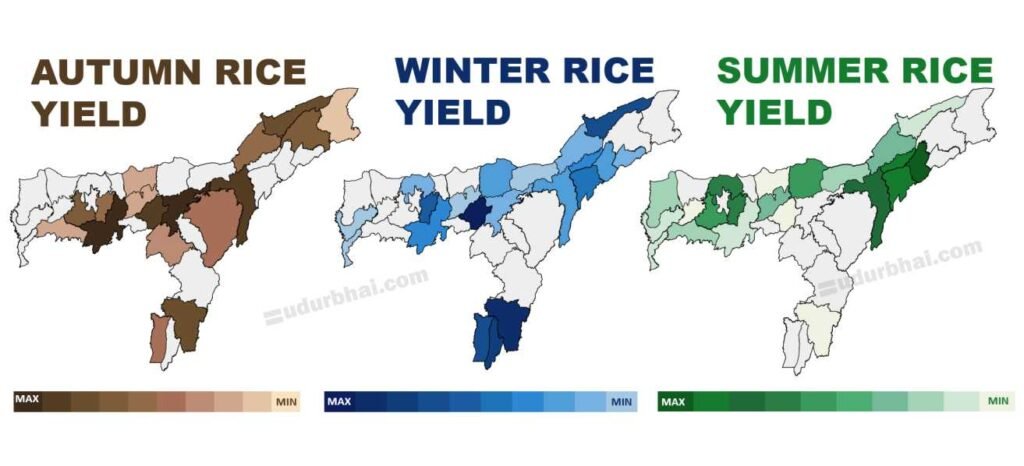
- Dominated by Winter/Sali Rice (~70–80% of area/production), followed by Summer/Boro (irrigated, higher yield) and Autumn/Ahu (rainfed, lower yield).
- HYV Rice coverage: ~1.55–1.82 million ha (high in Summer/Boro; ~70–75% overall).
- Trends: Area slightly declining/stabilizing due to floods/urbanization; production and yield rising gradually
- Districtwise insights on Rice production :
- High-production districts: Nagaon, Golaghat, Sonitpur, Barpeta (strong in Winter/Summer).
- HYV examples: Nagaon high in total HYV (~25 ‘000 ha in samples); yields 2,500–3,400 kg/ha in leading districts.
- Challenges in hilly/flood-prone: Lower in Karbi Anglong, Dima Hasao.
Wheat Production in Assam:
Assam contributes less than 0.1–0.2% to India’s total wheat production.
It is a rabi crop grown mainly in upland/non-flood-prone areas of the Brahmaputra Valley.
District-Wise Insights on Wheat Production :
Wheat is concentrated in upper and central Brahmaputra Valley districts with relatively better drainage and winter dryness.
Leading Districts (area/production higher):
Dibrugarh, Tinsukia, Jorhat, Golaghat (upper Assam; better upland areas).
Nagaon, Sonitpur, Darrang (central; some irrigation support).
Barpeta, Kamrup (limited pockets).
Cultivation of Wheat in Assam is limited due to:
- Subtropical humid climate (high humidity, rainfall during Rabi unsuitable for wheat).
- Flood-prone lowlands.
- Preference for rice and other crops.
- Soil acidity and poor drainage in many areas.
Pulses Production in Assam:
- Assam contributes <1% to India’s total pulses production.
Assam imports most pulses from other states (e.g., Madhya Pradesh, Rajasthan for gram; Maharashtra for tur).
- Seasonal Distribution of Pulse production:
- Rabi: ~60-70% of area/production (gram, lentil dominant; better yields with irrigation).
- Kharif: ~20-30% (urad, moong, tur; rainfed, flood risks).
District-Wise pulse production :
- Higher production (higher area/production): Nagaon, Sonitpur, Barpeta, Darrang, Goalpara, Kamrup (central/lower Brahmaputra; better Rabi conditions).
- Moderate production: Jorhat, Golaghat, Lakhimpur (upper Assam).
- Low production: Hilly districts (Karbi Anglong, Dima Hasao), Barak Valley (Cachar etc.; terrain constraints).
Oilseeds Production in Assam:
- Assam contributes <1-1.5% to India’s total oilseeds production (Rabi crop).
Primarily dominated by rapeseed and mustard , which accounts for 80-90% of total oilseeds output.
Other minor oilseeds include groundnut, sesamum (til), sunflower, soybean, niger, and linseed.
District-Wise production of Oilseeds:
- Leading districts (high area/production in rapeseed-mustard): Barpeta, Nagaon, Darrang, Sonitpur, Goalpara, Dhubri, Kamrup (central/lower Brahmaputra; better upland Rabi conditions).
- Upper Assam: Jorhat, Golaghat, Lakhimpur (moderate).
- Low: Barak Valley, hilly districts (terrain/flood issues).
Cash Crops
Jute Production in Assam:
- Assam is the third-largest producer of raw jute (after West Bengal and Bihar), contributing ~7–9% to India’s total jute production.
West Bengal ~81%, Bihar ~10%, Assam third
District-Wise Jute production :
Jute is concentrated in Lower and Central Brahmaputra Valley and Barak Valley districts with suitable soil and water for retting.
- Leading Districts (higher area/production):
- Barpeta, Goalpara, Dhubri, Bongaigaon (Lower Assam; major share).
- Nagaon, Morigaon, Darrang (Central).
- Cachar, Karimganj (Barak Valley).
- Leading Districts (higher area/production):
- Moderate: Kamrup, Nalbari.
- Low/Negligible: Upper Assam (Dibrugarh, Tinsukia), hilly districts (Karbi Anglong, etc.) due to terrain.
Sugarcane Production in Assam:
- Assam contributes <0.5–1% to India’s total sugarcane production.
District-Wise sugarcane production:
- Leading districts (higher area/production): Karbi Anglong (often highest due to upland suitability), Nagaon, Golaghat, Sonitpur, Tinsukia.
- Moderate: Darrang, Lakhimpur, Jorhat.
- Low/Negligible: Flood-prone Lower Assam (Dhubri, Goalpara), Barak Valley, hilly districts (Dima Hasao).
Horticulture Crops
Horticulture Production in Assam:
- Assam contributes ~2.5-3% to India’s total horticulture production
- Assam ranks among top NE states in horticulture, with fruits (especially tropical like pineapple, banana, citrus) and spices (ginger, turmeric) as strengths.
Major Fruit Crops of Assam
| Name of the crop | Districts where predominantly grown |
|---|---|
| Banana | Barpeta, Kamrup, Nagaon, Cachar, Nalbari, Goalpara, Jorhat, Golaghat, Sonitpur, Sibsagar, Tinsukia |
| Pineapple | Kamrup, Nagaon, Karbi Anglong, N.C. Hills, Cachar |
| Orange | Tinsukia, Karbi Anglong, North Cachar, Kamrup, Goalpara, Darrang, Dibrugarh |
| Papaya | Nagaon, Darrang, Kamrup, Karbi Anglong, N. Cachar, Nalbari, Barpeta, Sonitpur, Dhubri |
| Assam lemon | All districts of Assam |
| Guava | All districts of Assam |
| Litchi | All districts of Assam – mainly Kamrup, Sonitpur and Bongaigaon |
| Jack-fruit | All districts of Assam |
| Mango | All districts of Assam |
Major Spices of Assam
| Name of the spice | Districts where predominantly grown |
|---|---|
| Chilli | Dhubri, Barpeta, Darrang, Nagaon |
| Turmeric | Kamrup, Darrang, Nagaon, Barpeta, Sonitpur, Nalbari, Bongaigaon |
| Onion | Barpeta, Nagaon, Dhubri |
| Ginger | N.C. Hills, Cachar, Karbi Anglong, Kamrup, Barpeta, Sonitpur, Nagaon |
| Coriander | Dhubri, Nalbari, Kamrup, Barpeta, Sonitpur, Nagaon, Morigaon, Darrang, Goalpara |
| Garlic | Dhubri, Kamrup, Barpeta, Nagaon, Lakhimpur, Goalpara, Darrang |
| Black pepper | Jorhat, Sibsagar, Kamrup, Nagaon, Golaghat, Dibrugarh, Cachar, Barpeta |
Major tuber Crops of Assam
| Name of the crop | Districts where predominantly grown |
|---|---|
| Potato | Barpeta, Darrang, Kamrup, Sonitpur, Nagaon, Dhubri, Nalbari |
| Sweet potato | Dhubri, Kamrup |
| Tapioca | Kokrajhar, Nalbari, Darrang, Karbi Anglong, Goalpara |
Major vegetables of Assam
| Name of the crop | Districts where predominantly grown |
|---|---|
| Kharif vegetables | All districts of Assam |
| Rabi vegetables | All districts of Assam |
Plantation Crops
Rubber, bamboo, cashew, arecanut
Rubber Production in Assam:
- Assam contributes about 5.4% of India’s total natural rubber production.
- NorthEast (Assam/Tripura/Meghalaya) together accounts for 17.5% rubber production in Assam.
Statewise Ranking of Rubber production : Kerala (70-75 %) > Tripura (6%) > Assam(5.4%) > Tamil Nadu, Odisha & others.
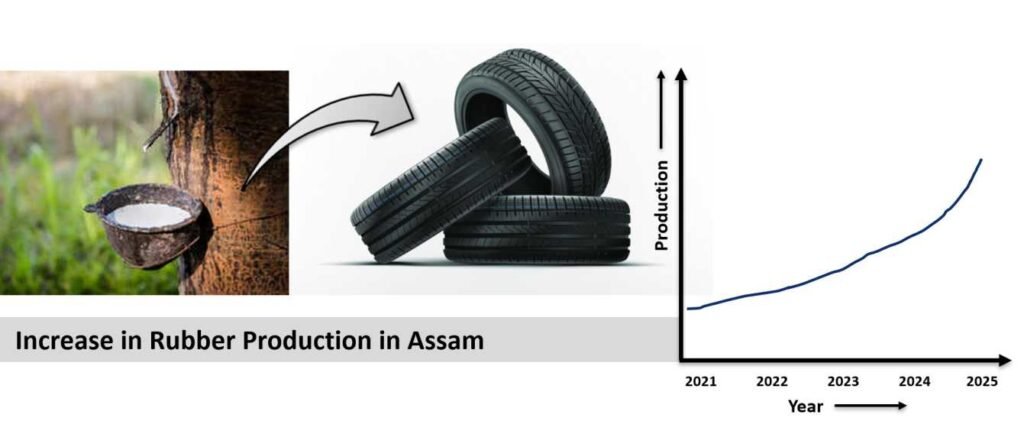
- Sribhumi, Goalpara, and Karbi Anglong leads the rubber areas and production.

Top Districts in Rubber Production | Production (MT) |
Karimganj | 16,360.00 |
Goalpara | 13,543.00 |
Karbi Anglong | 6,662.00 |
Kokrajhar | 3,928.80 |
Cachar | 2,475.00 |
Bamboo Production in Assam:
- Also known as “green gold” and “poor man’s timber“
- Assam hosts about 7-10% of India’s total bamboo, with 51 different type of Bamboo species.
- NorthEast holds 46% India’s Bamboo output.
- Major Bamboo producing states : Madhya Pradesh > Arunachal Pradesh > Maharashtra > Odisha > Assam > Chattisgarh.
- Major Bamboo producing North East states : Arunachal Pradesh > Assam > Nagaland > Manipur > Mizoram
- Assam Districts with a high percentage of areas under bamboo in the forests are Karbi-Anglong, Goalpara, Kamrup and Cachar & Karimganj.
- A/c to Forest surveys (FSI), the bamboo-bearing area in Assam’s forests has contineously increased (Note : Data on cultivated bamboo on private lands is not much available)
- According to Forest Survey of India, India is home to 125 indigenous and 11 exotic species of bamboo with more than 50% of them growing in Eastern and North-Eastern India in the states of Assam, Meghalaya, Manipur, Mizoram, Nagaland, Tripura, Sikkim, and West Bengal.
Hill districts dominating the bamboo production of Assam→ Karbi Anglong & Dima Hasao, with Barak Valley (Cachar–Karimganj) as the second major bamboo belt region.
District / Region | Approx. % Share of Assam’s Bamboo Output |
Karbi Anglong | ~22–25% |
Cachar / Karimganj Region | ~18–21% |
Goalpara | ~12–15% |
Kamrup | ~10–12% |
Nagaon | ~8–10% |
Lakhimpur | ~6–8% |
Dima Hasao | ~4–6% |
Cashew Production in Assam:
- Assam accounts for ~0.15% of India’s total cashewnut production.
- Major cashew producing states : Maharashtra > Odisha > Andhra > Karnataka > Tamil Nadu.
- Major cashew producing North East states :Meghalaya > Assam > Tripura > Nagaland
- Goalpara and Dhubri in Assam together accounts for ~60% states output.
District | Est. Production Share |
Goalpara | ~40-50% |
Dhubri | ~20-25% |
Kokrajhar | ~15-20% |
South Salmara | ~10% |
Arecanut Production in Assam:
- Assam ranks 3 nationally in arecanut production (behind Karnataka/Kerala).
- Top districts in Assam producing Arecanut are Sonitpur, Darrang, Kamrup.
- Major arecanut producing states : Karnataka > Kerala > Assam > Meghalaya > West Bengal.
- Major arecanut producing North East states : Assam > Meghalaya > Tripura > Mizoram.
- Major arecanut producing districts of Assam in India : Nagaon > Sonitpur > Darrang >Kamrup > Lakhimpur
Allied Sectors in Assam :
- Animal husbandry and livestock (cattle, poultry, milk production).
- Fisheries (riverine, beel, pond-based; species and production).
- Sericulture (silk varieties like Muga, Eri)
Problems of Agriculture in Assam :
- The majority of the land in the State is owned by Small and Marginal farmers, practicing subsistence agriculture, having low productivity.
- The present availability of operational Tractors & Power Tillers for agricultural purpose is very low as compared to the national average.
- The actual availability of horticulture crops in the markets for fruits & vegetables go down by about 35% – 40% due to post harvest losses.
- Irrigation availability in the state is very poor. Presently 20.7% of the net- cropped area and 37.72% of the gross cropped area are covered by irrigation.
- Post harvest technology and facilities like marketing infrastructure including storages and road communication in the State is grossly inadequate.
- Absence of Agro-processing industry make the farmers vulnerable to market volatility.
- The institutional structure of credit is extremely weak in the State. Most of the Gaon Panchayat Samitees and the Large Areas Multipurpose Societies (LAMPS) in the Hill districts are financially weak and inactive.
Steps taken in Agricultural sector by the government :
- Government is deploying System of Rice Intensification (SRI) technique, which is a climate & flood resilient, low-input farming methodology that has boosted rice yields. Eg. Swarna-Sub1 variety of rice has thrived in 2022 during Kaziranga floods.
Assam govt. has formulated Assam Agricultural Policy aligned with the National Agriculture Policy (2000), supplemented by vision documents like Agri Vision 2025 (a vision doc for sustainable agricultural growth).
Objectives of the Assam Agricultural Policy Framework
- Achieve self-sufficiency in food grains (especially rice), pulses, oilseeds, and horticultural products.
- Generate productive employment for the growing rural workforce (absorb labor surplus given limited industrial base).
- Ensure sustainable production amid environmental challenges (floods, erosion, soil acidity, climate change).
- Promote crop diversification, value addition, processing, and exports (e.g., aromatic rice, organic produce).
- Enhance farmer income through better inputs, credit, insurance, marketing, and mechanization.
- Protect biodiversity, conserve soil/water, and promote organic/integrated farming.
- Build resilience against natural calamities (floods affecting 20-30% cropped area annually).
- Align with national goals (e.g., doubling farmers’ income, Atmanirbhar Bharat) and SDGs (Zero Hunger, Climate Action).
Key Strategies and Thrust Areas (from State Policy & Agri Vision 2025)
- Crop Production and Productivity Enhancement:
- Focus on rice (staple crop): Promote HYVs, hybrids, submergence-tolerant varieties (e.g., Swarna Sub-1), SRI, and summer/Boro rice via irrigation.
- Diversification: Shift to pulses, oilseeds, maize; reduce monoculture risks.
- Targets (Vision 2025): Rice productivity to 4,500 kg/ha; total production ~135 lakh MT; pulses self-sufficiency with 1,200 kg/ha yield; oilseeds surplus.
- Irrigation and Water Management:
- Expand assured irrigation (from low ~20-25% to higher coverage via STWs, lift irrigation, PMKSY).
- Vision target: 10 lakh ha assured irrigation; exploit Brahmaputra basin potential.
- Rainwater harvesting, micro-irrigation, and flood-resilient infrastructure.
- Soil Health and Nutrient Management:
- Address acidic soils (pH 4.5-6.5); promote INM (bio-fertilizers, green manuring, organic manure).
- Fertilizer consumption target: 70 kg/ha balanced use.
- Soil testing labs and Soil Health Cards.
- Farm Mechanization:
- Low current levels (~0.3 HP/ha); promote tractors, power tillers, transplanters, harvesters.
- Custom hiring centers, subsidies under schemes like Mukhya Mantri Krishi Sa Sajuli Yojana.
- Input Supply and Seed Systems:
- Increase Seed Replacement Rate (SRR): Paddy to 50%, pulses/oilseeds to 35%.
- Seed production farms, private sector involvement, quality control.
- Horticulture and Plantation Crops:
- Expand area and production (fruits, vegetables, spices, flowers, medicinal/aromatic plants).
- Vision 2025 targets: Fruits ~32 lakh MT, vegetables ~58 lakh MT, spices ~5 lakh MT.
- Value addition: Processing units, cold chains, export promotion.
- Organic Farming and Sustainable Practices:
- Promotion of certified organic clusters (significant growth in 2024-25).
- IPM, bio-pesticides, conservation agriculture.
- Credit, Insurance, and Risk Management:
- Access to institutional credit (KCC, priority sector lending).
- Crop insurance under PMFBY (covers flood/drought risks).
- Micro-credit via SHGs and FMCs (Field Management Committees).
- Marketing and Value Chains:
- Improve market linkages (recent Agricultural Marketing Act for better opportunities).
- e-NAM integration, FPOs, cold storages, agro-processing.
- Reduce post-harvest losses (~10-15%).
- Research, Extension, and Human Resource Development:
- Assam Agricultural University (AAU), KVKs for technology dissemination.
- Training programs, Young Farmers’ Development Agency (incentives for youth).
- IT for market info, administration, and networking (e.g., FMC digitization).
- Institutional Framework:
- Directorate of Agriculture leads implementation.
- People’s participation: 25,000+ FMCs/SHGs for local planning and resource mobilization.
- Convergence with central schemes (NFSM-Rice, NMSA, RKVY) and projects (APART for agribusiness).
- Crop Production and Productivity Enhancement:
Major Schemes and Initiatives in Agricultural Sector :
- Central Schemes:
- NFSM: National Food Security Mission)
- PMKSY: Pradhan Mantri Krishi Sinchayee Yojana
- PMFBY: Pradhan Mantri Fasal Bima Yojana
- RKVY: Rashtriya Krishi Vikas Yojana
- NMAET: National Mission on Agricultural Extension and Technology
- PKVY: Paramparagat Krishi Vikas Yojana (organic).
- State Schemes:
- Mukhya Mantri Krishi Sa Sajuli Yojana (input support)
- Assam Millets Mission
- Organic Farming promotion
- FPO(Farmer Producer Organisation) strengthening (e.g., 500 high-performing FPOs in recent budgets).
- Projects: APART (World Bank, focused on value chains, climate-resilient practices; continuity planned post-2024).
- Recent Developments: New Agricultural Marketing Act (~2025) for livestock/farm produce linkages; agroforestry policy integration for climate mitigation.
- Central Schemes:
PYQs
Q. Suggest steps for qualitative improvement in agriculture in Assam through cropping diversification. (2023)
Let us know any further suggestions ,we at sudurbhai.com will be happy to hear from you in our comment section below !