Climate of Assam
Climatic Type of Assam
Factors controlling Climate of Assam
Seasons of Assam
Spatial Climatic Variations in Assam
A. Temperature Regime in Assam
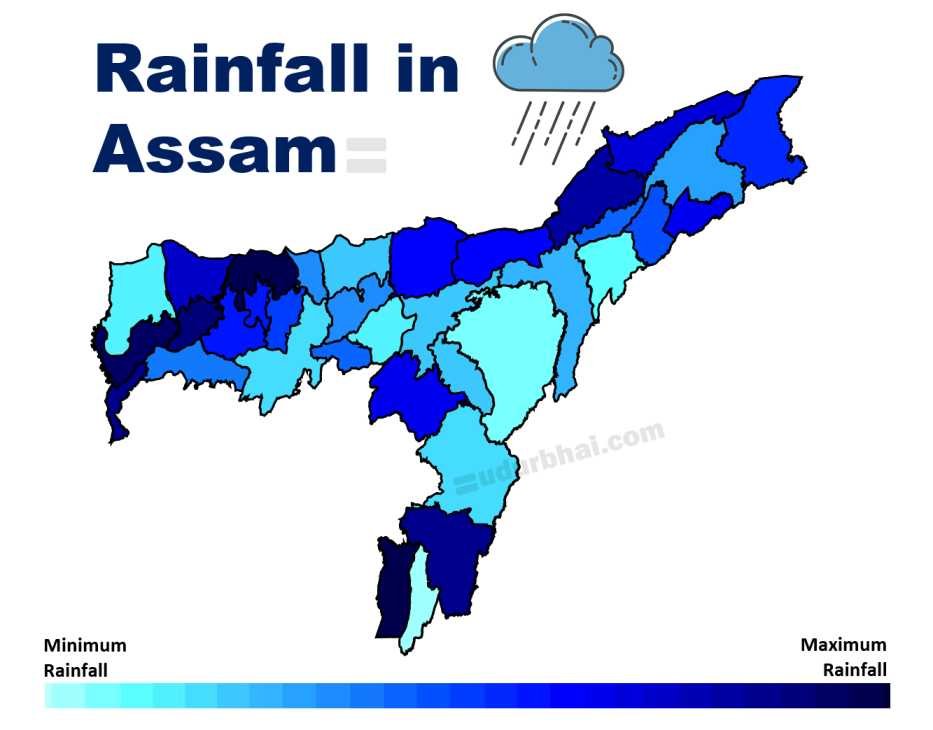
B. Rainfall Pattern in Assam
Assam has a tropical monsoon rainforest climate with high humidity, heavy rainfall and generally moderate temperatures. It shows clear seasonal rhythm, strong monsoon control and orographic influence of surrounding hills and Himalayas.
Climatic Type of Assam
Assam lies in the NE Himalayan foothills, between Brahmaputra and Barak valleys, exposed to Bay of Bengal branch of SW monsoon.
Officially described as having a tropical monsoon rainforest climate with high humidity and heavy rainfall.
Under Köppen Climatic Classification, most of Assam is a mix of tropical monsoon (Am) and humid subtropical with dry winter (Cwa) types.
Characteristics of Assam Climate:
High humidity (70-90%)
Temperatures vary from 6-8°C in winter to 35-38°C in summer.
Average annual rainfall ranges from 2000-4000 mm
Moderate temperatures compared to other states.
Factors controlling Climate of Assam
Latitude & monsoon track: Proximity to Bay of Bengal keeps moisture supply high and ensures strong SW monsoon impact.
Himalayan Barrier: Himalayas to north and hills of Arunachal, Nagaland, Manipur, Mizoram trap monsoon winds, enhancing rainfall and preventing their escape.
- Alternating pressure conditions : Low pressure over the north-west India (due to increased temperature) creates respective high pressure condition over the Bay of Bengal and North East region thereby attracting moisture laden winds.
Local mountain and valley winds results in precipitation along the foothill zone.
- Western Disturbance : The periodic visit of the Western disturbances during the later winter season results in Winter Rainfall.
River systems & wetlands: Extensive floodplains of Brahmaputra–Barak and beels maintain high humidity and frequent fog.
Forests & vegetation: Dense forests in Assam and NorthEast help sustain a moist micro‑climate.
Local Phenomena: Valley winds, cyclones and dust storms influences the Assam climate to a great extent.
- Opening on the west (towards West Bengal) allows moisture laden Monsoon winds to move towards west India.
Seasons of Assam
Assam has four main seasons:
1. Pre-Monsoon (March-May)
- Temperature: 25-38°C
- Rainfall: Increasing, 300-600 mm; prepares soil for cultivation.
- Hot and humid Climate.
- Characteristics :
- Pre‑monsoon thunderstorms (locally “Bordoicila”) with hail, lightning, and heavy showers.
- Acts as transition from cool dry winter to hot wet summer
March–April : Spring
April–May : Summer
2. Monsoon/Southwest Monsoon (June-September)
- Peak rainy season; 60-70% of annual rainfall.
- Temperature: 28-32°C (moderated by rain).
- Characteristics :
- Heavy and continuous rain.
- Causes floods in low-lying areas.
- Ideal for sowing Kharif Crops
3. Post-Monsoon/Retreating Monsoon (October-November)
- Rainfall decreases and weather turns more pleasant with comfortable temperature.
- Temperature: 20-30°C.
- Characteristics :
- Clear skies.
- Important for harvesting Kharif Crops
- Ideal for tourism.
4. Winter (December-February)
- Temperature: Min 6-12°C (Higher altitudinal areas- slightly cooler) , Max 20-25°C.
- Scanty rainfall (western disturbances occasionally).
- Characteristics:
- Cool and dry climate.
- Frequent foggy mornings/evenings.
- Ideal for growing Rabi Crops
Spatial Climatic Variations in Assam
Eastern Assam and southern hills (Barak valley, Dima Hasao, Karbi Anglong) receive more rainfall than western Brahmaputra valley.
Hill areas are slightly cooler with heavy orographic rain, while central valley has warmer conditions and repeated floods.
Western Assam (Goalpara, Dhubri side) shows relatively lower annual rainfall than upper Assam and southern slopes.
- Himalayan Foothills and regions along hill-plain junctions faces the impact of Mountain breeze(night) and Valley breeze(day).
- Weather of Assam as well as the entire north-east remains cloudy – whenever tropical cyclones that occur frequently along the coastal regions of Bay of Bengal.
- In general the climate of Assam is characterised by :
- Relative coolness,
- High relative humidity,
- Heavy rainfall in the summer season and
- Drought in the winter season.
Spatial Climatic Variations in Assam can be further analysed by studying :
A. Temperature Conditions in Assam
B. Rainfall Pattern in Assam
Temperature Conditions in Assam
Assam maintains moderate temperatures year-round due to high humidity, cloud cover, and surrounding hills—never too scorching or freezing, unlike northern India. This regime supports tea, rice, and dense forests but faces warming trends.
Overall Range
- Annual temps hover 6–38°C, with small diurnal/annual variations (5–10°C range).
- Summer peaks at 35–38°C (April-May), winters dip to 6–8°C (Dec-Jan).
- Both Summers and Winters are mild due to the impact of Brahmaputra moisture.
- Humidity keeps it feeling warmer; valleys warmer than hills.
Seasonal Variations
Winter (Nov-Feb)
- Mins 6–12°C, max 22–25°C; foggy mornings, rare cold waves.
- January coldest; suits rabi crops like mustard—think Jorhat winters, crisp but not biting.
- Trend: Slight warming, min temps up 0.2–0.5°C/decade.
Pre-Monsoon/Summer (Mar-May)
- Max 30–38°C, humid with “Bordoicila” storms cooling afternoons.
- April hottest; evapotranspiration high, preps for monsoon paddy transplant.
- Dibrugarh sees fastest max temp rise (0.58%/season).
Monsoon (Jun-Sep)
- Warm-wet: 25–32°C, cloudiness caps highs despite rain.
- July warmest month; high humidity (80–90%) feels sticky.
- Minimal variation; floods disrupt but stabilize temps.
Post-Monsoon (Oct)
- Transitional: 20–30°C, pleasant drop in humidity.
- Harvest season; Dhubri shows high min temp variability here.
Spatial Differences
- Western Assam (Dhubri) cooler winters, higher variability; eastern (Dibrugarh) warmer summers.
- Hills (Karbi, Dima Hasao) 2–4°C cooler than Brahmaputra plains.
- Guwahati: Urban heat island effect pushes means up post-2000.
Trends & Factors
- Rising temps: +0.01–0.02°C/year since 1980s, max > min, per IMD stations.
- Controls: Bay moisture, orographic lift, forests moderate extremes—like tea gardens staying lush.
Rainfall Patterns in Assam
Assam’s rainfall is massive—1500-3000+ mm annually, mostly from SW monsoon.
Annual Average
- State average ~1800-2500 mm, with 66-72% in June-Sep (SW monsoon).
- Eastern/southern hills (Karimganj, Hailakandi) top 3000-3500 mm; western valleys (Goalpara) dip to 1500-2000 mm.
Seasonal Distribution
SW Monsoon (Jun-Sep)
Peak season:
June (28.6% of Monsoon Rainfall),
July (28.7% of Monsoon Rainfall),
Aug (23.8% of Monsoon Rainfall),
Sep (18.9% of Monsoon Rainfall).
71.8% of annual total is mainly due to orographic lift from hills.
Rainy days: 62-68 in east (Dhemaji, Cachar), 45-62 elsewhere.
Pre-Monsoon (Mar-May)
24.8% total (~400-500 mm); thunderstorms (“Bordoicila”) hit hard.
Builds humidity for paddy and other Kharif Crops.
Post-Monsoon (Oct-Nov)
Scanty, 1-2% (~50 mm); aids harvesting of Kharif Crops.
Winter (Dec-Feb)
Minimal, 2% (~30-50 mm); foggy but dry.
Spatial Variations
High rainfall zones:
Barak valley (Karimganj >3000 mm annual)
Upper Brahmaputra (Lakhimpur, Dibrugarh >2500 mm).
Moderate rainfall zones: Central plains (Nagaon, Jorhat 2000-2500 mm).
Low rainfall zones: Western (Kokrajhar 2482 mm SW, Goalpara drier).
Hills get more due to NE winds; valleys even out via rivers.
Monthly Peaks & Heavy Days
July wettest (348 mm avg), June (309 mm); heavy rain days 2-3/month in west.
Annual rainy days: 102-112 in east, 67-76 in central/west.
Kokrajhar leads SW Monsoon Rainfall total (2482 mm).
Trends & Factors
Slight increase: +16 mm/year (1982-2017), June/Aug up (4.4/3.5 mm/yr).
Controls: Bay branch monsoon, Himalayan block, deforestation worsens variability.
Climate shift: More extremes, 40% rise in heavy events projected.