Soils of Assam

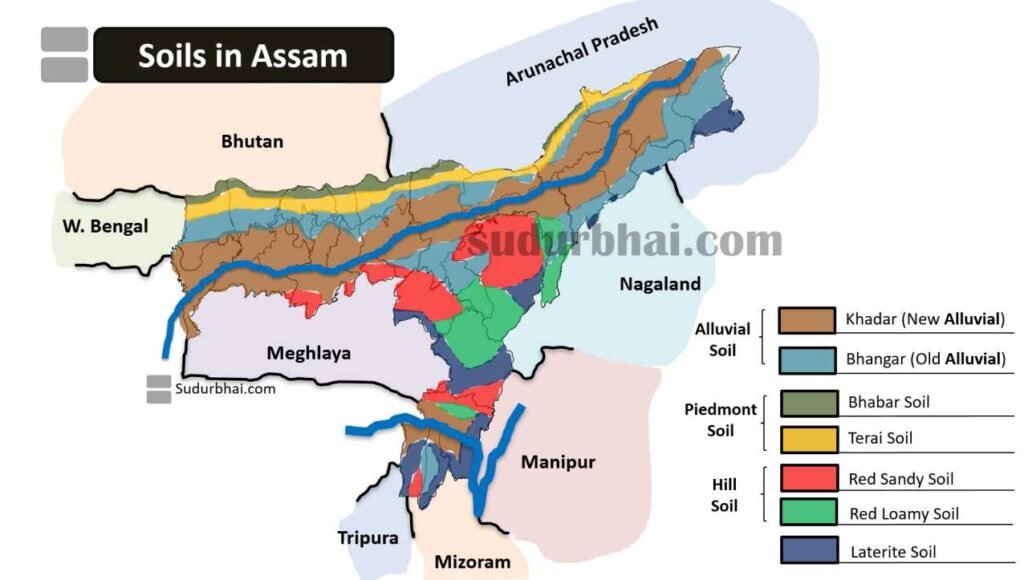
The soils of Assam are formed under diverse geological conditions, topographical features, heavy rainfall, humid climate, and rich vegetation cover. Assam’s soils are influenced by the Brahmaputra and Barak river systems, hilly terrains, and piedmont zones. A distinctive feature of most soils in Assam is their acidity, with pH ranging from 4.2 to 5.8 (except some flood plains with pH 6.0-6.5). Organic matter content is generally medium to high.

According to USDA Soil Taxonomy, major orders in Assam are:

        • Inceptisols (49.3%)
        • Entisols (32.3%)
        • Alfisols (12.3%)
        • Ultisols (6.1%)

Broadly, soils are classified into four major groups:

        1. Alluvial Soils,
        2. Piedmont Soils,
        3. Hill Soils, and
        4. Lateritic Soils.

1. Alluvial Soils

Distribution of Alluvial soils in Assam

    • Extensively distributed over the Brahmaputra Valley plains and Barak Valley plains.
    • Covers major parts of districts like Darrang, Kamrup, Lakhimpur, Goalpara, Dibrugarh, and parts of Garo Hills.
    • Formed by sediments deposits from the Brahmaputra, Barak, and their tributaries.
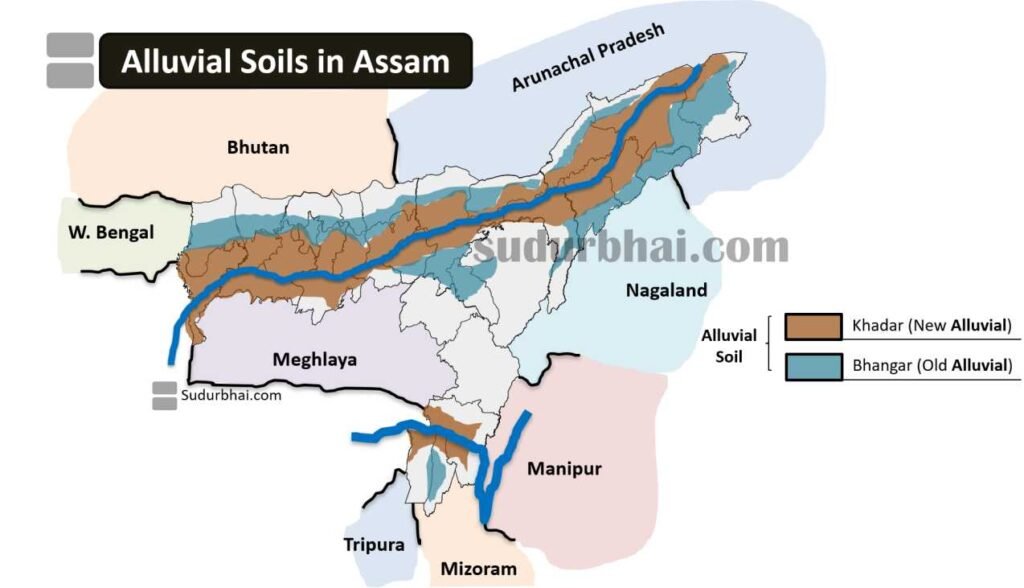
Sub-types of Alluvial soils in Assam

Sub-type Location Age of Deposits Colour Texture Depth pH
Younger Alluvium (Khadar)
Active flood plains and riverbanks
Recent deposits
Grey to mottled grey
Sandy to silty loam
Moderately deep to very deep
Slightly acidic
Older Alluvium (Bhangar)
Away from active flood zones
Older deposits
Brownish to yellowish-brown
Fine to coarse loam
Very deep
Slightly to moderately acidic

Characteristics

    • Highly fertile, rich in nitrogen, organic matter, potash, and lime.
    • Well-suited for multiple cropping due to good water retention and nutrient availability.
    • Upper Assam alluvial soils are deep, well-drained, with higher phosphoric content.

Agricultural Significance

    • Ideal for cereals (rice, wheat), pulses, oilseeds, plantation crops (tea), sugarcane, and vegetables.
    • Supports intensive agriculture; new alluvial in chars suitable for oilseeds, pulses, and rabi crops.
    • Tea plantations thrive in well-drained acidic alluvial soils of Upper Assam.

2. Piedmont Soils

Distribution of Piedmont soils in Assam

    • Confined to narrow zones along the northern foothills of the Himalayas (Assam-Arunachal border).
    • Includes Bhabar and Terai belts.
    • Extends east up to the Subansiri River.
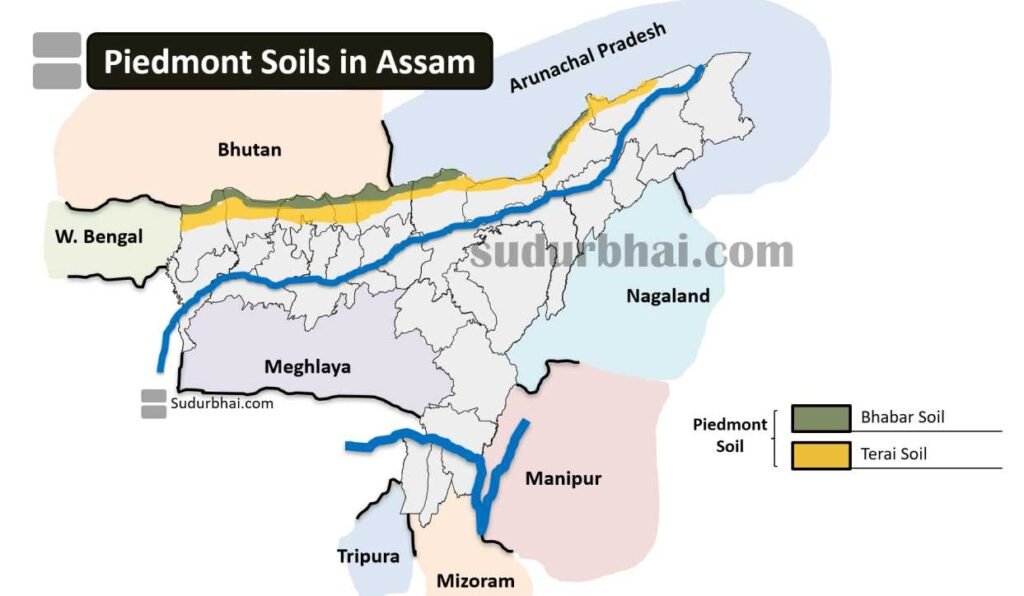
Sub-types of Piedmont soils in Assam

Sub-types Location Nature of Deposits Texture Drainage / Moisture Condition
Bhabar Soil
Narrow belt along the Himalayan foothills
Boulders, pebbles, cobbles, sand, silt
Coarse and highly porous
Excessively drained; low water retention
Terai Soils
Belt below the Bhabar zone
Finer alluvial deposits
Fine to medium texture
Poorly drained; swampy and waterlogged in parts

Characteristics of Piedmont soils in Assam

    • Very deep, fine to coarse loamy texture.
    • Lightly to moderately acidic.
    • Deficient in nitrogen, phosphoric acid, humus, and lime.

Agricultural Significance of Piedmont soils in Assam

    • Suitable for tea and forest plantations with amendments.
    • Often used for horticulture after drainage improvements.

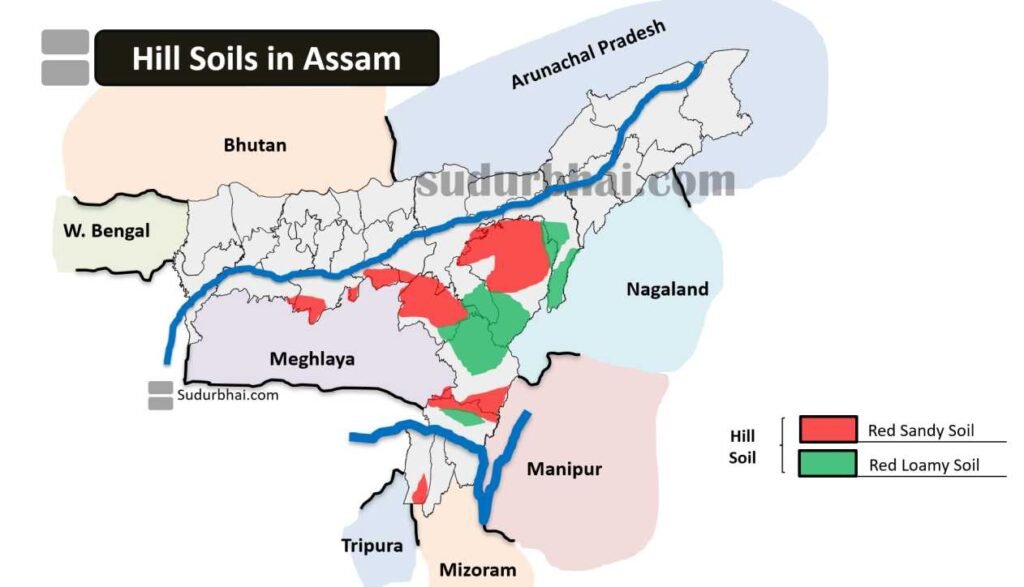
3. Hill Soils

Distribution of Hill Soils in Assam

    • Found in southern hilly regions: Karbi Anglong Plateau, Dima Hasao (North Cachar Hills), parts of Garo, Khasi-Jaintia, and Mizo Hills bordering Assam.

Sub-types of Hill Soils in Assam

Sub-types Location Nature of Deposits Texture
Red Sandy Soils
Narrow belt along Assam–Meghalaya border, Karbi Plateau, southern Barail Range, eastern Cachar foothills
Coarse
Low water-holding capacity, well-drained, generally less fertile
Red Loamy Soils
Southern foothill belts along Assam–Arunachal and Assam–Nagaland borders, fringes of Karbi Plateau and Barail Hills
Loamy (medium)
Better moisture retention, relatively more fertile than red sandy soils

Characteristics of Hill Soils in Assam

    • Deep, dark greyish-brown to red colour.
    • Fine to coarse loamy texture.
    • Acidic; deficient in nitrogen, phosphoric acid, humus, and lime.
    • Rich in iron oxides; porous and friable.

Agricultural Significance of Hill Soils in Assam

    • Suitable for shifting cultivation (jhum), horticultural crops (pineapple, orange), and forestry.
    • Terracing and manuring required for sustained productivity.
    • Supports tea in some elevated areas.

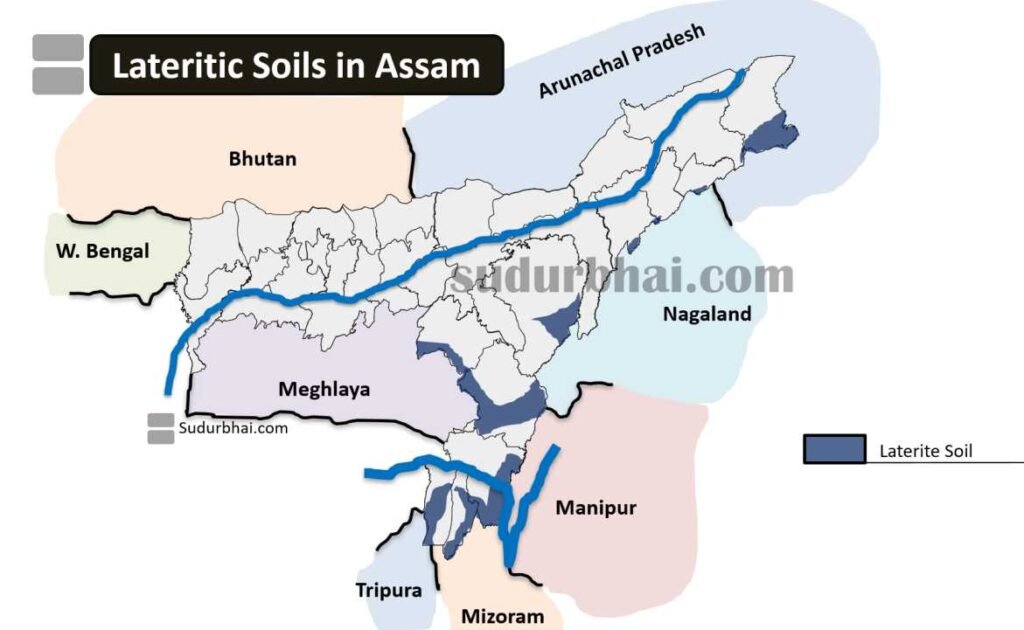
4. Lateritic Soils

Distribution

    • Predominantly in Dima Hasao (North Cachar Hills) district.
    • Patches in southern Karbi Plateau, Hamren sub-division (Karbi Anglong), southern Golaghat border, northern Barak Plain along Barail foothills.
    • Also in parts of Sibsagar, Nowgaon, Cachar.

Characteristics

    • Dark-coloured, heavy texture.
    • Rich in iron and aluminium oxides (due to leaching under high rainfall).
    • Highly acidic, porous, compact.
    • Deficient in nitrogen, potash, phosphoric acid, lime, and organic matter.
    • Hardens on exposure.

Agricultural Significance

    • Low fertility; suitable for tree crops like cashew (with amendments).
    • Limited agriculture; mainly forestry or plantation crops after heavy fertilization.

General Issues and Conservation of Soils in Assam

    • Soil Erosion: Prevalent due to heavy rainfall, deforestation, and jhum cultivation in hills; flood-induced erosion in plains.
    • Acidity and Nutrient Deficiency: Widespread acidity requires liming; deficiencies in N, P, K, and micronutrients (S, Zn, B) increasing due to intensive farming.
    • Conservation Measures: Terracing in hills, afforestation, contour bunding, flood control embankments, and balanced fertilizer use.

These soils contribute significantly to Assam’s agriculture, supporting rice (staple), tea (major export), and horticulture, making the state a key agricultural hub in Northeast India.

Leave a Comment

Your email address will not be published. Required fields are marked *

Scroll to Top