Jorhat District

Jorhat District

  • Location: In the northeastern state of Assam, India.
  • Established: 1983.
  • Significance: Known as the “Cultural Capital of Assam” with a rich cultural heritage, agriculture, and historical importance.

  History of Jorhat District

1. Early History & Ahom Rule

    • Chutiya Kingdom (Before 16th Century):
      • Jorhat was originally part of the Chutiya Kingdom, an important kingdom in Assam.

      • The Ahoms defeated the Chutiyas in the 16th century, bringing Jorhat under their rule.

    • Ahom Capital Shift (1794):
      • King Gaurinath Singha of the Ahom dynasty moved the capital from Sibsagar to Jorhat.

      • Jorhat became a political and commercial hub, with new roads, tanks (ponds), and markets.

      • The city flourished under Ahom rule, attracting traders and settlers.

2. Burmese Invasions & British Rule

    • Burmese Invasions (1817–1825):
      • Jorhat was repeatedly attacked and destroyed by the Burmese army.

      • The local population suffered, and the once-thriving city was in ruins.

      • In 1825, the British defeated the Burmese and took control of Jorhat.

    • British Administration & Revolts (1858):
      • Under British rule, Jorhat saw new administration and infrastructure development.

      • Local revolutionaries like Piyali Phukan, Gomdhar Konwar, and Jeuram Medhi resisted British rule.

      • During the 1858 Sepoy Mutiny, Maniram Dewan and Piyali Phukan were publicly executed for opposing the British.

This period shaped Jorhat’s historical significance, from being a powerful Ahom capital to a center of resistance against British rule.

  Geography of Jorhat District

    • Area: 2,851 square kilometers.
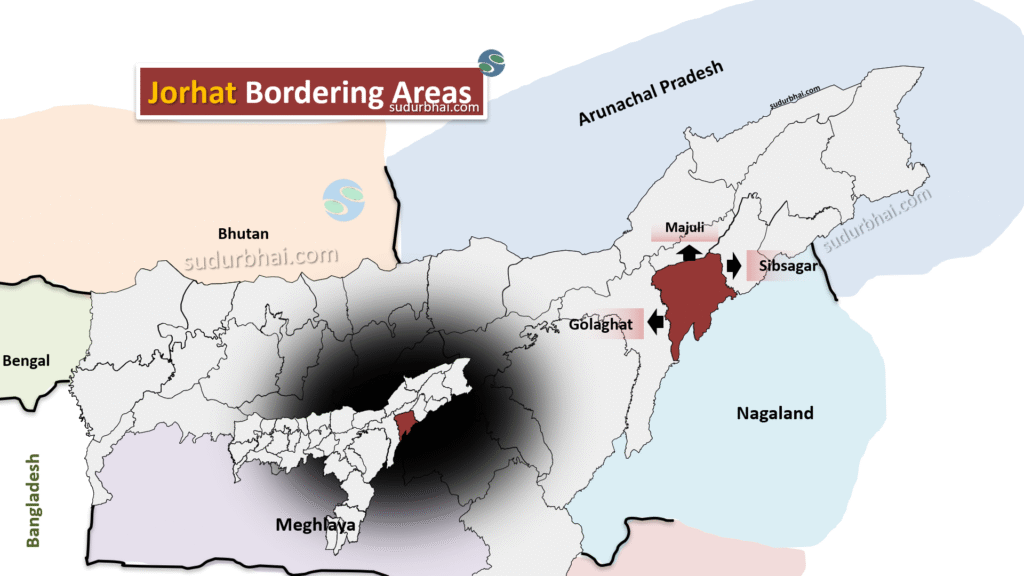
    • Boundaries:
      • North: Majuli district.
      • South: Nagaland.
      • East: Sivasagar district.
      • West: Golaghat district.
        Jorhat District
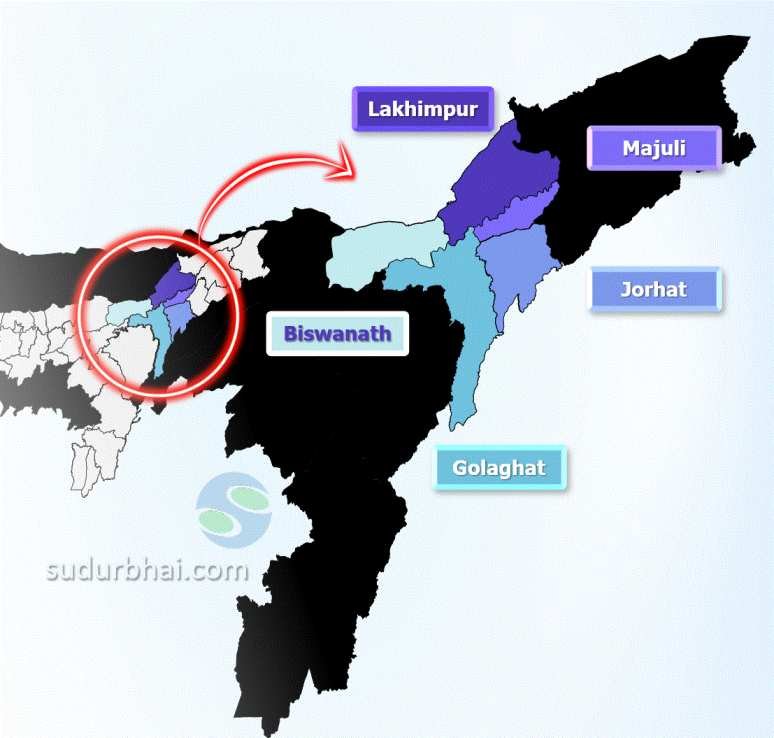
        Jorhat Neighbouring Districts
    • Topography: Mainly flat plains with some hilly areas, and fertile alluvial soil along the Brahmaputra River that supports agriculture.
    • Climate: Humid subtropical with 1,867 mm of annual rainfall (mostly during the monsoon, June to September).
    • Rivers : Brahmaputra (northern border), Bhogdoi, Kakodonga, Jhanji, Teok.
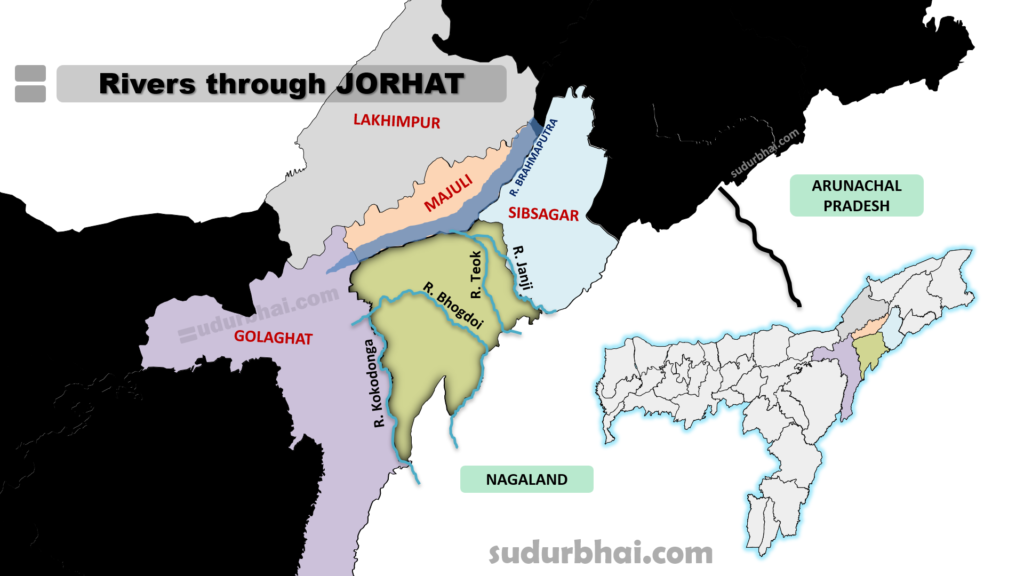
Rivers through Jorhat
Rivers through Jorhat District

  Socio Economy of Jorhat District

    • Economy: Primarily agrarian, with tea production being a major industry.
    • Major Crops: Rice, tea, jute, mustard, and various fruits.
      • Jorhat is a significant center for tea cultivation, home to Tocklai Experimental Station (a major tea research center).
    • Livestock: Includes cattle, goats, and poultry.
    • Small-scale Industries: Includes handicrafts, particularly bamboo and cane products.
    • Tourism: Jorhat has potential for tourism, with archaeological sites and natural attractions.

  Transport of Jorhat District

    • Roadways: The district is well-connected via National Highway 37, linking it to major cities.
    • Railways: The Jorhat railway station provides connectivity within Assam and beyond.
    • Airways: Rowriah Airport (Jorhat Airport) connects the district to Guwahati and other cities.

  Demographics of Jorhat District

Population Statistics

    • Total Population: 1,092,256

      • Male Population: 556,805 (50.93%)

      • Female Population: 535,451 (49.07%)

    • Population Density: 383 inhabitants per square kilometer

    • Urban Population: 220,534 (20.17%)

    • Rural Population: 871,722 (79.83%)

Sex Ratio

    • Overall Sex Ratio: 956 females per 1000 males

    • Urban Sex Ratio: 963 females per 1000 males

    • Rural Sex Ratio: 968 females per 1000 males

Literacy Rate

    • Overall Literacy Rate: 83.42%

      • Male Literacy Rate: 86.24%

      • Female Literacy Rate: 80.01%

Age Distribution

    • Children (0-6 years): 103,394 (9.45% of total population)

      • Child Sex Ratio: 968 girls per 1000 boys

Scheduled Castes and Scheduled Tribes

    • Scheduled Castes (SC): 64,787 (7.00%)

    • Scheduled Tribes (ST): 62,368 (6.74%)


      Religious Composition

      Religion

      Percentage

      Hinduism

      91.09%

      Islam

      5.85%

      Christianity

      2.25%

      Other/Not Stated

      0.81%

 Administrative Setup of Jorhat District

    • Sub-Divisions: Two sub-divisions – Jorhat and Majuli.
    • Revenue Circles: Five revenue circles – Jorhat, Teok, Golaghat, Majuli, and Mariani.
    • Development Blocks: Six blocks – Jorhat, Teok, Golaghat, Majuli (partially), Mariani (partially), and Bhogdoi.
    • Administrative Headquarters: Located in Jorhat city.

 Attractive Tourist places of Jorhat District

Historical and Cultural Sites:

    • Thengal Bhavan Built in 1880, this historical mansion belonged to Assamese writer Rai Bahadur Siva Prasad Barooah and now serves as a heritage site
    • Lachit Borphukan’s Maidam Constructed to honor Lachit Barophukan, who defeated the Mughal army in 1672
    • Burigosain Devalay An ancient temple dedicated to the goddess Burigosain, an incarnation of the goddess Kali
    • Hatibaruah Namghar A significant religious and cultural center and historical temple
    • Gazpur An ancient historical site near Jorhat, famous for its archaeological remains and ancient temples
    • Bangalpukhari A historic water tank believed to have been created during the reign of the Ahom king, Swargadeo Rudra Singha
    • Ladai Garh A historical fort known for its strategic importance during the Ahom rule
    • Raja Maidam A historical landmark
    • Sukapha Samannay Kshetra Another historical site/memorial to visit
    • Dhekiakhowa Bornamghar Jorhat A religious site

Nature and Wildlife:

    • Hoollongapar Gibbon Sanctuary A wildlife sanctuary
    • Molai Forest A man-made forest on Majuli Island, home to diverse flora and fauna
    • Majuli Island The world’s largest river island, also a center of neo-Vaishnavite pilgrimage
    • Kakochange Waterfall Known for its scenic beauty
    • Kaziranga National Park Features diverse animal life, including one-horned rhinoceroses, tigers, bisons, and elephants

 Languages spoken in Jorhat District

    • Assamese: 88.65%
    • Bengali: 3.77%
    • Hindi: 3.04%
    • Mising: 1.63%

Let us know any further suggestions ,we at sudurbhai.com will be happy to hear from you in our comment section below ! 

Leave a Comment

Your email address will not be published. Required fields are marked *

Scroll to Top