
The period between 1874 and 1905 marks a significant transformation in Assam’s administrative, economic, and political landscape. After decades under the Bengal Presidency, Assam was finally given a separate administrative identity, but this change also intensified colonial exploitation, demographic shifts, and popular resistance.
Formation of the Chief Commissioner’s Province (1874)
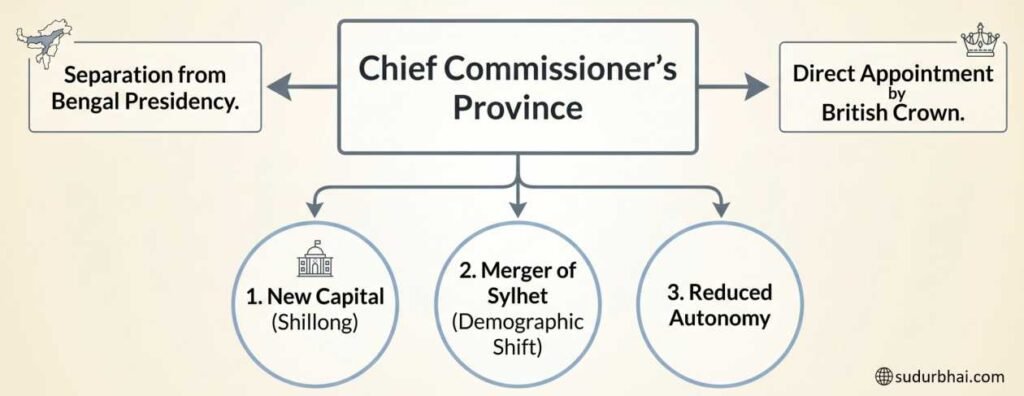
In 1874, Assam was separated from the Bengal Presidency and made a Chief Commissioner’s Province.
What does this mean?
- Assam was now governed by a Chief Commissioner, directly appointed by the British. i.e, Assam became Chief Commissioner’s Province.
- It had less autonomy compared to provinces governed by Governors.
- The administration remained highly centralized and colonial in nature.
Inclusion of Sylhet and Public Reaction
- The district of Sylhet was merged with Assam.
- This decision led to strong protests from the Sylheti population.
Why the protest?
- Sylhet had closer cultural and administrative ties with Bengal.
- People feared loss of identity and economic disadvantages.
This was one of the earliest instances where people protested against colonial boundary decisions, a trend that continued later in Indian history.
Shillong as the Capital
- The capital of Assam was established at Shillong.
- Chosen for:
- Cool climate
- Strategic location in the hills
Shillong soon developed into an important administrative and educational center, often called the “Scotland of the East.”
Language Reforms: Revival of Assamese Identity
One of the most significant cultural developments was the restoration of the Assamese language.
Background
- In 1837, Bengali was imposed as the official language.
- Assamese was sidelined in administration and education.
Change during this period
- Assamese was reinstated alongside Bengali.
Importance:
- Marked the beginning of linguistic revival and a phase of Assamese Renaissance
- Strengthened regional identity and pride
This revival encouraged the growth of Assamese literature, newspapers, and education, helping preserve local culture.
Economic Developments: Rise of Extractive Industries
The British transformed Assam into a resource-rich colonial economy, focusing on extraction rather than development.
(A) Discovery of Oil at Digboi (1889)
- Oil was discovered in Digboi in 1889.
- It became one of the earliest oil fields in Asia.
Significance:
- Foundation of the Assam oil industry
- Attracted British investment and infrastructure
In the late 19th century, British engineers laying railway tracks in Upper Assam noticed elephants returning with footprints soaked in black, oily mud. Identifying potential petroleum, engineer Willie Lake urged local labourers to dig, shouting, “Dig, boy, dig!”. This frequent command became synonymous with the area, leading to the name Digboi.
(B) Expansion of Tea and Coal Industries
- Tea plantations expanded rapidly.
- Coal mining also developed in regions like Makum.
Reality Check:
- These industries were controlled by British companies
- Profits were sent to Britain (Drain of Wealth)
Even though Assam produced tea and oil, local farmers and workers remained poor.
Demographic and Agricultural Changes
Colonial policies caused major demographic shifts in Assam.
Decline of Indigenous Population
- Many local people suffered due to:
- Starvation
- Poor living conditions
- Areas like Nagaon were badly affected.
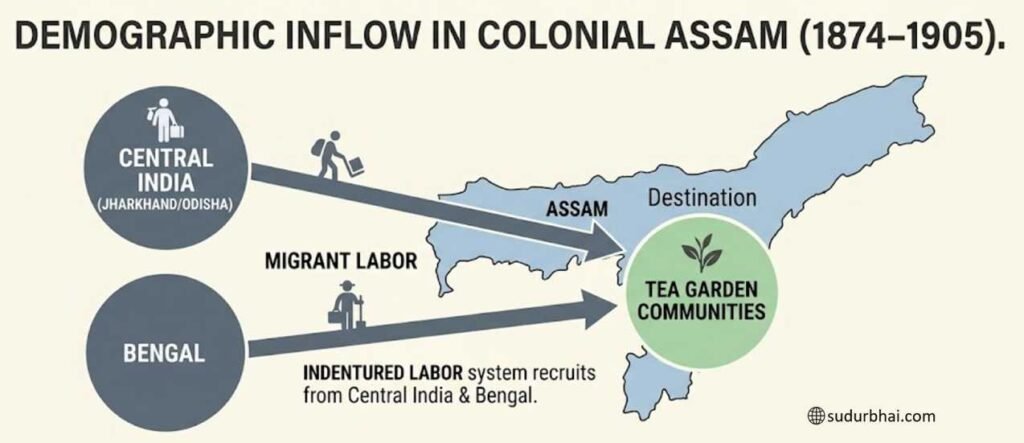
Inflow of Immigrant Labour
- Laborers were brought from Central India and Bengal.
- Mainly employed in tea plantations.
Impact:
- Created long-term demographic changes
- Led to future social and political tensions
Tea garden communities in Assam today trace their origins to these migrant laborers.
Rural Distress and Agrarian Unrest
Despite industrial growth, the agrarian population suffered greatly.
Causes of Peasant Distress
| Cause | Explanation |
|---|---|
| High Taxation | Heavy land revenue burden on farmers |
| Opium Monopoly | British controlled opium trade, affecting local economy |
| Moneylenders | High-interest loans trapped peasants in debt |
Raiz Mels and the Patharughat Uprising (1894)
What are Raiz Mels?
- Traditional people’s assemblies
- Villagers gathered to discuss and decide collective action
The Patharughat Uprising (1894)
- Took place in Darrang district
- Peasants protested against increased taxes
What happened?
- British forces opened fire on unarmed peasants
- Around 15 people were killed
- Many were:
- Tortured
- Arrested
- Their homes looted
This incident is often compared to later events like Jallianwala Bagh, as it involved brutal suppression of peaceful protest.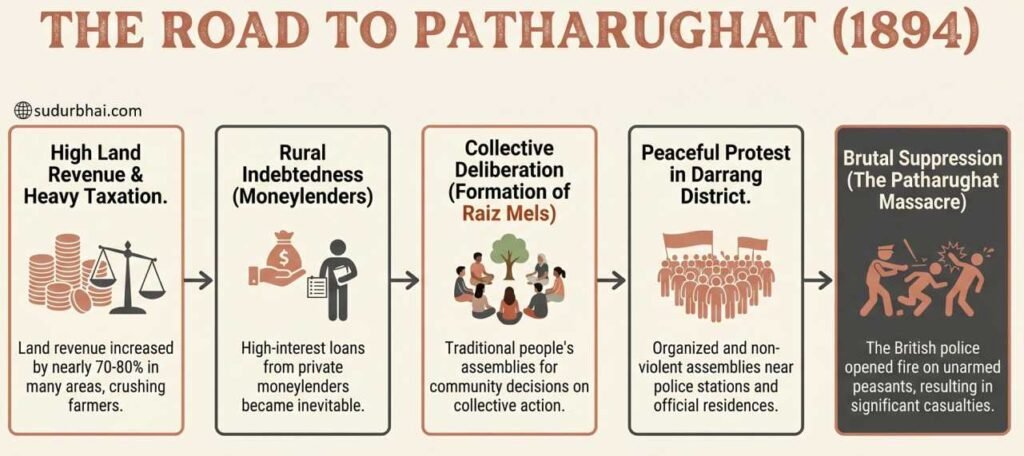
Rise of Political Consciousness
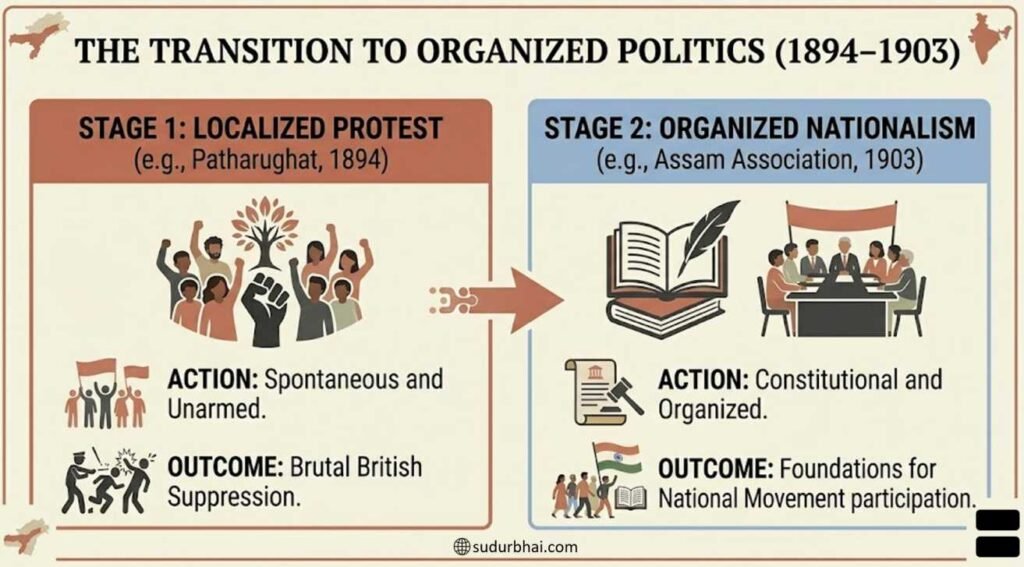
By the early 20th century, people in Assam began organizing politically.
Formation of the Assam Association (1903)
- First political organization in Assam
- Manik Chandra Baruah became its first secretary
Objectives:
- Represent Assamese interests
- Raise issues with the British government
- Promote political awareness
Importance:
- Marked the beginning of organized political movements in Assam
- Laid the foundation for later participation in the Indian National Movement
Summary
| Aspect | Key Developments | Impact |
|---|---|---|
| Administration | Separate province, Shillong capital | Centralized control |
| Language | Assamese reinstated | Cultural revival |
| Economy | Tea, oil, coal industries | Resource exploitation |
| Demography | Migration and population shifts | Social changes |
| Agriculture | Heavy taxation, opium monopoly | Rural distress |
| Resistance | Patharughat uprising | Anti-colonial sentiment |
| Politics | Assam Association (1903) | Political awakening |
The Chief Commissioner’s Province era (1874–1905) was a mixed phase in Assam’s history:
Positive Developments
- Administrative recognition of Assam
- Growth of industries like tea, oil, and coal
- Revival of Assamese language and identity
Negative Realities
- Economic exploitation by the British
- Peasant suffering and revolts
- Marginalization of local people
While the British developed infrastructure and industries, their primary goal was resource extraction, not the welfare of Assam’s people. This led to resistance, awareness, and eventually political mobilization.