
The period between 1826 and 1873 marks a crucial phase in the history of Assam when it was brought under the administrative control of the Bengal Presidency. This era witnessed economic restructuring, rise of plantation economy, exploitation of labor, and early resistance movements against colonial rule. Policies like the Wasteland Rules, import of indentured labor, and revenue reforms triggered widespread discontent, leading to early revolts such as those by Gomdhar Konwar and the Phulaguri uprising against colonial oppression.
Assam as Part of the Bengal Presidency
After the Treaty of Yandabo (1826), Assam was officially incorporated into the Bengal Presidency, one of the major administrative divisions of British India.
Key Features of This Phase
- Assam was governed centrally from Calcutta (Kolkata), far from its local realities.
- Policies were designed primarily for British economic interests, not for local welfare. This led to their economic exploitation.
- Assamese people had little to no representation in governance.
Decisions regarding Assam’s land and economy were often taken in Bengal without understanding local conditions, which led to mismanagement and resentment among the people.
Development of the Tea Industry in Assam
One of the most significant transformations during this period was the rise of the tea plantation industry, which changed Assam’s economy forever.
(A) Beginnings of Tea Cultivation
- Tea cultivation began around 1837 in Upper Assam.
- The discovery of indigenous tea plants attracted British attention.
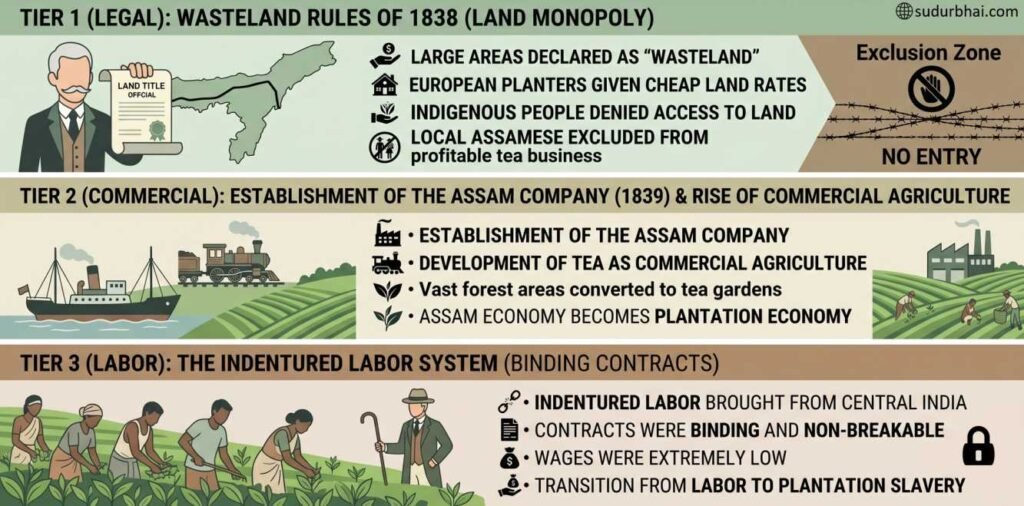
- In 1839, the Assam Company was established to commercialize tea production.
- This led to the development of Tea as Commercial Agriculture. And Assams Economy becamePlantation Economy.
The British converted vast forest areas into tea gardens, especially in regions like Dibrugarh and Sivasagar.
(B) Wasteland Rules (1838): Land Monopoly
The Wasteland Rules of 1838 played a major role in shaping land ownership.
Features:
- Declared large areas as “wastelands”
- These lands were given to European planters at cheap rates
- Indigenous people were denied access to land
Impact:
- Creation of a land monopoly by Europeans
- Local Assamese were excluded from profitable tea business
Even if a local farmer wanted to start a tea plantation, he could not get land, while British planters got thousands of acres easily.
(C) Liberalisation of Land Policy (1854)
- In 1854, restrictions were relaxed.
- This led to a “land rush”, with more investors entering tea cultivation.
- However, benefits still largely went to British investors, not locals.
Labor Policies and Exploitation
The success of tea plantations depended on cheap and controlled labor, which led to severe exploitation.
(A) Early Labor Experiments
- Initially, Chinese laborers were brought due to their expertise.
- They left Assam by 1843 due to harsh conditions.
- Later, local tribes like the Kacharis were employed.
(B) Import of Indentured Labor (From 1859)
- Laborers were brought from Central India (Jharkhand, Odisha, Chhattisgarh).
- They worked under indentured contracts (Labour contract that creates a binding, involuntary obligation to labor, typically lasting several years).
Features of the System:
- Contracts were binding and non-breakable
- Workers had no freedom to leave
- Wages were extremely low. This led to Plantation Slavery.
A laborer who signed a contract could not return home even if treated badly—similar to bonded labor.
(C) Horrific Transportation Conditions
- The journey to Assam was extremely dangerous.
- Around 10% of laborers died during transit.
- Many laborers died due to:
- Disease
- Starvation
- Overcrowded transport
British Economic Monopoly
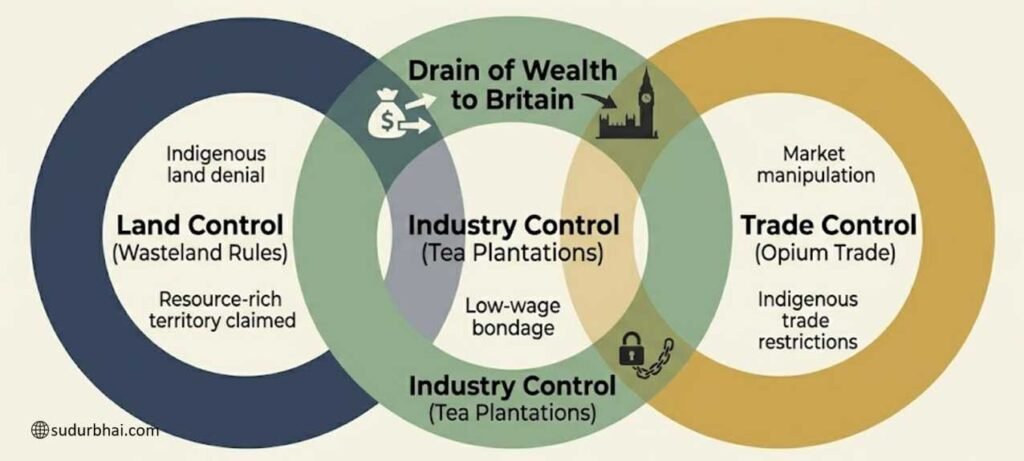
The British established a complete economic monopoly over Assam’s resources.
Key Areas of Control
- Tea Industry
- Opium Trade
Impact
- Local people were excluded from profitable sectors
- Wealth generated in Assam was drained to Britain
Even though tea was grown in Assam, most profits went to British companies, not Assamese farmers.
Early Resistance and Revolts in Assam
Colonial exploitation led to early resistance movements, showing that opposition to British rule began much earlier than the national freedom struggle.
(A) Revolt of Gomdhar Konwar (1828)
- One of the first revolts after British occupation.
- Attempted to restore Ahom rule.
- Suppressed quickly by the British.
(B) Revolt of 1830
The Revolt of 1830 in Assam was an early armed uprising against British colonial rule, primarily led by members of the former Ahom nobility. It was a continuation of resistance efforts following the annexation of Assam by the British after the Treaty of Yandabo in 1826.
Leaders:
- Dhananjoy Burhagohain
- Piyali Phukan
- Jiuram Medhi
Outcome:
- All were captured and executed
These revolts showed that Assamese nobility resisted loss of power.
(C) Role in the Revolt of 1857
While the major armed uprisings during Revolt of 1857 were concentrated in North and Central India, Assam’s resistance was largely intellectual, conspiratorial, and “silent,” led by local elites attempting to restore Ahom rule.
- Assam did not witness large-scale rebellion.
- However, there was silent resistance and non-cooperation.
Key Figures:
- Maniram Dewan
- Piyali Baruah
Outcome:
- Both were executed by the British
(D) Phulaguri Uprising (1861)
- Took place in Nagaon district
- Peasants gathered in a Raiz Mel (people’s assembly)
Cause:
- Taxes on betel nut and paan
What happened?
- Clash between peasants and British officer Lt. Singer
- Lt. Singer was killed
- British responded with brutal suppression
This was one of the earliest examples of organized peasant protest in Assam.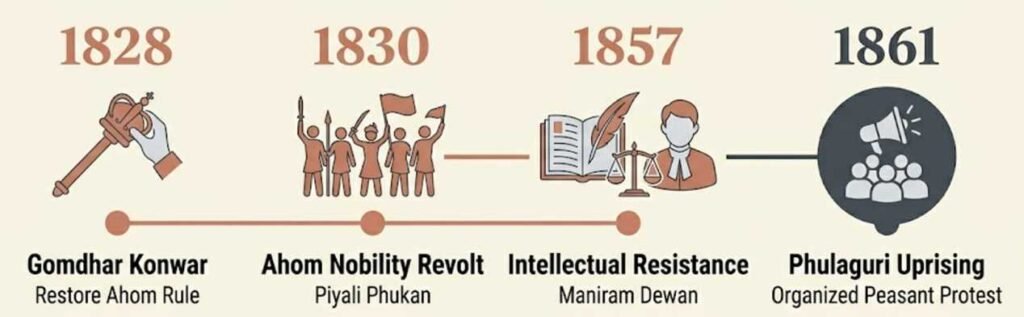
Key Developments (1826–1873)
| Aspect | Key Features | Impact on Assam |
|---|---|---|
| Administration | Under Bengal Presidency | Loss of autonomy |
| Tea Industry | Rise of plantations, Assam Company | Economic transformation |
| Land Policies | Wasteland Rules, land monopoly | Exclusion of locals |
| Labor System | Indentured labor, exploitation | Human suffering |
| Economic Control | Monopoly over tea and opium | Wealth drain |
| Resistance | Revolts (1828–1861) | Rise of anti-British sentiment |
The period of Bengal Presidency rule in Assam (1826–1873) was marked by:
- Economic exploitation through tea plantations
- Severe labor oppression
- Marginalization of local people
- Emergence of early resistance movements
Although the British introduced commercial agriculture and new administrative systems, these changes primarily served colonial interests, not the people of Assam.