The establishment of British rule in Assam was not a sudden event but a gradual process of conquest, diplomacy, and political manipulation. Between 1826 and 1854, the British systematically dismantled traditional kingdoms and replaced them with a centralized colonial administration.
Think of it like a chess game — instead of attacking everything at once, the British made careful, step-by-step moves, weakening their opponents before taking control.
Background: First Anglo-Burmese War (1824–1826)
The roots of British rule in Assam lie in the First Anglo-Burmese War (1824–1826) — a crucial turning point in Northeast Indian history.
Why did the war happen?
- The Burmese Empire had aggressively expanded into Assam, Manipur, and Bengal frontiers.
- This expansion threatened the interests of the British East India Company.
- Frequent border conflicts escalated into a full-scale war.
What happened during the war?
- By 1825, British forces successfully drove out the Burmese army from the Brahmaputra Valley.
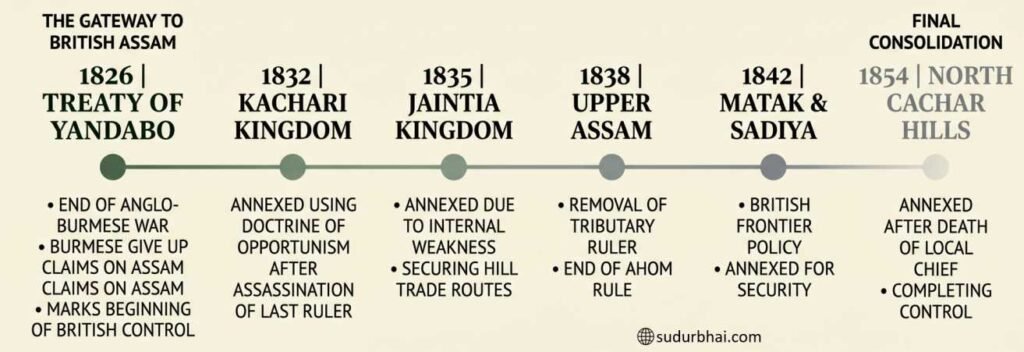
- The war ended with the historic Treaty of Yandabo (1826).
Key Outcomes of the Treaty of Yandabo
- The Burmese king Bagyidaw gave up all claims over Assam.
- Assam officially came under British control.
- This marked the beginning of British political intervention in Assam.
Before British arrival, Assam had multiple independent kingdoms like the Ahoms, Kacharis, and Jaintias. After 1826, these kingdoms gradually lost their sovereignty.
Gradual Expansion of British in Assam: Political Annexations
After gaining control, the British followed a strategy of “divide, weaken, and annex”. Instead of conquering everything at once, they targeted one region at a time by following a smart policy, they ;
- Observed weaknesses
- Intervened politically
- Took control step by step
(A) Annexation of the Kachari Kingdom (1832)
- The Kachari Kingdom was located in southern Assam.
- In 1830, its last ruler Govinda Chandra was assassinated.
- The British used this political instability as an excuse to annex the kingdom in 1832.
- This is often termed as Doctrine of Opportunism (though informal, British often used instability as justification)
Whenever a ruler died without a strong successor, the British stepped in claiming to “restore order,” but actually took control of the territory.
(B) Installation and Removal of Purandar Singha (1833–1838)
- In 1833, the British tried indirect rule by installing Purandar Singha, an Ahom prince, as a tributary ruler to rule a Tributary State.
Conditions imposed on him:
- He had to pay annual revenue to the British.
- He had limited administrative authority.
Why was he removed?
- Administrative inefficiency
- Failure to pay revenue
In 1838, the British annexed Upper Assam, ending Ahom rule permanently.
This shows how the British first experimented with indirect control, and when it failed, they imposed direct rule.
(C) Annexation of the Jaintia Kingdom (1835)
- The Jaintia Kingdom covered areas of present-day Meghalaya and Assam.
- Annexed in 1835 due to:
- Internal political weakness
- British interest in controlling hill trade routes
- Result: The Khasi–Jaintia Hills came under British control.
Control over hills helped the British monitor tribal movements and secure trade routes, especially for resources like lime and minerals.
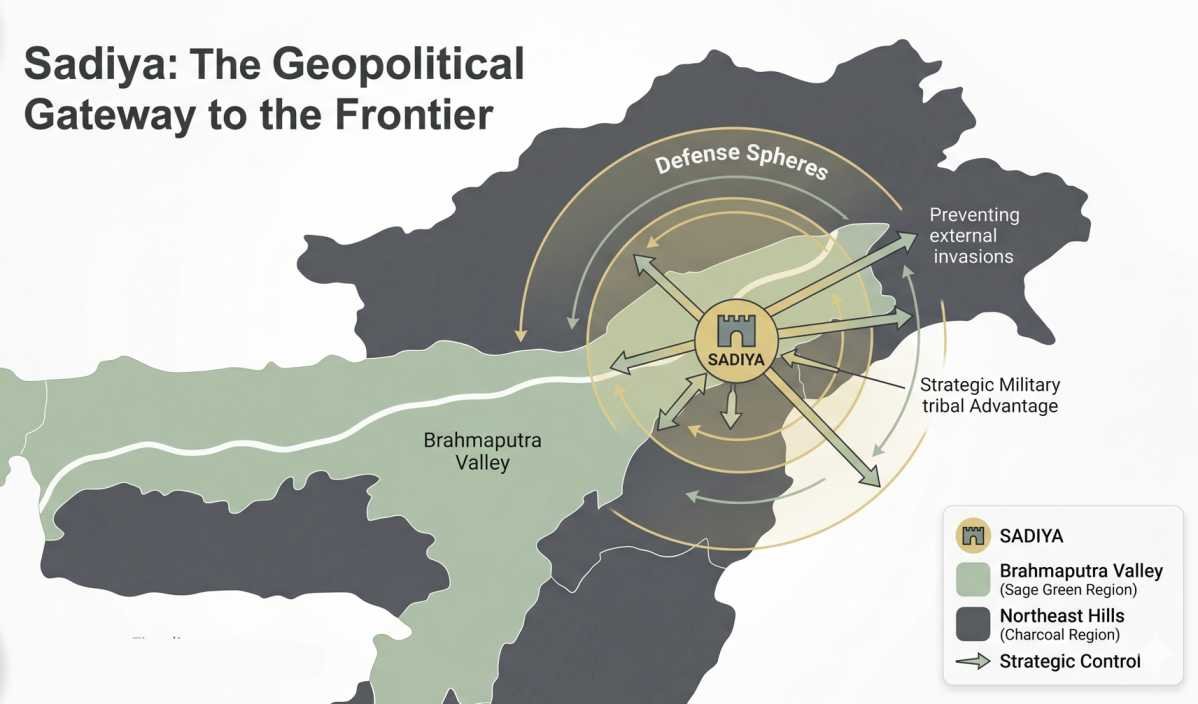
(D) Annexation of Matak and Sadiya Regions (1842)
- These regions were ruled by local tribal chiefs and were semi-autonomous.
- In 1842, the British annexed them to:
- Strengthen frontier security
- Prevent external invasions
- This was British’s Frontier Policy to have a Strategic control and expansion over the region.
Sadiya was an important gateway to Northeast frontier areas, so controlling it meant military advantage.
(E) Annexation of North Cachar Hills (1854)
- Ruled by Tularam Senapati, a local chief.
- After his death, the British annexed the region in 1854.
- This was the final step in consolidating British power in Assam.
Summary
| Region/Kingdom | Year | Reason for Annexation | Impact |
|---|---|---|---|
| Kachari Kingdom | 1832 | Death of ruler, political instability | Expansion into Southern Assam |
| Upper Assam (Ahom) | 1838 | Failure of tributary system | End of Ahom rule |
| Jaintia Kingdom | 1835 | Internal weakness, strategic interest | Control over Khasi-Jaintia Hills |
| Matak & Sadiya | 1842 | Frontier security | Strengthened border control |
| North Cachar Hills | 1854 | Death of ruler (Tularam) | Final consolidation |
Methods Used by the British for Consolidation
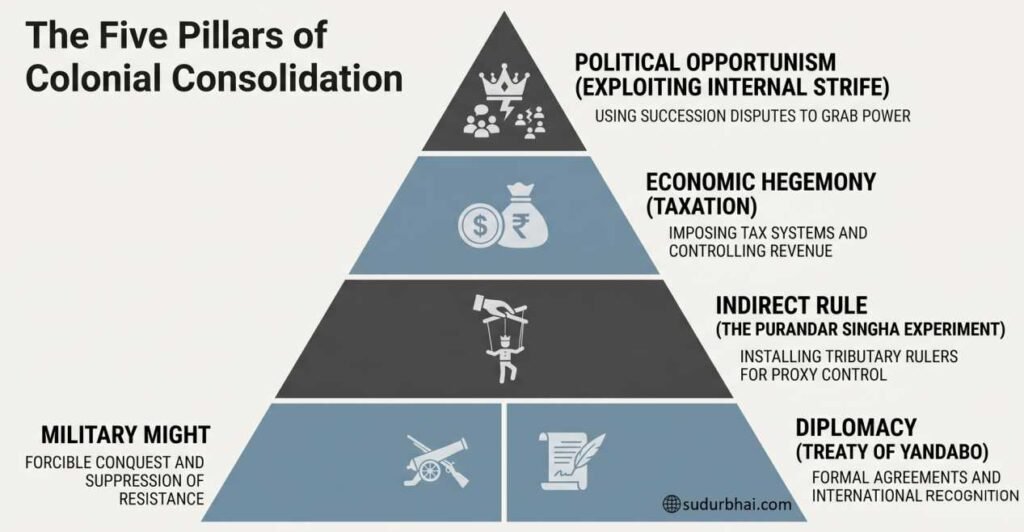
The British did not rely only on war. They used multiple strategies:
(1) Military Power
- Defeated Burmese forces
- Suppressed local resistance
(2) Diplomatic Agreements
- Example: Treaty of Yandabo
(3) Indirect Rule
- Installing rulers like Purandar Singha
(4) Economic Control
- Imposed taxation and revenue systems
(5) Exploiting Weaknesses
- Took advantage of:
- Succession disputes
- Internal conflicts
Impact of British Rule in Assam
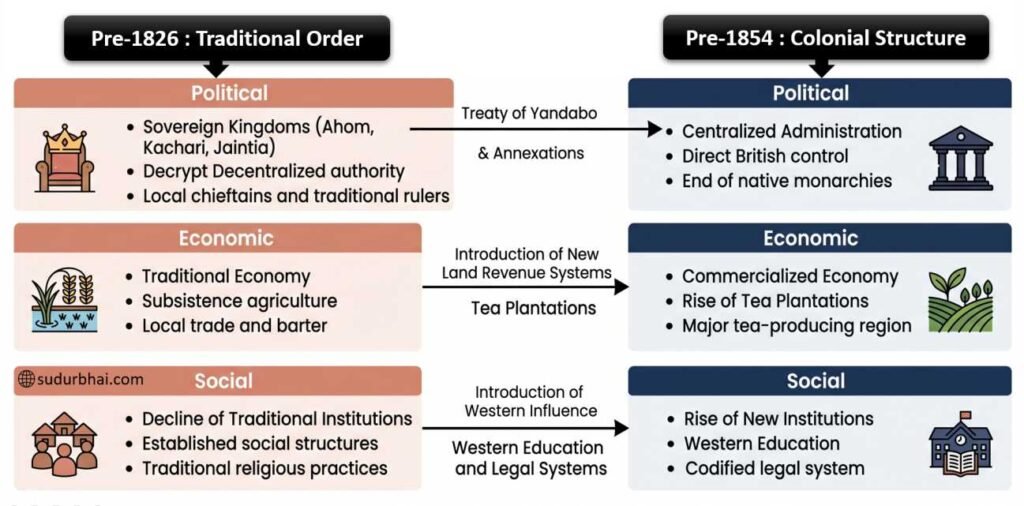
Political Impact
- End of traditional kingdoms like Ahom, Kachari, and Jaintia
- Introduction of centralized colonial administration
Economic Impact
- Beginning of tea plantations (later major industry)
- New land revenue systems
Social Impact
- Decline of traditional institutions
- Introduction of Western education and legal systems
The British later developed Assam into a major tea-producing region, changing its economic structure permanently.
By 1854, the British had successfully:
- Annexed all major regions of Assam
- Eliminated local rulers
- Established a strong administrative system
The consolidation of British rule in Assam was a systematic and strategic process, combining:
- War
- Diplomacy
- Political manipulation