
End of Kamarupa and Rise of Successor States

End of Kamrupa and Rise of Successor States

The Kingdom of Kamarupa had been one of the most powerful political entities in ancient northeastern India. From the early centuries of the Common Era until the 12th century, it controlled large parts of the Brahmaputra valley, maintaining diplomatic relations with powerful states such as North Indian kingdoms and Tibet. However, after the decline of the Pala dynasty of Kamarupa, the once unified state gradually weakened.

Instead of a single central authority, the region began to fragment into several smaller kingdoms and regional chieftaincies. This transition period, spanning roughly the 12th to 14th centuries, marks the transformation of Assam from an ancient centralized kingdom into a mosaic of regional powers.

Political instability, feudal rivalries, tribal autonomy, and foreign invasions all contributed to the collapse of the classical Kamarupa state and the emergence of new political formations that shaped the medieval history of Assam.
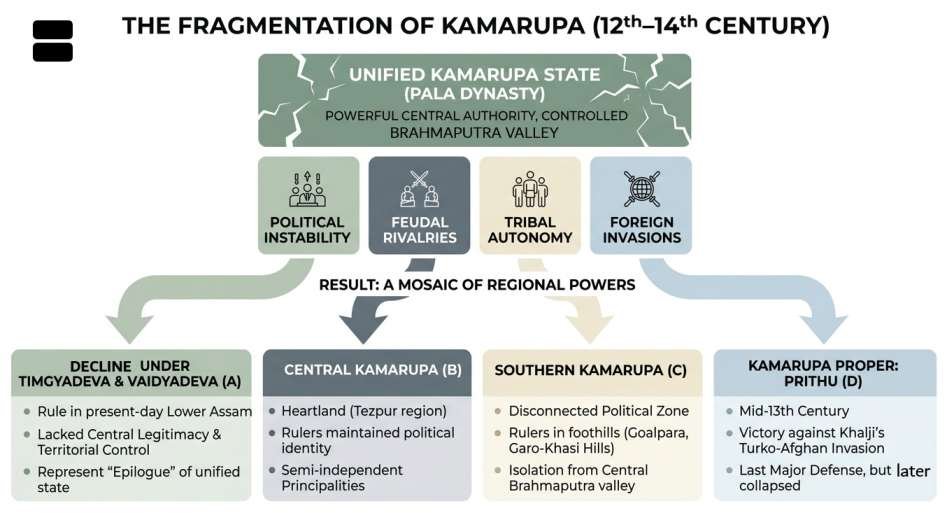
It can be further understood under following subheadings ;

A. Decline under Timgyadeva and Vaidyadeva.

B. Central Kamarupa (Bhaskara to Vallabhadeva)

C. Southern Kamarupa (Kharabana to Kesavadeva)

D. Kamarupa Proper: Prithu and Turko-Afghan Invasions

E. Rise of Sandhya and Formation of the Kamata Kingdom.

F. Emergence of Regional Powers

A. Decline under Timgyadeva and Vaidyadeva

The first clear signs of the decline of Kamarupa appear in the reigns of rulers such as Timgyadeva and Vaidyadeva, who governed parts of the old kingdom after the fall of the Palas.

Rule of Timgyadeva

Timgyadeva ruled in the western regions of the former Kamarupa territory, particularly in areas corresponding to present-day Lower Assam.

  • His existence is known mainly from inscriptions and land grants discovered in the region.

  • These records show that he attempted to exercise royal authority, but his power was largely regional rather than imperial.

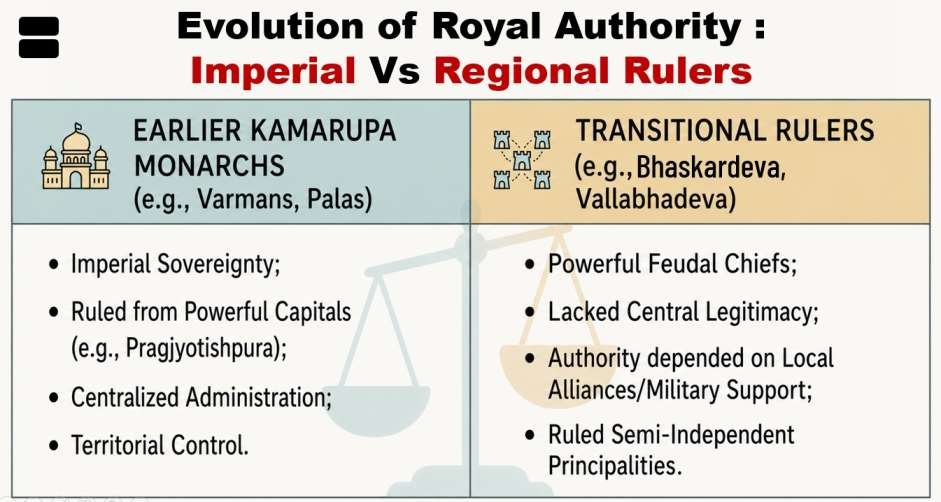
Unlike earlier Kamarupa monarchs who ruled from powerful capitals such as Pragjyotishpura, Timgyadeva lacked central legitimacy and territorial control.

Rule of Vaidyadeva

Another important ruler of this transitional period was Vaidyadeva, who governed during the mid-12th century.

  • Vaidyadeva issued several land grants to Brahmins, a common method used by rulers to legitimize authority.

  • He also performed ritual ceremonies and religious donations to strengthen his political image.

However, historians believe that Vaidyadeva was more of a powerful feudal chief than a sovereign monarch. His authority likely depended on local alliances and military support rather than centralized administration.

Historical Significance

The reigns of Timgyadeva and Vaidyadeva represent the final phase of Kamarupa’s political unity. Their rule reflects a period of decentralization, where multiple regional leaders exercised control over fragments of the former kingdom.

For this reason, historians often describe their reigns as the epilogue” of the classical Kamarupa state.

B. Central Kamarupa (Bhaskara to Vallabhadeva)

Even after the collapse of central authority, the heartland of Kamarupa, especially the region around Tezpur and the central Brahmaputra valley, continued to be ruled by local successors.

A line of rulers—from Bhaskaradeva to Vallabhadevamaintained political authority in this region.

These kings continued many traditional practices of earlier Kamarupa rulers, including:

    • Issuing inscriptions and copperplate land grants

    • Using Sanskritic royal titles

    • Patronizing Brahmanical religious institutions

However, their power was far more limited than that of earlier dynasties like the Varmans and Palas.

Instead of ruling a large kingdom, these kings probably controlled small semi-independent principalities centred around particular cities or fertile regions.

This phase therefore represents the survival of Kamarupa’s political identity, even though the actual unified state had disappeared.
C. Southern Kamarupa (Kharabana to Kesavadeva)

While the central region struggled to maintain continuity, southern Kamarupa developed its own independent lineage of rulers.

This branch included kings such as:

    • Kharabana

    • Samalavarman

    • Kesavadeva

Although historical records about them are limited, inscriptions indicate that they ruled areas located near the southern hills and foothills of present-day Assam and Meghalaya.

Their capitals remain uncertain, but historians believe they may have been located in regions near Goalpara and the Garo-Khasi hills.

These rulers continued to:

    • Issue donative inscriptions

    • Claim descent from earlier Kamarupa dynasties

    • Maintain Brahmanical rituals and royal traditions

However, their territories were isolated from the central and eastern Brahmaputra valley, highlighting the political fragmentation of the region.

Thus, southern Kamarupa represents a separate and disconnected political zone, reflecting the breakdown of the earlier unified state.

D. Kamarupa Proper: Prithu and Turko-Afghan Invasions

One of the most dramatic episodes in the final phase of Kamarupa occurred during the reign of Prithu, who ruled in the mid-13th century.

He is remembered primarily for his conflict with Muhammad Bakhtiyar Khalji, a powerful general of the Delhi Sultanate.

Bakhtiyar Khalji’s Invasion

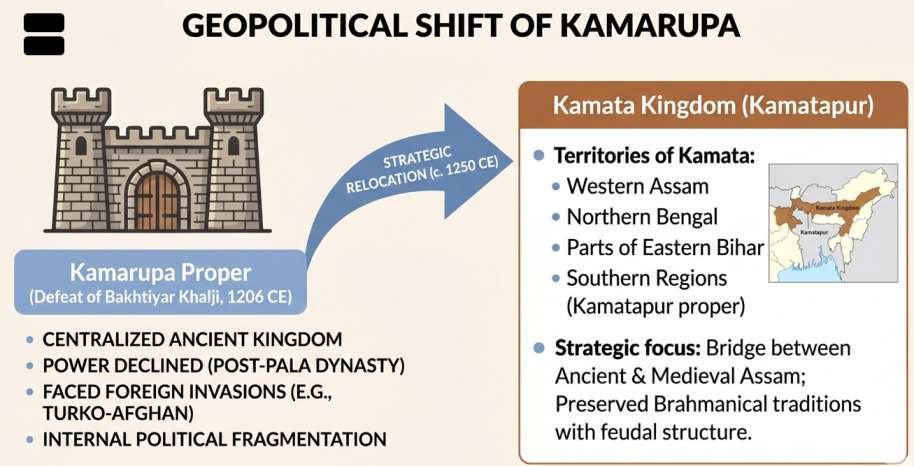
Around 1206 CE, Bakhtiyar Khalji attempted to invade the eastern regions of India, including Assam.

However, his expedition into the difficult terrain of the Brahmaputra valley faced serious challenges:

    • Dense forests and rivers

    • Difficult climate and unfamiliar geography

    • Strong resistance from local forces

King Prithu successfully defeated Khalji’s army, forcing the invader to retreat. Khalji later died soon after the failed campaign.

Historical Importance

Prithu’s victory was significant because it:

    • Prevented early expansion of the Delhi Sultanate into Assam

    • Demonstrated the military resilience of local Assamese rulers

    • Marked the last major defense of the classical Kamarupa kingdom

However, despite this success, the state structure of Kamarupa soon collapsed due to continued internal divisions and lack of strong dynastic succession.

Thus, Prithu’s reign represents both a moment of resistance and the final chapter of ancient Kamarupa.

E. Rise of Sandhya and Formation of the Kamata Kingdom

Following the decline of Kamarupa, a new political centre emerged under Sandhya.

Around 1250 CE, Sandhya moved his capital from the old Kamarupa region to Kamatapur in present-day North Bengal.

This strategic relocation helped him establish the Kamata Kingdom, which soon became a powerful state in eastern India.

The Kamata Kingdom controlled territories including:

    • Western Assam

    • Northern Bengal

    • Parts of eastern Bihar

Sandhya’s kingdom served as an important bridge between ancient and medieval Assam, preserving many Brahmanical traditions while adopting a more feudal political structure.

This shift also laid the foundation for later dynasties such as the Koch rulers.
F. Emergence of Regional Powers

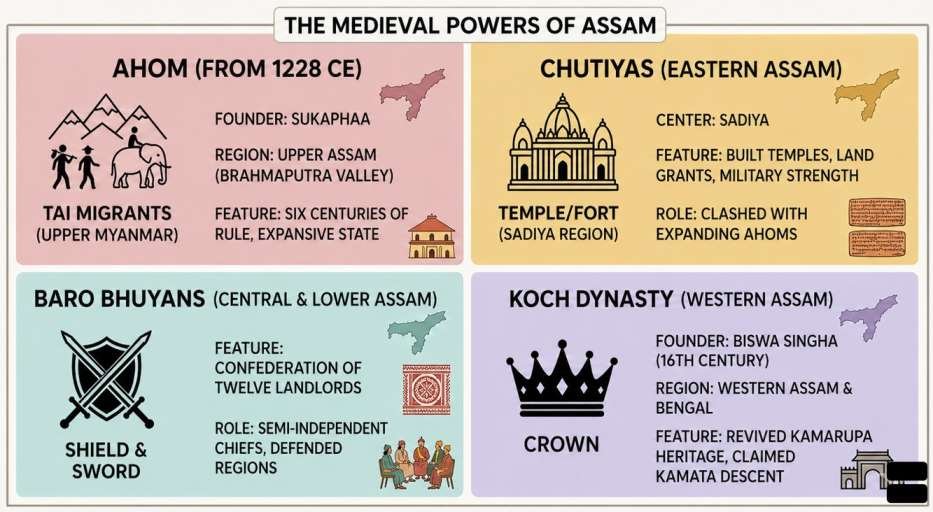
With the disappearance of Kamarupa’s centralized authority, several new regional kingdoms and confederations rose to power across Assam.

These states shaped the medieval political landscape of the region.

1. Ahoms (From 1228 CE)

  • One of the most significant new powers was founded by Sukaphaa.
  • In 1228 CE, Sukaphaa led a group of Tai migrants from Upper Myanmar into the Brahmaputra valley.
  • They established the Ahom Kingdom, which gradually expanded across Upper Assam.
  • The Ahoms eventually built a powerful state that ruled Assam for nearly six centuries, making it one of the longest-lasting kingdoms in Indian history.

2. Chutiyas

Another important regional kingdom was the Chutiya Kingdom, centred around Sadiya in eastern Assam.

The Chutiya rulers were known for:

    • Constructing temples

    • Issuing copperplate land grants

    • Maintaining military strength

They frequently clashed with the expanding Ahom kingdom.

3. Baro Bhuyans

  • In central and lower Assam, political authority often rested with a confederation known as the Baro Bhuyans.
  • The term literally means Twelve Landlords.”
  • These chiefs controlled local territories and acted as semi-independent rulers, forming alliances to defend their regions from external threats.
  • They played a crucial role as intermediate powers between larger kingdoms.

4. Koch Dynasty

  • By the 16th century, a new power emerged under Biswa Singha.
  • He founded the Koch Kingdom, which controlled large areas of western Assam and Bengal.
  • The Koch rulers claimed descent from the earlier Kamata kingdom, thereby reviving elements of Kamarupa’s political heritage.
The end of Kamarupa did not mark the disappearance of Assamese political traditions. Instead, it led to a period of transformation and regionalization.

Power shifted from a centralized ancient kingdom to a network of regional states and tribal polities. These included the Kamata kingdom, Ahoms, Chutiyas, Baro Bhuyans, and Koch dynasty, each contributing to the development of medieval Assam’s political identity.

Thus, the fall of Kamarupa represents not merely a collapse but a transition from ancient imperial structures to a dynamic and diverse medieval political landscape.

Citations
  1. E. A. Gait. (1906). A History of Assam. Calcutta: Thacker, Spink & Co.

  2. H. K. Barpujari. (1990). The Comprehensive History of Assam, Vol. I: Ancient Period. Guwahati: Assam Publication Board.

  3. P. C. Choudhury. (1959). The History of Civilisation of the People of Assam to the Twelfth Century A.D. Guwahati: Department of Historical and Antiquarian Studies.

  4. K. L. Barua. (1933). Early History of Kamarupa. Guwahati: Lawyers Book Stall.

  5. Minhaj-i-Siraj Juzjani. (13th century). Tabaqat-i-Nasiri. Provides accounts of the invasion of Muhammad Bakhtiyar Khalji into eastern India and the Assam region.

  6. Kanai Borosiboa Rock Inscription. (13th century CE). Epigraphic evidence describing early conflicts between local rulers of Kamarupa and invading forces.

Let us know any further suggestions ,we at sudurbhai.com will be happy to hear from you in our comment section below ! 

Leave a Comment

Your email address will not be published. Required fields are marked *

Scroll to Top