
The literary sources of Assam history play an important role in reconstructing the political, cultural, religious, and social life of ancient Assam. Unlike archaeological sources such as monuments or inscriptions, literary sources provide narrative descriptions, stories, and interpretations of historical events.
These texts help historians understand how people of earlier periods thought, believed, governed, and practiced religion.
In the case of Assam, literary sources include:
Religious texts
Secular chronicles and records
Accounts of foreign travellers
Together, these sources help historians reconstruct the historical development of ancient kingdoms such as Pragjyotisha and Kamarupa, as well as the later Ahom kingdom.
However, it is important to remember that literary sources often contain myths, legends, and exaggerations, so historians must analyze them critically and scientifically to extract reliable historical information.
Major Categories of Literary Sources of Assam History
| Category | Description | Examples |
|---|---|---|
| Religious Literature | Sacred texts containing myths, rituals, and religious traditions | Kalika Purana, Yogini Tantra |
| Secular Literature | Chronicles, administrative documents, and historical narratives | Ahom Buranjis, copperplate charters |
| Foreign Accounts | Observations of Assam by travellers from other countries | Chinese, Tibetan, and Muslim writings |
1. Religious Literature
One of the most significant literary sources of Assam’s early history comes from religious texts. These works were usually composed by scholars, priests, or religious practitioners and contain valuable information about religion, mythology, rituals, and sacred geography.
Two of the most important texts related to Assam are:
Kalika Purana
Yogini Tantra
Although these texts are primarily religious in nature, they also contain historical references to rulers, places, and cultural practices.
Kalika Purana
The Kalika Purana is one of the most important religious and mythological texts associated with Assam.
Key Features of Kalika Purana
Composed around the 10th century CE
Written mainly in Sanskrit
Associated with the Shakta tradition (worship of the Goddess)
Closely connected with the Kamakhya temple at Nilachala hill
This text provides valuable information about the religious importance of ancient Assam, particularly the region known as Pragjyotisha or Kamarupa.
Historical and Cultural Importance of Kalika Purana
The Kalika Purana contains several narratives that describe:
The sacred geography of Assam
The origin myths of ancient rulers
The importance of goddess worship
It strongly emphasizes the significance of Nilachala hill, where the famous Kamakhya temple is located. The text describes this place as a powerful Shakti Peetha, where the divine feminine energy (Shakti) is worshipped.
The Kalika Purana contains stories about several legendary rulers such as:
| Ruler | Description |
|---|---|
| Narakasura | Mythical king believed to have ruled Pragjyotisha |
| Bhagadatta | A famous king mentioned in the Mahabharata who fought in the Kurukshetra war |
| Banasura | Another legendary ruler connected with ancient Assam |
These stories provide clues about how ancient people perceived their rulers and political traditions.
However, historians must separate mythological elements from historical facts while studying such texts.
Yogini Tantra
Another important religious text related to Assam is the Yogini Tantra.
Key Features
Composed around the 16th century CE
Associated with Tantric religious traditions
Focuses on rituals, esoteric practices, and goddess worship
This text provides important insights into the Tantric religious culture of medieval Assam.
Religious and Cultural Significance
The Yogini Tantra describes:
Various Tantric rituals
The worship of different forms of the goddess
Sacred sites associated with Shaktism
It also provides information about regional customs, social practices, and religious beliefs.
Example :
For example, the text describes special rituals performed at sacred places like Kamakhya, where Tantric priests conducted secret spiritual practices to invoke divine power.
Such descriptions help historians understand the religious atmosphere and spiritual traditions of Assam during the medieval period.
2. Secular Literature
- While religious texts focus mainly on myths and rituals, secular literature provides information about political events, administration, and everyday life.
- Secular sources are extremely valuable because they often contain more factual and historical information.
- Some important secular literary sources of Assam include:
Ahom Buranjis
Copperplate grants and royal charters
Administrative documents
Government reports
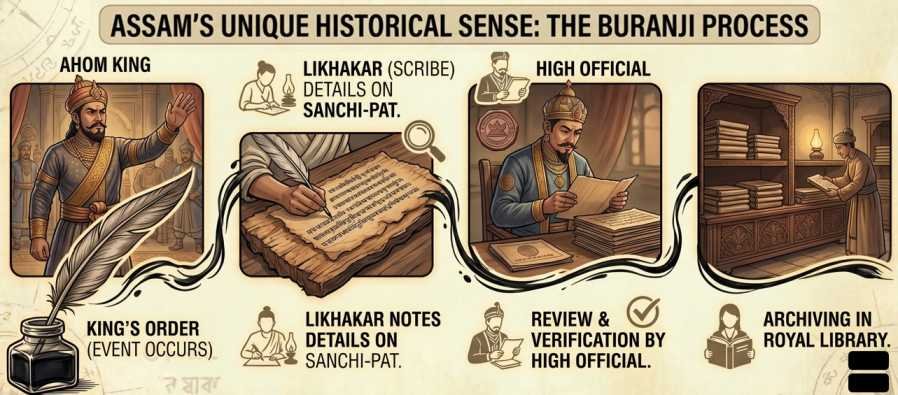
Ahom Buranjis
The Ahom Buranjis are among the most important historical chronicles of Assam.
What are Buranjis?
- The word “Buranji” means “a storehouse of historical knowledge.”
- These were official chronicles written during the Ahom kingdom by court historians.
- Initially, they were written in the Ahom language, but later many were translated into Assamese.
Information Contained in Buranjis
The Buranjis provide detailed information about:
Political events
Wars and military campaigns
Genealogies of kings
Diplomatic relations with neighbouring kingdoms
Administrative decisions
For Example :
The Ahom Buranjis contain detailed descriptions of the conflicts between the Ahom rulers and the Mughal Empire.
From these records, historians can learn about:
Military strategies of the Ahoms
Political alliances
Diplomatic negotiations
Thus, the Buranjis serve as an important historical record of the Ahom period.
Copperplate Grants and Royal Charters
- Another important form of secular literary source is copperplate grants issued by kings.
- These documents were official records that granted land or privileges to individuals, temples, or institutions.
Information Found in Copperplate Grants
| Type of Information | Historical Importance |
|---|---|
| Names of rulers | Helps identify dynasties |
| Date of the grant | Helps establish chronology |
| Land ownership details | Reveals administrative structure |
| Religious donations | Shows patronage of temples and religious institutions |
These grants were often written in refined Sanskrit prose or poetry, making them important literary documents as well as historical records.
Colonial Government Reports
- During the British colonial period, several government officials prepared reports about Assam.
- One example is the 1891 Census conducted by Edward Gait.
Although these reports were created by colonial administrators, they provide valuable information about:
Population and demographics
Ethnic communities
Languages spoken in Assam
Social structure
These documents help historians understand the social and cultural conditions of Assam during the colonial period.
3. Accounts of Foreign Travellers
- Another valuable source of information about Assam comes from foreign travellers and writers.
- Although such accounts are relatively limited, they provide an external perspective on the region.
These travellers often recorded observations about:
Geography
Political conditions
Trade and economic activities
Religious practices
Foreign References to Assam
Historical references to Assam can be found in:
Chinese records
Tibetan writings
Early Muslim chronicles
These sources sometimes mention Pragjyotisha or Kamarupa, indicating that Assam was known beyond the Indian subcontinent.
Importance of Foreign Accounts
Foreign accounts are valuable because they:
Provide independent confirmation of historical events
Describe trade connections and diplomatic relations
Offer different perspectives on Assamese society
For Example :
Some early writings mention the military strength of the rulers of Kamarupa, suggesting that the region had a well-organized political system and strong defense.
Such accounts help historians verify information found in indigenous texts.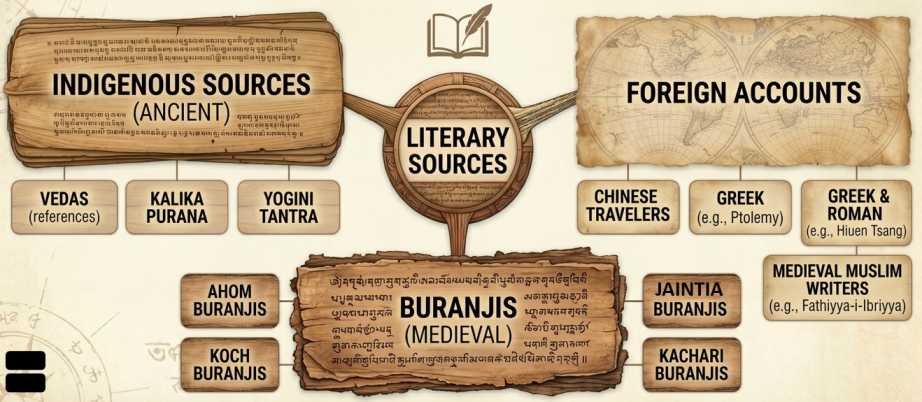
Importance of Literary Sources in Assam History
Literary sources play a crucial role in reconstructing Assam’s past because they provide detailed narratives about people, rulers, and religious traditions.
Contributions of Literary Sources
| Contribution | Explanation |
|---|---|
| Historical Narratives | Provide stories and descriptions of past events |
| Cultural Information | Describe customs, rituals, and traditions |
| Political History | Record the achievements of rulers and kingdoms |
| Religious Beliefs | Explain spiritual traditions and sacred places |
Limitations of Literary Sources
Despite their importance, literary sources also have certain limitations.
Some texts contain:
Mythological stories
Exaggerated descriptions
Religious bias
Therefore, historians must compare literary evidence with archaeological discoveries and inscriptions to obtain a more accurate historical understanding.
The literary sources of Assam history are invaluable for understanding the political, cultural, and religious development of the region.
Texts such as the Kalika Purana, Yogini Tantra, and Ahom Buranjis, along with copperplate grants and foreign accounts, provide rich narratives about Assam’s past.
However, these sources must be studied carefully and critically to distinguish historical facts from myths and legends.
When combined with archaeological and epigraphical evidence, literary sources help historians reconstruct a balanced and comprehensive history of Assam, preserving the region’s rich cultural heritage and historical legacy.