
The development of the Assamese language was a long and gradual linguistic process that took place over many centuries. It was not created suddenly; rather, it evolved through the interaction of classical languages, local dialects, and regional cultural influences.
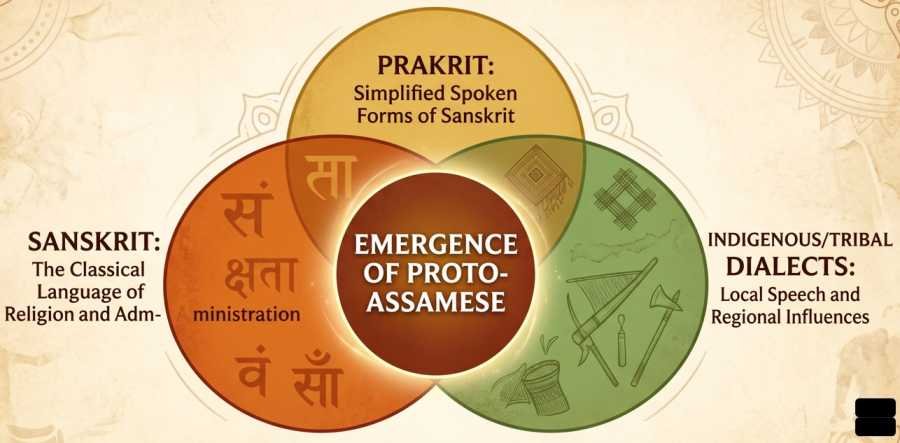
The Assamese language developed through a synthesis of three major elements:
Sanskrit, the classical language of religion and administration
Prakrit, the simplified spoken forms of Sanskrit
Indigenous dialects and tribal languages of Assam
Through this interaction, a distinct regional language gradually emerged, which later developed into modern Assamese.
The transformation of the language was also reflected in changes in scripts, inscriptions, and literary traditions.
Major Stages in the Development of Assamese Language
The evolution of the Assamese language can be broadly understood through several historical stages.
| Stage | Time Period | Characteristics |
|---|---|---|
| Sanskrit Dominance | Early centuries CE | Sanskrit used in inscriptions and religious texts |
| Prakrit Influence | Early medieval period | Local speech forms appear within Sanskrit inscriptions |
| Proto-Assamese Phase | Medieval period | Emergence of a regional language distinct from Sanskrit |
| Early Assamese Literature | 13th–15th centuries | Vernacular Assamese begins to appear in inscriptions and literature |
| Modern Assamese Development | Later medieval period onwards | Language gains literary identity and standardized script |
Influence of Sanskrit and Local Dialects
In ancient Assam, Sanskrit served as the official language of administration, religion, and scholarship.
Most inscriptions and royal documents during the reigns of the following dynasties were written in Sanskrit:
Varman Dynasty
Salasthambha Dynasty
Pala Dynasty
These inscriptions include:
Royal proclamations
Temple donations
Genealogical records of kings
However, although Sanskrit was the official language, the common people spoke various local dialects and tribal languages.
Over time, these spoken dialects began influencing the written language.
Linguistic Mixing: Sanskrit and Local Speech
Many Sanskrit inscriptions in Assam show linguistic irregularities such as:
Unusual spellings
Simplified grammar
Non-standard vocabulary
Initially, scholars thought these were mistakes made by scribes.
However, later linguistic studies showed that these features actually reflected local speech patterns.
Contribution of Scholars
Some important scholars who studied these linguistic features include:
Padmanath Bhattacharya
B. M. Barua
Dimbeswar Neog
They demonstrated that the so-called “errors” were actually systematic regional variations, indicating the presence of a local spoken language evolving from Sanskrit.
This process is known as Prakritization, where classical Sanskrit gradually transforms into simpler spoken forms.
Example of Linguistic Transition :
For instance, certain names of places and people in inscriptions appear in forms that are closer to spoken Assamese than classical Sanskrit.
This indicates that the language of the people was influencing the official written language, which eventually contributed to the formation of Assamese.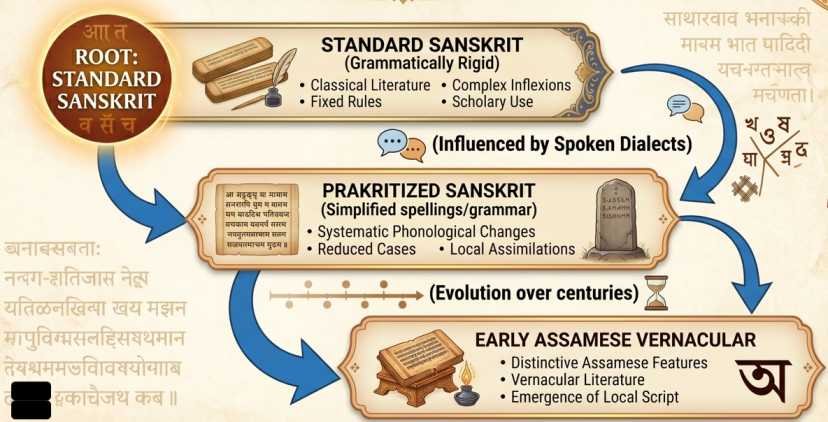
Prakrit Elements in Inscriptions
One of the most important pieces of evidence for the development of Assamese comes from ancient inscriptions found in Assam.
Many inscriptions contain Prakritized forms of Sanskrit words, meaning they were written in a simplified way so that common people could understand them more easily.
These inscriptions provide valuable clues about the transitional phase between Sanskrit and Assamese.
Important Inscriptions Showing Prakrit Influence
| Inscription | Ruler | Historical Importance |
|---|---|---|
| Tezpur Rock Inscription | Harjaravarman | Shows linguistic transition from Sanskrit to local speech |
| Ambari Stone Inscription | Samudrapala | Contains Prakritized vocabulary and regional expressions |
These inscriptions demonstrate that spoken dialects were gradually influencing the formal written language.
Example :
For example, instead of using complex Sanskrit grammar, some inscriptions use simpler forms of words and sentence structures.
This indicates that scribes were adapting the language to match local pronunciation and everyday speech.
Thus, inscriptions serve as linguistic evidence for the gradual emergence of Assamese language.
Evolution of Script: From Brahmi to Assamese Script
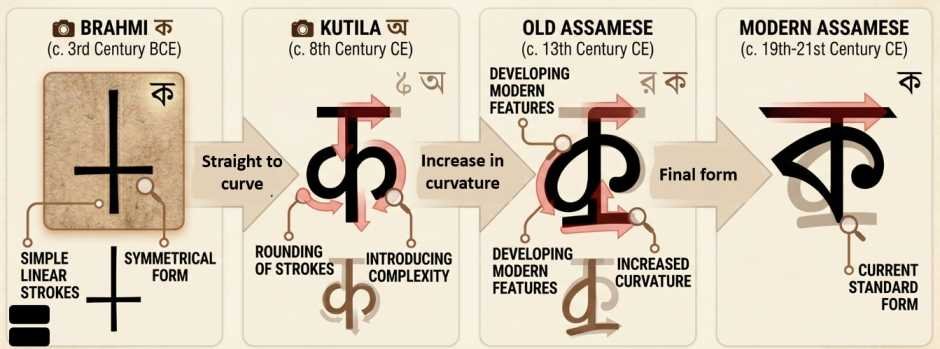
The development of Assamese language was also accompanied by the evolution of its writing system (script).
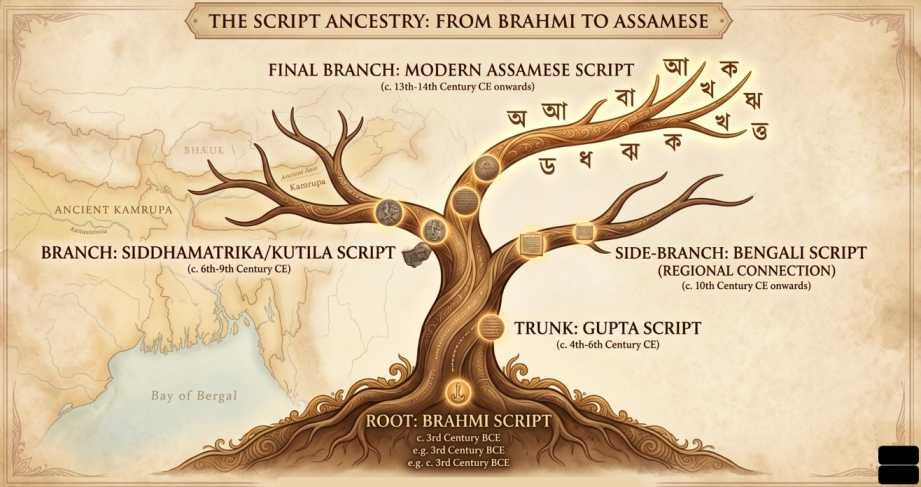
The earliest inscriptions in Assam were written using variants of the Brahmi script.
Over time, this script underwent several transformations.
Early Script Used in Assam
The most common script used in early inscriptions was the Siddhamatrika or Kutila script, which was a regional variation of the Brahmi script.
Characteristics of this script included:
Curved letter shapes
Decorative styles
Adaptation to local writing practices
This script gradually evolved into regional scripts used in eastern India, including the Assamese script.
Factors Influencing Script Evolution
The transformation of the script was influenced by several factors:
Regional cultural traditions
Linguistic changes in spoken language
Contact with neighbouring regions such as Bengal and Mithila
Administrative and literary requirements
Over time, these influences led to the emergence of a distinct Assamese script.
Example: Script Variation in Royal Inscriptions
An interesting example of script evolution can be seen in inscriptions issued by King Bhaskaravarman.
Two of his inscriptions show different script styles depending on the region.
| Inscription | Location | Script Characteristics |
|---|---|---|
| Dubi Inscription | Assam | Shows local script influences |
| Nidhanpur Inscription | Bengal | Reflects regional script variations |
This demonstrates that scripts evolved differently depending on local cultural influences.
Emergence of Early Assamese Language
A major turning point in the history of Assamese language occurred when vernacular Assamese began to appear in inscriptions instead of Sanskrit.
One of the most important examples of this transition is the Gachtal Stone Pillar Inscription.
Gachtal Stone Pillar Inscription (1362 CE)
This inscription, dated 1362 A.D. (Saka 1284), represents a significant milestone in the development of Assamese language.
Important Features
Written in early Assamese instead of classical Sanskrit
Demonstrates the growing acceptance of vernacular language in official records
Contains words influenced by Maithili and Brajabuli
Cultural Significance
The presence of Maithili and Brajabuli elements indicates that Assam was connected with broader literary and cultural movements of eastern India.
This period marks the transition from classical Sanskrit dominance to the rise of vernacular Assamese literature.
Importance of Inscriptions in Studying Assamese Language
Inscriptions play a crucial role in understanding the development of Assamese language and script.
They provide evidence for:
| Contribution | Explanation |
|---|---|
| Linguistic transition | Show how Sanskrit gradually transformed into Assamese |
| Script evolution | Reveal changes in writing styles |
| Regional identity | Demonstrate the emergence of a distinct Assamese linguistic tradition |
| Cultural interaction | Indicate influences from neighbouring regions |
The development of the Assamese language was the result of centuries of linguistic interaction and cultural exchange.
Starting from Sanskrit inscriptions of ancient dynasties, the language gradually incorporated Prakrit elements and local dialects, eventually evolving into a distinct regional language.
The transformation of scripts from Brahmi and Siddhamatrika to Assamese script, along with the appearance of early Assamese in inscriptions such as the Gachtal Stone Pillar, marks important milestones in this process.
Thus, the Assamese language represents a rich linguistic heritage shaped by classical traditions, local speech, and regional cultural identity.