
The archaeological sources of Assam’s past are among the most important and reliable forms of historical evidence for understanding the ancient history of the region. Unlike literary sources, which may contain myths or exaggerated narratives, archaeological sources provide physical and tangible evidence of past human activities.
These sources include material remains, coins, inscriptions, sculptures, tools, and architectural ruins that have survived from ancient times. Through careful excavation, analysis, and scientific study, historians and archaeologists are able to reconstruct the political, religious, cultural, and economic history of Assam.
In the absence of continuous historical chronicles like the Rajatarangini or Harshacharita, archaeological discoveries play a crucial role in understanding Assam’s past.
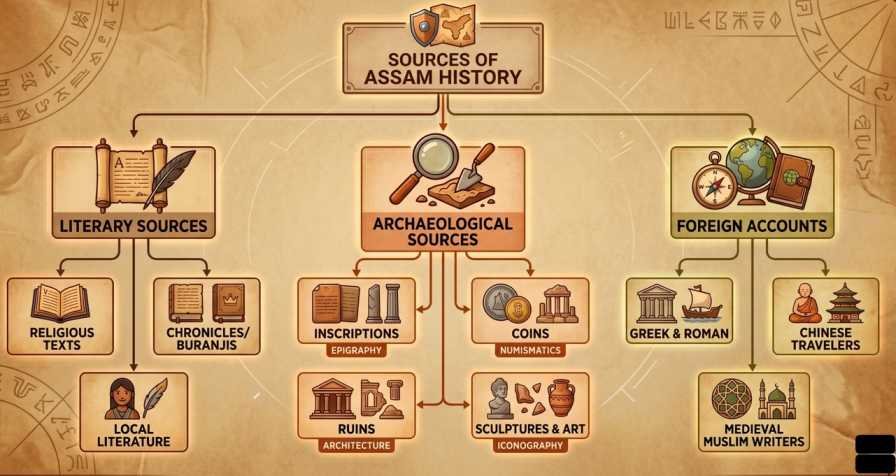
Major Types of Archaeological Sources in Assam
Archaeological sources of Assam can be broadly divided into the following categories:
| Type of Source | Description | Historical Value |
|---|---|---|
| Material Remains | Temples, palaces, forts, sculptures, tools | Reveal architecture, religion, and technology |
| Coins (Numismatics) | Gold, silver, and copper coins issued by rulers | Provide information about economy, kingship, and chronology |
| Inscriptions (Epigraphy) | Writing engraved on stone or copper plates | Record political events, land grants, and genealogies |
Each of these sources contributes significantly to reconstructing the ancient civilization of Assam.
1. Material Remains
Temples, Palaces, and Fortifications
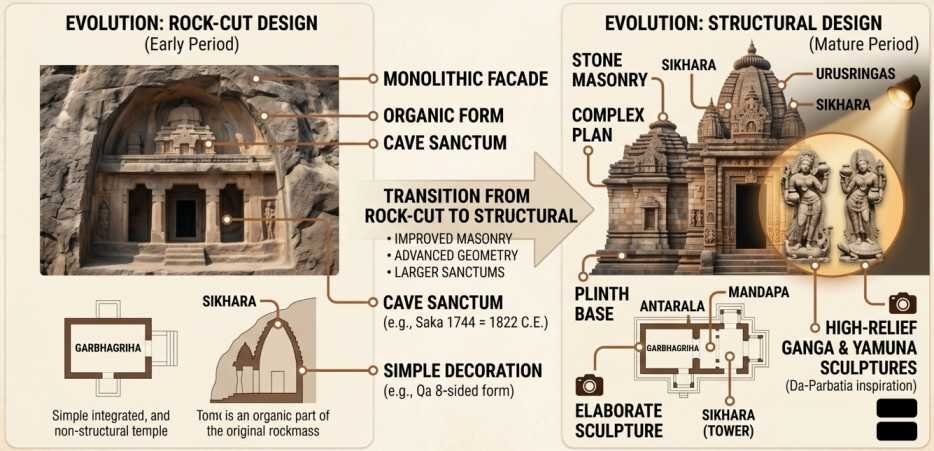
One of the most significant forms of archaeological evidence in Assam is the architectural remains of temples, palaces, and forts.
The earliest phase of large-scale architectural activity in Assam is believed to have started during the Varman Dynasty, which ruled the region roughly between the 4th and 7th centuries CE.
Early Temple Construction
- Historical evidence suggests that temple construction began during the reign of King Surendravarman (450–485 A.D.).
- One of the earliest examples is the Umachal Cave Temple, which was dedicated to Balabhadraswamin (a form of Vishnu).
- This temple is important because it provides early architectural evidence of religious worship in ancient Assam.
Characteristics of Ancient Temples
Although no complete ancient temples survive today, archaeologists have discovered ruins, foundations, and fragments of temple structures across the region.
These remains indicate that temples were dedicated to several Hindu deities such as:
Shiva
Vishnu
Surya
Devi
This reflects the religious diversity and spiritual traditions of ancient Assam.
Example: Reuse of Temple Sites by the Ahoms
During the rule of the Ahom Kingdom, many ancient temple sites were renovated or rebuilt.
One famous example is Da-Parbatia Temple Ruins, which contains beautifully carved stone doorways believed to belong to an early temple structure.
The Ahoms later reused this site, demonstrating how different historical periods interacted with earlier architectural heritage.
Sculptures and Stone Tools
Another important archaeological source is sculptures and stone tools discovered at various sites in Assam.
Sculptures
Ancient temples were often decorated with intricately carved sculptures. These sculptures were used as:
Decorative elements on temple walls
Door frames and pillars
Ceiling ornaments
Many sculptures depict:
Hindu deities
Mythological figures
Floral and geometric motifs
These artistic works provide valuable information about:
Religious beliefs
Artistic styles
Cultural symbolism
Prehistoric Tools
Apart from sculptures, archaeologists have discovered prehistoric stone tools across Assam, especially from Neolithic and Megalithic cultures.
Examples include:
Grooved hammer stones
Polished stone axes
Stone chisels
These tools indicate that early inhabitants of Assam possessed basic technological skills and knowledge of tool-making.
They also reveal important details about:
Hunting and agricultural practices
Settlement patterns
Daily life of prehistoric communities
2. Coins and Numismatics
The study of coins is known as Numismatics, and it plays an important role in reconstructing the economic and political history of Assam.
Coins provide information about:
Names and titles of rulers
Regnal years
Religious affiliations
Economic conditions
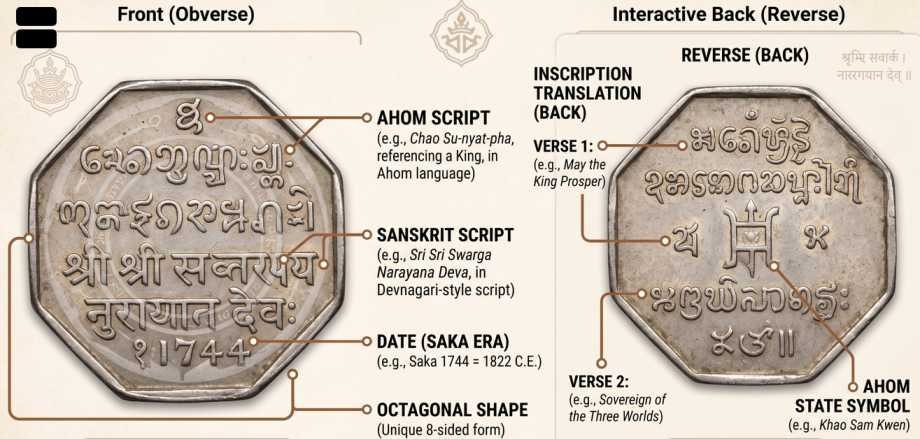
Ahom Coinage
- The earliest coins issued by the Ahom rulers are believed to have been introduced by Sutyinpha in 1648 CE.
- These coins were often made of gold and silver, and they carried inscriptions in Sanskrit.
- One famous inscription found on Ahom gold coins reads:
- “Sri Sri Hari Hara Charana Parayanasya Sri Sri Svarga Narayanasya.”
- This phrase indicates the religious devotion of the king towards the Hindu deities Hari (Vishnu) and Hara (Shiva).
- Thus, coins help historians understand the religious and political ideology of rulers.
Discovery at Paglatek (Goalpara)
- In 1972, archaeologists discovered 31 gold coins at Paglatek.
- One of these coins carried the inscription “Sri Kumara” written in Brahmi-Prakrit script.
- This coin is considered one of the earliest numismatic evidences from the Kamarupa kingdom.
Copper Coins of the Mleccha Dynasty
The Mleccha Dynasty introduced copper coinage during the 9th century CE.
Large numbers of these coins were discovered in places such as:
Dhulapadung Tea Estate
Tulip Tea Estate
These coins contain proto-Assamese characters such as “Va” and “Ha.”
This suggests that linguistic changes were already taking place, which eventually contributed to the development of the Assamese language.
3. Inscriptions (Epigraphical Sources)
Among all archaeological sources, inscriptions are considered the most reliable historical records.
Inscriptions are texts engraved on stone slabs, pillars, copper plates, or other durable materials.
They often contain valuable information about:
Royal genealogies
Political events
Land grants
Religious donations
Administrative practices
Because Assam lacked continuous historical chronicles like Rajatarangini, inscriptions play a crucial role in reconstructing the region’s history.
Materials Used for Inscriptions
Ancient inscriptions in Assam were created using several materials.
| Material | Description |
|---|---|
| Copper plates | Used for recording royal land grants |
| Stone slabs | Used for commemorative inscriptions |
| Bronze plates | Sometimes used for official records |
| Burnt clay tablets | Occasionally used for inscriptions |
Copperplate inscriptions were often tied with copper rings sealed with heart-shaped bronze medallions, giving them an official and authentic appearance.
Language and Script Used in Inscriptions
- Most early inscriptions were written in Sanskrit, which was the official language of administration and religion.
- However, many inscriptions also show influence of local Prakrit dialects, especially the Kamarupi dialect.
- Over time, some inscriptions began to include early forms of the Assamese language.
Script Used in Assam
The script used in inscriptions evolved gradually.
| Script | Origin | Characteristics |
|---|---|---|
| Brahmi Script | Ancient Indian writing system | Foundation of later scripts |
| Siddhamatrika / Kutila Script | Derived from Brahmi | Used widely in early Assam |
| Proto-Assamese Script | Regional development | Influenced later Assamese script |
These script changes reflect the linguistic evolution of the region.
Writing Style of Inscriptions
The writing style of inscriptions usually combined:
Prose (for administrative details)
Poetry (for praising kings)
These poetic sections were often composed by learned Sanskrit scholars and included eulogies celebrating the achievements of rulers.
Categories of Inscriptions
Historians classify inscriptions based on their purpose.
| Type | Purpose |
|---|---|
| Commemorative | Record important events |
| Royal Decrees | Announce official orders |
| Commemorative-Donative | Record donations and grants |
| Eulogistic-Donative | Praise kings and record gifts |
| Combined Inscriptions | Mix praise, events, and donations |
This classification helps historians understand why a particular inscription was created.
Important Inscriptions of Assam
Several inscriptions have played a crucial role in reconstructing Assam’s history.
| Inscription | Historical Importance |
|---|---|
| Umachal Rock Inscription | Oldest architectural record of temple construction |
| Tezpur Rock Inscription | Example of royal directive |
| Dubi Copper Plate | Issued by Bhaskaravarman, records land grants |
| Nidhanpur Copper Plate | Contains genealogy of rulers |
| Kanaiborsiboa Rock Inscription | Mentions early Turko-Afghan invasions |
| Ambari Stone Inscription | Shows pre-Ahom writing practices |
| Gachtal Pillar Inscription (1362 CE) | Written in early Assamese language |
The archaeological sources of Assam’s past provide invaluable insights into the political, cultural, religious, and economic life of ancient Assam.
Material remains such as temple ruins, sculptures, and prehistoric tools, along with coins and inscriptions, help historians reconstruct the complex and rich history of the region.
Through the study of these sources, scholars can trace the evolution of religious practices, political institutions, artistic traditions, and linguistic developments in Assam.
Thus, archaeology plays a fundamental role in preserving and understanding the historical heritage of Assam.