
Introduction
- The Co-District(Xama-Zilla/সমজিলা) system is an important innovation in the field of administrative decentralisation and district administration in Assam.
- It seeks to bring district-level governance closer to the people by creating smaller administrative units within existing districts.
- Presently, there are 57 Co-Districts in Assam.
- A Co-District is not a separate district. It functions as a decentralised administrative unit of its parent district.
- It is headed by a Co-District Commissioner (CDC) and is entrusted with several functions that were traditionally concentrated at the District Commissioner level.
- The system is particularly significant from the perspective of Assam Polity, as it deals with:
- State administration
- District administration
- Administrative decentralisation
- Delegation of powers
- Good governance
- Citizen-centric administration
- Last-mile delivery of public services
- Official district portals now formally list Co-Districts as part of their administrative structure. For example, Golaghat lists Bokakhat, Sarupathar and Dergaon as its three Co-Districts.
Meaning of Co-District
- A Co-District may be understood as a territorial administrative unit created below/within the parent district framework for decentralised exercise of specified district-level functions.
- The prefix “Co-” signifies that the unit works as part of the broader district administrative structure rather than replacing the parent district.
- The Co-District:
- Has a defined territorial jurisdiction.
- Has a designated administrative headquarters.
- Is headed by a Co-District Commissioner.
- Exercises powers specifically delegated by the State Government.
- Continues to function under the broader administrative framework of the parent district.
Thus:
District → Decentralisation of Functions → Co-District → Administration closer to Citizens
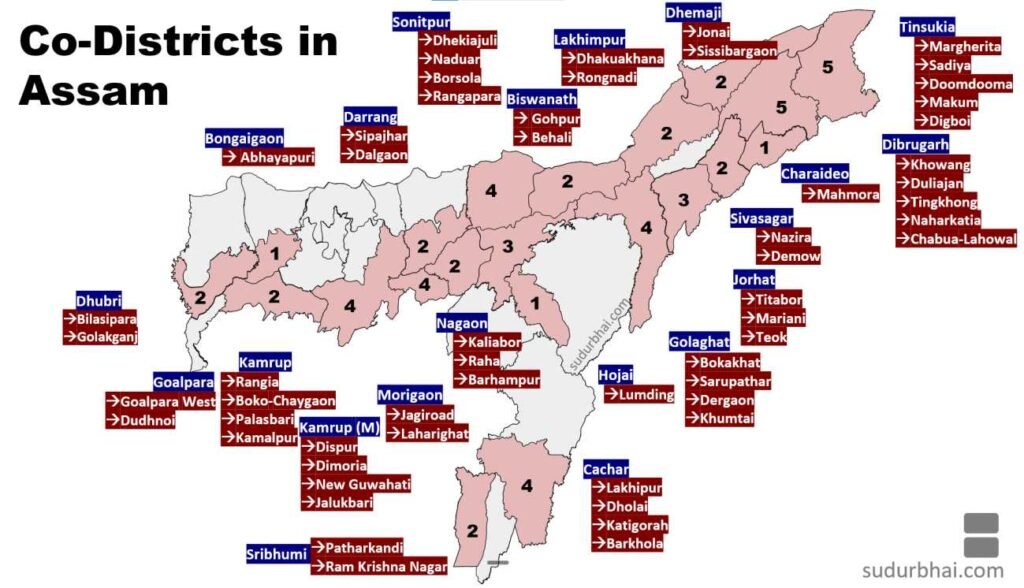
Name of Co-District | District where it lies |
1. Bilasipara | Dhubri |
2. Golakganj | Dhubri |
3. Abhayapuri | Bongaigaon |
4. Rangia | Kamrup |
5. Boko-Chaygaon | Kamrup |
6. Palasbari | Kamrup |
7. Kamalpur (’26) | Kamrup |
8. Kaliabor | Nagaon |
9. Raha | Nagaon |
10. Barhampur (’26) | Nagaon |
11. Gohpur | Biswanath |
12. Behali | Biswanath |
13. Dhakuakhana | Lakhimpur |
14. Rongnadi (’26) | Lakhimpur |
15. Jonai | Dhemaji |
16. Sissibargaon (’26) | Dhemaji |
17. Margherita | Tinsukia |
18. Sadiya | Tinsukia |
19. Doomdooma | Tinsukia |
20. Makum | Tinsukia |
21. Digboi | Tinsukia |
22. Nazira | Sivasagar |
23. Demow | Sivasagar |
24. Titabor | Jorhat |
25. Mariani | Jorhat |
26. Teok | Jorhat |
27. Bokakhat | Golaghat |
28. Sarupathar | Golaghat |
29. Dergaon | Golaghat |
30. Khumtai (’26) | Golaghat |
31. Lakhipur | Cachar |
32. Dholai | Cachar |
33. Katigorah (’26) | Cachar |
34. Barkhola (’26) | Cachar |
35. Goalpara West | Goalpara |
36. Dudhnoi | Goalpara |
37. Dispur | Kamrup Metropolitan |
38. Dimoria | Kamrup Metropolitan |
39. New Guwahati | Kamrup Metropolitan |
40. Jalukbari | Kamrup Metropolitan |
41. Sipajhar | Darrang |
42. Dalgaon | Darrang |
43. Jagiroad | Morigaon |
44. Laharighat | Morigaon |
45. Lumding | Hojai |
46. Dhekiajuli | Sonitpur |
47. Naduar | Sonitpur |
48. Barchalla (Borsola) | Sonitpur |
49. Rangapara | Sonitpur |
50. Khowang | Dibrugarh |
51. Duliajan | Dibrugarh |
52. Tingkhong | Dibrugarh |
53. Naharkatia | Dibrugarh |
54. Chabua-Lahowal (’26) | Dibrugarh |
55. Mahmora | Charaideo |
56. Patharkandi | Sribhumi (formerly Karimganj) |
57. Ram Krishna Nagar | Sribhumi (formerly Karimganj) |
Background of the Co-District Concept
Need for Administrative Decentralisation
- Assam’s traditional district administration placed considerable responsibility on the District Commissioner (DC).
- With increasing population, developmental activities and welfare programmes, the workload of district administrations expanded considerably.
- Citizens living far from district headquarters often had to travel considerable distances for administrative services.
- This created problems such as:
- Higher transaction costs
- Delay in service delivery
- Greater workload at district headquarters
- Difficulty in grievance redressal
- Slower administrative response
- Weak last-mile coordination
Assam-Specific Requirements
- Assam presents special administrative challenges because of:
- Riverine areas
- Char areas
- Flood-prone settlements
- Hilly and difficult terrain
- Dispersed rural population
- Seasonal connectivity problems
- Recurrent floods and erosion
- Therefore, merely concentrating administration at the district headquarters may not always provide effective last-mile governance.
Evolution of the Co-District System
- The concept initially developed through the creation of Sub-Districts.
- The nomenclature was subsequently changed to Co-Districts.
- The government operationalised the new arrangement on a substantial scale from October 2024.
- The institutional framework has subsequently been strengthened through:
- Delegation of administrative functions
- Assignment of election-related responsibilities
- Conferment/delegation of revenue responsibilities
- Magisterial arrangements
- For example, an Assam Gazette notification of 9 January 2025 specifically delegated the conduct of Panchayat elections to Co-District Commissioners in addition to previously allotted subjects.
- Further delegation continued thereafter. A September 2025 Gazette notification authorised Co-District Commissioners to exercise specified powers under the Assam Land and Revenue Manual, 1886 within their respective jurisdictions.
Position of Co-District in Assam’s Administrative Structure
The Co-District must be understood within the larger framework of state field administration.
Government of Assam
↓
Administrative Division
↓
District
↓
District Commissioner
↓
Co-District
↓
Co-District Commissioner
↓
Revenue Circles / Development and Field Administration
↓
Local Institutions and Citizens
- However, the exact territorial relationship between a Co-District, Revenue Circle and other field units depends upon the administrative arrangement notified for the particular area.
- For example, the official Dhubri district profile separately lists 2 Co-Districts, 8 Revenue Circles and 13 Development Blocks, demonstrating that these are distinct components of field administration rather than interchangeable units.
Co-District Commissioner
Position
- Every Co-District is headed by a Co-District Commissioner (CDC).
- The CDC is the principal civil administrative officer for the functions delegated to the Co-District.
- Current government district portals show IAS and Assam Civil Service (ACS) officers serving as Co-District Commissioners.
- The CDC therefore becomes an important link between:
- District Commissioner
- Line departments
- Revenue administration
- Development administration
- Local institutions
- Citizens
Nature of Authority
- A CDC does not automatically possess every power of a District Commissioner.
- The CDC exercises those powers and functions that have been assigned or delegated by the State Government.
This distinction is important for Assam Polity:
District Commissioner = Overall district-level authority
Co-District Commissioner = Decentralised authority within specified jurisdiction and delegated subjects
Objectives of the Co-District System
Bringing Administration Closer to People
- The primary objective is to reduce the physical and administrative distance between citizens and district administration.
- People can obtain many services without repeatedly travelling to the principal district headquarters.
Administrative Decentralisation
- Certain powers and responsibilities are transferred from the district headquarters to Co-District-level authorities.
- This creates a more distributed administrative system.
Faster Service Delivery
- Local availability of administrative authority can reduce:
- Movement of files
- Processing time
- Administrative delays
- Dependence on the district headquarters
Reduction of Workload
- District Commissioners handle a wide range of functions relating to:
- Revenue
- Development
- Elections
- Disaster management
- Law and order
- Welfare
- Inter-departmental coordination
- Co-Districts allow some of these responsibilities to be geographically distributed.
Improved Grievance Redressal
- Citizens can approach a relatively senior administrative authority closer to their locality.
- This can improve accessibility and responsiveness of government.
Better Local Coordination
- The CDC can coordinate various departments operating within the Co-District.
- This can reduce administrative fragmentation at the field level.
Major Functions of Co-District Administration
Revenue and Land Administration
- Land administration constitutes an important area of decentralisation.
- Co-District administration can coordinate with the Revenue Circles falling within its jurisdiction.
- Functions may involve matters connected with:
- Land administration
- Revenue administration
- Government land
- Land records
- Local revenue issues
- Supervision and coordination of field revenue machinery
- In September 2025, Assam delegated to CDCs specified powers previously exercised by District Commissioners under Executive Instruction No. 115 of the Assam Land and Revenue Manual, 1886.
- This shows that Co-Districts are being strengthened through actual delegation of statutory/administrative powers, rather than merely functioning as geographical labels.
Development Administration
- Co-Districts facilitate decentralised development administration.
- Their role can include:
- Monitoring developmental programmes
- Reviewing implementation of government schemes
- Coordination among line departments
- Identifying local bottlenecks
- Monitoring public infrastructure
- Co-District-level Development Committees are also functioning in practice. For example, official records from Barchalla show a Co-District Development Committee meeting chaired by the local MLA and co-chaired by the CDC to review departmental progress and implementation issues.
Panchayat and Rural Development
- Co-District administration has an important relationship with Panchayat and Rural Development (P&RD) administration.
- It can facilitate:
- Coordination with rural-development institutions
- Monitoring of development programmes
- Panchayat-related administration
- Election administration
- The Government of Assam formally added conduct of Panchayat elections to the delegated responsibilities of Co-District Commissioners in January 2025.
Election Administration
- Co-District Commissioners have substantial operational responsibilities during elections entrusted to them.
- In the context of Panchayat elections, official instructions assign responsibilities relating to:
- Election arrangements
- Material distribution centres
- Strong rooms
- Counting centres
- Transportation arrangements
- Requisition of vehicles
- Polling personnel logistics
- Emergency response
- Zilla Parishad constituency-related activities
- However, the District Commissioner continues to exercise overall supervisory responsibilities in important areas such as personnel randomisation, training, strong-room oversight and declaration of final results.
This illustrates the principle of:
Decentralised Execution + District-Level Supervision
Disaster Management
- Co-District administration has particular importance in a disaster-prone state like Assam.
- It can provide more localised administrative coordination during:
- Floods
- River-bank erosion
- Landslides
- Storms
- Fires
- Other local emergencies
- A decentralised administrative authority can facilitate:
- Faster reporting
- Damage assessment
- Relief coordination
- Evacuation support
- Inter-departmental coordination
- Official election instructions also specifically empower CDC offices to take quick measures during emergencies such as natural disasters, unrest or violence affecting the electoral process.
Magisterial Functions
- Co-District Commissioners have also been brought within the framework of executive-magisterial administration through government notifications.
- The Assam Personnel Department specifically lists a notification concerning magisterial powers of Co-District Commissioners.
- This enhances their ability to deal with administrative situations requiring executive-magisterial intervention within their jurisdiction.
Welfare and Public-Service Delivery
- Co-Districts can serve as a platform for improving coordination and monitoring of:
- Government welfare schemes
- Social-sector programmes
- Food and civil supplies
- Rural-development programmes
- Citizen services
- The central objective remains last-mile delivery.
Co-District and District: Major Differences
| Basis | District | Co-District |
|---|---|---|
| Administrative status | Principal district-level territorial unit | Decentralised unit within a parent district |
| Head | District Commissioner (DC) | Co-District Commissioner (CDC) |
| Territorial position | Independent district administration | Part of the parent district framework |
| Powers | Broad district-level powers | Delegated/assigned powers |
| Administrative scope | Entire district | Specified Co-District jurisdiction |
| Role | Overall district administration | Localised administration and service delivery |
| Election role | Overall district supervision | Operational responsibilities assigned within jurisdiction |
| Objective | General district administration | Administrative decentralisation |
| Relationship | Parent administrative unit | Functions under the larger district framework |
Co-District and Revenue Circle: Difference
- The two concepts should not be confused.
| Co-District | Revenue Circle |
|---|---|
| Wider decentralised administrative unit | Primarily a revenue-administration unit |
| Headed by Co-District Commissioner | Headed by Circle Officer |
| Deals with multiple delegated administrative subjects | Primarily associated with land and revenue administration |
| May coordinate several administrative functions | Functions mainly within revenue administration |
| Created to strengthen decentralised district governance | Long-established component of Assam’s revenue administration |
- Official district profiles separately enumerate Co-Districts and Revenue Circles, confirming their distinct institutional identity.
Co-District and Local Self-Government
- A Co-District is not a local self-government institution.
- It should not be confused with:
- Gram Panchayat
- Anchalik Panchayat
- Zilla Parishad
- Municipal Board
- Municipal Corporation
- Panchayats and municipalities are institutions of democratic decentralisation/local self-government.
- Co-Districts belong to the structure of state administrative decentralisation.
Therefore:
Panchayat/Municipality → Democratic Decentralisation
Co-District → Administrative Decentralisation
- Co-Districts do not replace the constitutional institutions created under the 73rd and 74th Constitutional Amendments.
Constitutional and Legal Position
- The Constitution of India does not specifically provide for a “Co-District.”
- Districts and their internal administrative arrangements largely form part of the state’s administrative machinery.
- The Assam Government can therefore reorganise its field administration and delegate functions through:
- Government notifications
- Executive orders
- Departmental instructions
- Delegation under applicable laws and rules
- Hence, the Co-District is essentially an administrative innovation of the Government of Assam, rather than a separate constitutional tier of government.
- This is a crucial distinction for APSC examinations.
Significance of Co-Districts for Assam Polity
Administrative Decentralisation
- Co-Districts represent the principle that administration should not remain excessively concentrated at the district headquarters.
- They distribute administrative responsibility geographically.
Principle of Subsidiarity
- The system broadly reflects the idea of subsidiarity:
- A matter should, as far as practicable, be handled at the lowest effective administrative level.
- Routine local matters need not always travel upward to the district headquarters.
Citizen-Centric Governance
The system shifts emphasis from:
Citizen travelling to Administration
↓
Administration moving closer to Citizen
Good Governance
- Co-Districts can promote the principles of:
- Accessibility
- Accountability
- Responsiveness
- Efficiency
- Transparency
- Participation
- Inclusiveness
Last-Mile Governance
- Policies formulated at Dispur ultimately have to reach villages, towns and individual beneficiaries.
- Co-Districts provide another administrative mechanism for bridging the gap between policy formulation and field implementation.
Importance of Co-Districts for Remote and Rural Assam
- Co-Districts have special relevance where:
- District headquarters are far away.
- Transport connectivity is difficult.
- Rivers create physical barriers.
- Floods periodically disrupt transport.
- Populations are geographically dispersed.
- Decentralisation can therefore reduce the time and financial cost of accessing government.
Importance for Disaster-Prone Assam
- Assam’s recurring floods and erosion often require decisions at very short notice.
- A senior administrative authority located closer to affected areas can potentially improve:
- Preparedness
- Response
- Relief distribution
- Damage assessment
- Rehabilitation coordination
- Thus, the Co-District concept has relevance beyond routine administration and can strengthen local administrative resilience.
Advantages of the Co-District System
- Administration closer to citizens
- Faster administrative decision-making
- Reduced pressure on District Commissioner offices
- Reduced travel requirements for citizens
- Better monitoring of government schemes
- Faster grievance redressal
- Better inter-departmental coordination
- Improved disaster response
- Greater administrative presence in remote areas
- Better understanding of local needs
- Strengthened land and revenue administration
- More efficient election management
- Improved accountability of field administration
Challenges and Limitations
Overlapping Jurisdictions
- There may be functional overlap among:
- District Commissioner
- Co-District Commissioner
- Circle Officer
- Block Development Officer
- Panchayat authorities
- Line departments
- Clearly defined jurisdiction and responsibility are therefore essential.
Possibility of Additional Bureaucratic Layer
- If genuine powers are not delegated, Co-Districts could merely add another level through which files must pass.
The objective should therefore be:
Fewer procedures + Faster decisions, rather than simply more offices.
Human Resource Requirements
- Effective Co-Districts require:
- Adequate officers
- Ministerial staff
- Revenue personnel
- Technical personnel
- IT staff
- Field-level support
Infrastructure
- New administrative units require:
- Office buildings
- Record rooms
- Internet connectivity
- Citizen-service facilities
- Transport
- Digital equipment
Coordination
- Successful decentralisation requires effective coordination between:
- DC and CDC
- CDC and Circle Officers
- CDC and line departments
- CDC and local governments
Financial Delegation
- Administrative decentralisation becomes meaningful when accompanied by appropriate financial authority and resources.
- Without this, CDCs may remain dependent on the district headquarters.
Measures to Strengthen Co-District Administration
- Clearly codify the powers and responsibilities of CDCs.
- Ensure adequate delegation of administrative authority.
- Provide sufficient trained manpower.
- Establish permanent Co-District administrative complexes where required.
- Develop single-window citizen service centres.
- Integrate Co-District offices with Assam’s e-governance systems.
- Digitise land and administrative records.
- Establish time-bound grievance-redressal mechanisms.
- Strengthen coordination with Revenue Circles and Development Blocks.
- Ensure coordination rather than competition with Panchayati Raj Institutions and Urban Local Bodies.
- Introduce measurable performance indicators such as:
- Average service-delivery time
- Grievance-disposal rate
- Scheme implementation rate
- Disaster-response time
- Citizen satisfaction
- Periodically review whether powers currently exercised by district headquarters can safely be further decentralised.
Broader Political and Administrative Significance
- The Co-District model represents a shift from the traditional idea of administration based primarily on territorial control towards administration centred on service delivery.
- It demonstrates how a state can reorganise its field administration without necessarily creating numerous new full-fledged districts.
- Creation of a new district can involve substantial:
- Administrative infrastructure
- Manpower
- Financial expenditure
- Departmental reorganisation
- Co-Districts provide an alternative mechanism through which administrative accessibility can be increased while retaining the parent district structure.