
India Pakistan Relations
- India and Pakistan emerged as independent states in August 1947 following the Partition of British India under the Indian Independence Act, 1947.
- The international boundary between the two countries was largely demarcated through the Radcliffe Award.
- India shares its international boundary with Pakistan across Jammu & Kashmir/Ladakh, Punjab, Rajasthan and Gujarat.
- Since independence, bilateral relations have been characterised by a combination of:
- Territorial disputes
- Cross-border terrorism
- Military conflicts
- Nuclear deterrence
- Water-related disputes
- Limited trade
- Periodic diplomatic engagement
- People-to-people and religious contacts.
- The Jammu & Kashmir issue and cross-border terrorism have remained the most persistent sources of tension.
- India officially maintains that it seeks peaceful and cooperative relations with Pakistan in an environment free from terrorism, hostility and violence.
- Stable India-Pakistan relations are important for peace, security, connectivity and economic development in South Asia.
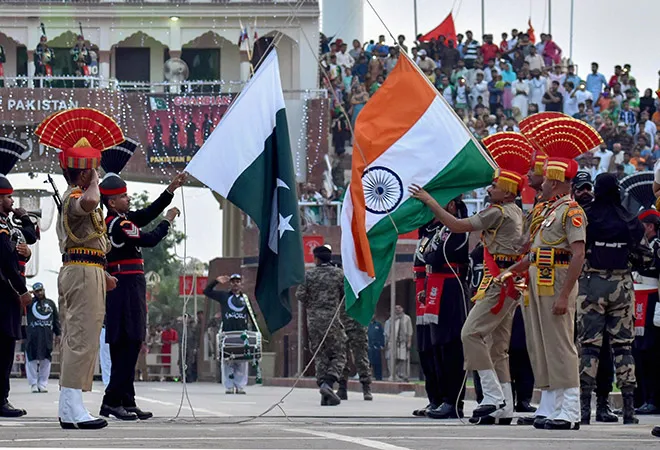
Major Events in India–Pakistan Relations
| Year | Major Development |
|---|---|
| 1947 | Partition of British India; India and Pakistan became independent states. |
| 1947–48 | First India-Pakistan War over Jammu & Kashmir. |
| 1949 | UN-mediated ceasefire came into effect; a Ceasefire Line was established. |
| 1960 | Indus Waters Treaty (IWT) signed with World Bank involvement. |
| 1965 | Second India-Pakistan War. |
| 1966 | Tashkent Declaration signed after the 1965 war. |
| 1971 | India-Pakistan War culminated in the creation of Bangladesh. |
| 1972 | Simla Agreement signed; the Ceasefire Line in J&K was redesignated as the Line of Control (LoC). |
| 1984 | India launched Operation Meghdoot and established control over key positions in the Siachen region. |
| 1988 | Agreement prohibiting attacks on each other’s nuclear installations and facilities signed. |
| 1998 | India and Pakistan conducted nuclear tests, establishing an overt nuclear dimension to their rivalry. |
| 1999 | Lahore Declaration followed by the Kargil conflict. |
| 2001 | Terrorist attack on the Indian Parliament caused a major military crisis. |
| 2003 | India and Pakistan agreed to a ceasefire along the LoC. |
| 2004–08 | Composite Dialogue Process and several confidence-building initiatives. |
| 2008 | Mumbai terrorist attacks (26/11) severely damaged bilateral relations. |
| 2016 | Pathankot and Uri attacks; India subsequently announced surgical strikes across the LoC. |
| 2019 | Pulwama attack and Balakot airstrike; relations deteriorated sharply. |
| 2019 | India withdrew Pakistan’s MFN status and imposed 200% customs duty on Pakistani goods. |
| 2019 | Constitutional changes concerning Article 370 followed by further deterioration in diplomatic and trade relations. |
| 2019 | Kartarpur Corridor became operational for Sikh pilgrims. |
| 2021 | DGMOs reaffirmed adherence to the 2003 ceasefire understanding. |
| 2022 | Pakistan was removed from the FATF grey list. |
| 2025 | Pahalgam terrorist attack killed 26 people. |
| 2025 | India announced that the Indus Waters Treaty would be held in abeyance. |
| May 2025 | India launched Operation Sindoor against terrorist infrastructure in Pakistan and Pakistan-occupied Jammu & Kashmir. |
| May 2025 | Following several days of India-Pakistan military exchanges, an understanding to halt military action was reached. |
Historical Background of Relations
Partition of 1947
- India-Pakistan relations are deeply rooted in the political developments of the late colonial period.
- The All-India Muslim League, led by Muhammad Ali Jinnah, increasingly demanded a separate Muslim homeland.
- The Indian Independence Act, 1947 resulted in the creation of:
- India
- Pakistan.
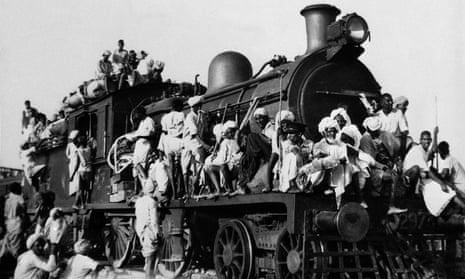
- Partition triggered:
- Large-scale communal violence
- Migration of around 14–15 million people
- Massive loss of life
- Long-term political mistrust.
- Several disputes emerging from Partition subsequently became permanent features of bilateral relations.
Accession of Jammu & Kashmir
- Under the arrangements surrounding British withdrawal, princely states had to determine their future relationship with India or Pakistan.
- Jammu & Kashmir was ruled by Maharaja Hari Singh.
- Following an invasion by tribal forces from Pakistan in October 1947, Maharaja Hari Singh signed the Instrument of Accession to India.
- Indian forces were subsequently deployed in the state.
- This became the immediate trigger for the 1947–48 India-Pakistan War.
Major Wars and Military Conflicts
1947–48 War
- The first war was centred on Jammu & Kashmir.
- A UN-sponsored ceasefire became effective on 1 January 1949.
- The territory remained divided between areas administered by India and Pakistan.
- The resulting Ceasefire Line was later redesignated as the LoC under the 1972 Simla Agreement.

1965 War
- The second major India-Pakistan war was again largely centred around Jammu & Kashmir.
- Pakistan launched Operation Gibraltar, seeking to infiltrate forces into J&K.
- Fighting expanded across the international border.
- The war ended following a UN-backed ceasefire.
- The Tashkent Declaration, 1966, facilitated by the Soviet Union, formalised the post-war settlement.
1971 War
- The conflict originated primarily from the political and humanitarian crisis in East Pakistan.
- Millions of refugees entered India.
- India supported the Bangladesh liberation movement.
- The war ended with:
- Pakistan’s military surrender in Dhaka
- Creation of Bangladesh
- Capture of around 93,000 Pakistani prisoners of war by Indian and allied forces.

Simla Agreement, 1972
- Signed by Prime Minister Indira Gandhi and President Zulfikar Ali Bhutto after the 1971 war.
- Important principles included:
- Peaceful settlement of disputes
- Respect for sovereignty and territorial integrity
- Bilateral resolution of differences.
- The existing Ceasefire Line in Jammu & Kashmir was redesignated as the Line of Control (LoC).
- The agreement remains an important historical framework for India’s preference for bilateral resolution of India-Pakistan disputes.
Kargil Conflict, 1999
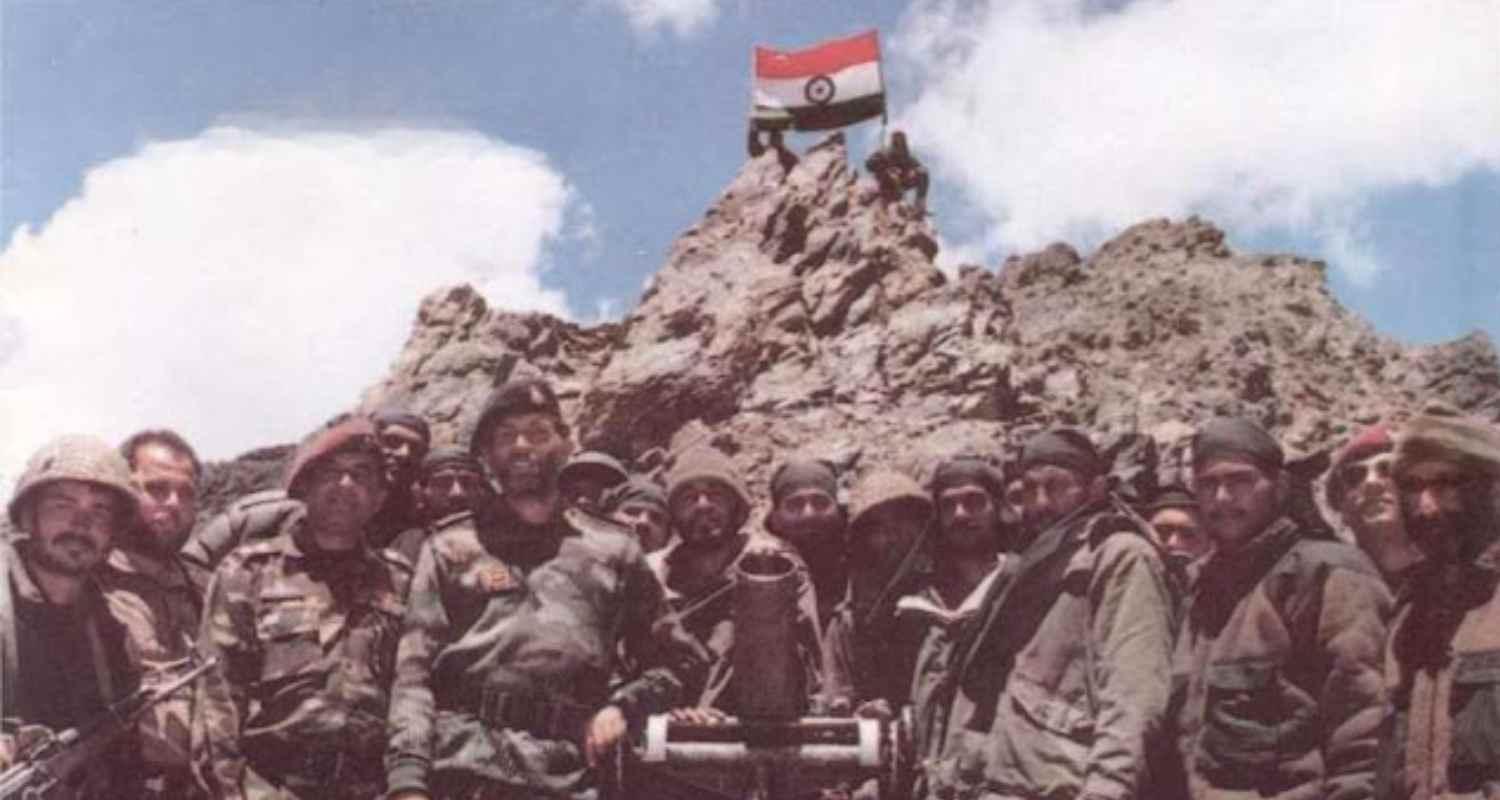
- Pakistani soldiers and infiltrators occupied positions on the Indian side of the LoC in the Kargil sector.
- India launched Operation Vijay to regain the occupied positions.
- Indian forces recaptured key strategic heights.
- Kargil demonstrated that nuclear weapons do not eliminate the possibility of limited conventional conflict.
Lahore Declaration, 1999
- Signed during PM Atal Bihari Vajpayee’s historic bus journey to Lahore.
- Both sides emphasised:
- Peaceful resolution of disputes
- Nuclear risk reduction
- Confidence-building measures
- Greater bilateral engagement.
- However, the subsequent Kargil conflict severely undermined the peace process.
Major Areas of Cooperation
Political and Diplomatic Engagement
- Despite recurring crises, India and Pakistan have periodically used:
- Official diplomatic dialogue – Track I
- Back-channel negotiations
- Track II diplomacy
- Military-to-military communication.
- Previous dialogue frameworks included:
- Composite Dialogue
- Foreign Secretary-level talks
- National Security Adviser-level interactions.
- However, structured bilateral dialogue has remained largely suspended in recent years.
Economic and Commercial Relations
- India-Pakistan economic relations remain far below their potential.
- Major constraints include:
- Political tensions
- Security concerns
- Trade restrictions
- Poor regional connectivity.
- India withdrew Pakistan’s Most Favoured Nation (MFN) status in February 2019 after the Pulwama attack.
- India subsequently imposed 200% customs duty on Pakistani imports.
- Pakistan suspended most bilateral trade following India’s constitutional changes in Jammu & Kashmir in August 2019.
- Following the Pahalgam attack in 2025, India prohibited the direct and indirect import or transit of goods originating in or exported from Pakistan.
- Consequently, formal bilateral merchandise trade has become extremely restricted.
Potential Benefits of Trade Normalisation
- In a conducive political environment, greater trade could:
- Reduce transportation costs
- Improve regional supply chains
- Generate employment
- Increase market access
- Promote South Asian economic integration.
- However, economic normalisation remains dependent on improvements in the security and political environment.
People-to-People Relations
- India and Pakistan possess strong historical, cultural and linguistic connections.
- Important channels have included:
- Religious pilgrimages
- Cricket diplomacy
- Cultural exchanges
- Academic interactions
- Family visits
- Track-II diplomacy.
Kartarpur Corridor
- The Kartarpur Corridor became operational in November 2019.
- It connects Dera Baba Nanak in Punjab, India, with Gurdwara Darbar Sahib Kartarpur in Pakistan.
- It allows eligible Indian pilgrims visa-free access to one of Sikhism’s most important religious sites.
- The corridor represents an important example of religious diplomacy and people-to-people connectivity, even during periods of political tension.

Security Cooperation and Crisis Management
- Direct counter-terrorism cooperation remains extremely limited.
- However, mechanisms aimed at reducing accidental military escalation include:
- DGMO hotline
- Ceasefire arrangements
- Prior notification of certain military exercises
- Advance notification of ballistic missile tests
- Annual exchange of lists of nuclear installations.
Major Issues in India–Pakistan Relations
Cross-Border Terrorism
- Cross-border terrorism remains the central security concern for India in its relations with Pakistan.
- India has repeatedly stated that Pakistan-based terrorist organisations have planned or executed attacks against India.
- Major groups of concern include:
- Lashkar-e-Taiba (LeT)
- Jaish-e-Mohammed (JeM)
- The Resistance Front (TRF) and other associated organisations.
- Major terrorist attacks affecting bilateral relations include:
- 2001 Parliament attack
- 2008 Mumbai attacks
- 2016 Pathankot attack
- 2016 Uri attack
- 2019 Pulwama attack
- 2025 Pahalgam attack.
Pahalgam Attack and Operation Sindoor
Pahalgam Terrorist Attack – 2025
- On 22 April 2025, terrorists attacked tourists near Pahalgam in Jammu & Kashmir, killing 26 people.
- The attack produced one of the most serious India-Pakistan crises since 2019.
- India announced several measures against Pakistan, including:
- Holding the Indus Waters Treaty in abeyance
- Closure of the Attari Integrated Check Post
- Reduction in diplomatic personnel
- Visa-related restrictions.
Operation Sindoor
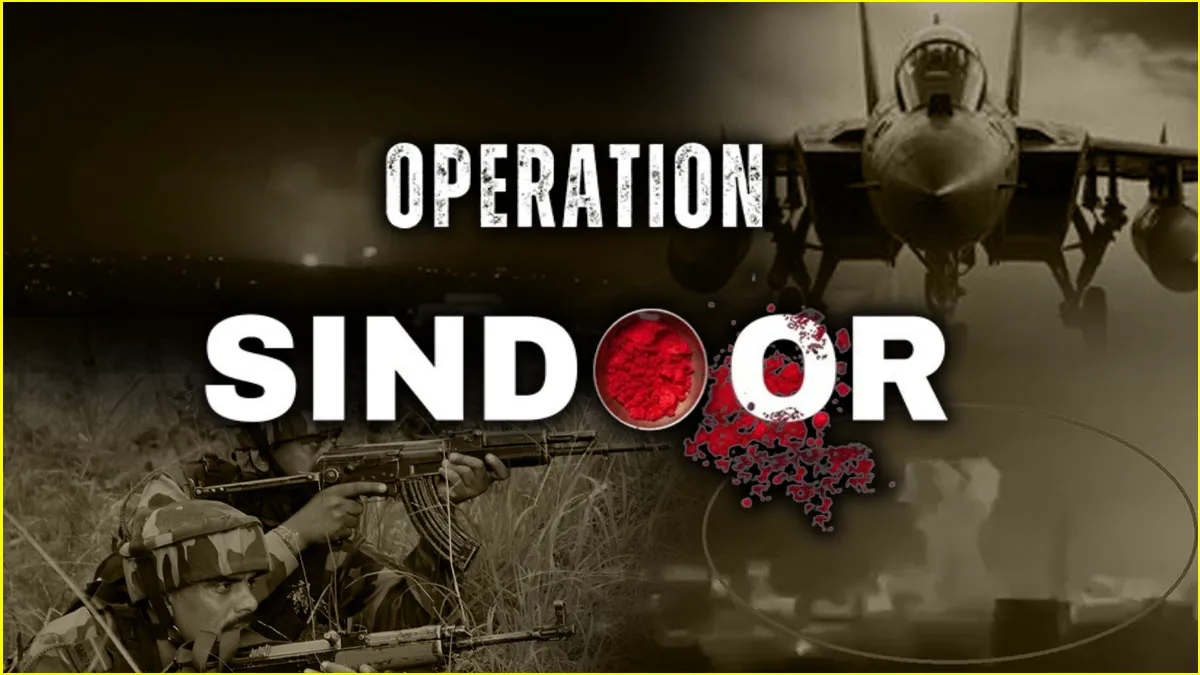
- On 7 May 2025, India launched Operation Sindoor.
- India stated that it targeted terrorist infrastructure at nine locations in Pakistan and Pakistan-occupied Jammu & Kashmir.
- The subsequent escalation involved:
- Missiles and drones
- Air defence operations
- Cross-border firing
- Strikes against military targets during the escalation.
- On 10 May 2025, India and Pakistan reached an understanding to stop military actions on land, air and sea.
- The episode highlighted the danger of rapid escalation between two nuclear-armed states.
Jammu & Kashmir Issue
- Jammu & Kashmir has remained one of the most contentious bilateral issues since 1947.
- India’s position rests on the Instrument of Accession signed in October 1947.
- Pakistan disputes India’s position and exercises control over parts of the former princely state.
- India maintains that matters relating to Jammu & Kashmir are to be addressed bilaterally, consistent with the Simla Agreement.
Post-2019 Developments
- On 5 August 2019, India:
- Made Article 370 inoperative in its earlier form
- Reorganised the former state into the Union Territories of Jammu & Kashmir and Ladakh.
- Pakistan strongly opposed the decision and downgraded diplomatic relations.
- India maintains that the constitutional changes are an internal matter of India.
- On 5 August 2019, India:
Line of Control
- The LoC is not the internationally recognised India-Pakistan boundary.
- It separates areas under Indian and Pakistani administration in Jammu & Kashmir.
- The present terminology emerged from the Simla Agreement, 1972.
- Major problems historically included:
- Ceasefire violations
- Infiltration
- Terrorist movement
- Civilian casualties
- Military escalation.
- The February 2021 DGMO understanding significantly reduced ceasefire violations for a period, although the wider relationship remained tense.
Indus Waters Treaty
Background
- The Indus Waters Treaty (IWT) was signed in 1960 by:
- Indian PM Jawaharlal Nehru
- Pakistani President Ayub Khan
with the World Bank playing an important role.
- It established a framework for sharing the Indus river system.
Allocation of Rivers
Eastern Rivers → India
- Ravi
- Beas
- Sutlej
Western Rivers → Pakistan for largely unrestricted use
- Indus
- Jhelum
- Chenab
- India retained specified rights over the western rivers for:
- Domestic use
- Non-consumptive use
- Agricultural use within prescribed limits
- Run-of-river hydroelectric generation subject to treaty conditions.

Why the Treaty Was Important
- For decades, the IWT survived:
- Wars
- Terror attacks
- Diplomatic crises
- Military confrontations.
- It was therefore frequently cited as an example of functional cooperation despite political hostility.
Indus Waters Treaty: Current Position
- Following the Pahalgam terrorist attack, India announced on 23 April 2025 that the IWT would be held in abeyance with immediate effect until Pakistan “credibly and irrevocably” abjures support for cross-border terrorism.
- The development represents a major change in India-Pakistan water relations.
Existing Water Disputes
- Important disputes have concerned Indian hydropower projects such as:
- Kishenganga
- Ratle.
- Differences have centred on:
- Dam design
- Storage
- Spillways
- Treaty interpretation
- Dispute-settlement mechanisms.
Sir Creek Dispute
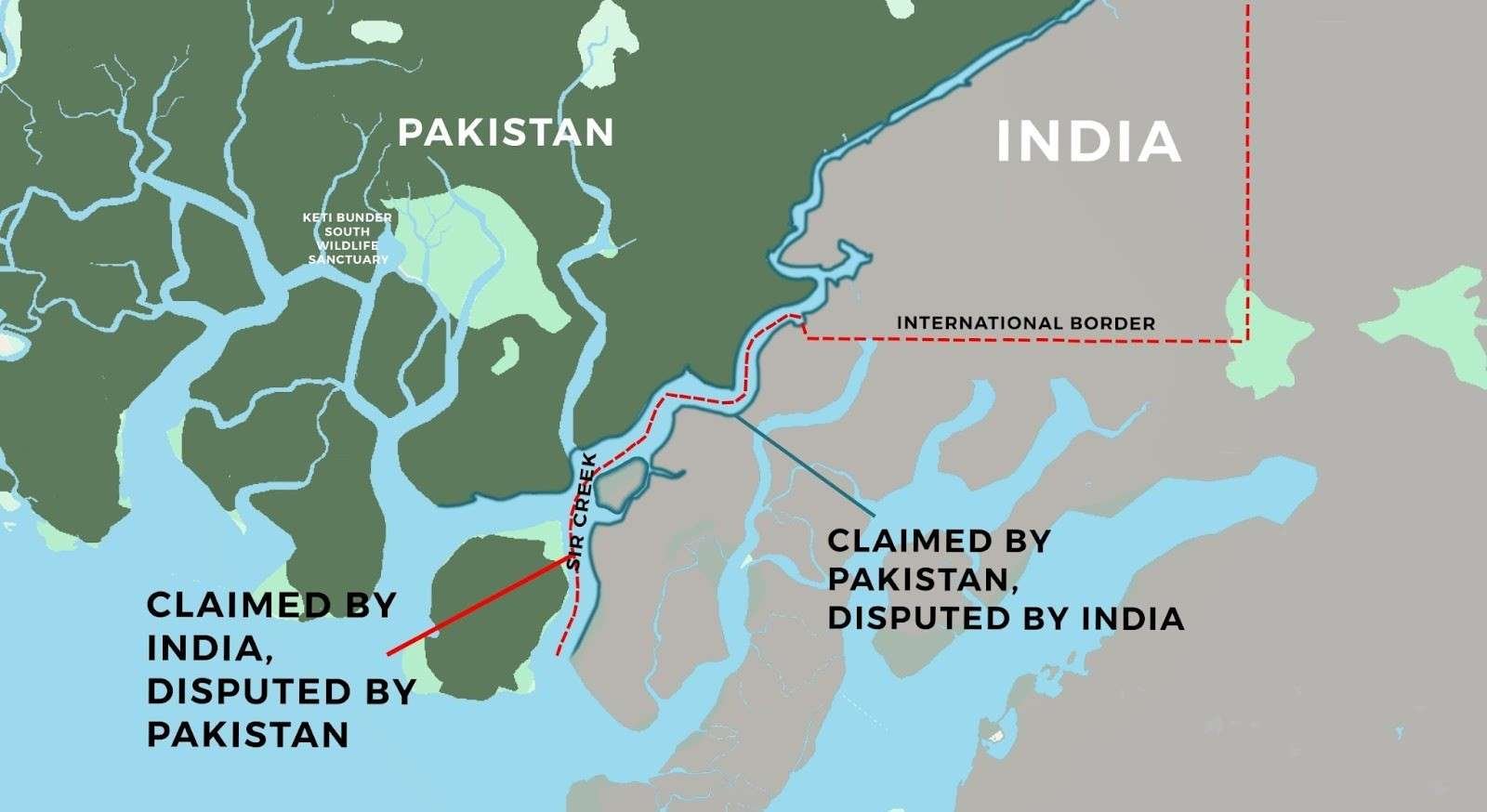
- Sir Creek is approximately a 96-km tidal estuary in the marshlands of the Rann of Kutch.
- It lies between:
- Gujarat in India
- Sindh in Pakistan.
- The dispute concerns the precise location of the boundary through the creek.
India’s Position
- India argues that the boundary should generally follow the mid-channel principle (Thalweg Principle).
Pakistan’s Position
- Pakistan has historically claimed that the boundary lies along the eastern bank of the creek, based on its interpretation of colonial-era documents.
Strategic Importance
- Resolution is important because it affects:
- Maritime boundary delimitation
- Exclusive Economic Zones
- Fisheries
- Potential offshore resources.
- Fishermen from both countries are frequently detained after inadvertently crossing poorly defined maritime boundaries.
Siachen Dispute
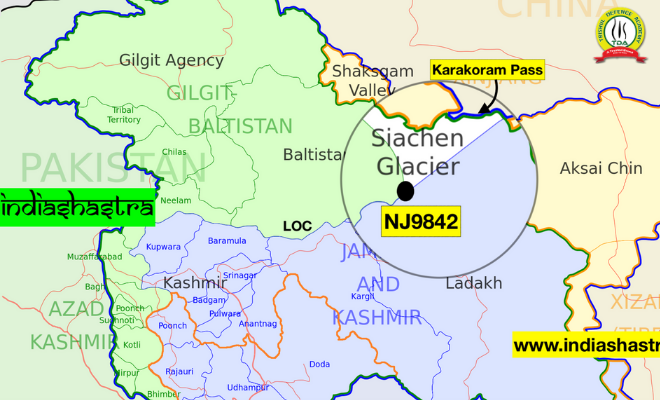
- Siachen Glacier lies in the eastern Karakoram region.
- The dispute originates from the fact that the 1949 Karachi Agreement did not delineate the ceasefire line beyond NJ9842.
- India and Pakistan subsequently interpreted the continuation of the line differently.
Operation Meghdoot
- In 1984, India launched Operation Meghdoot and occupied strategically important positions along the Saltoro Ridge.
- The region became one of the world’s highest military deployment zones.
India’s Position
- India favours authentication of the Actual Ground Position Line (AGPL) before any major troop withdrawal.
Pakistan’s Position
- Pakistan has historically resisted formal authentication before demilitarisation because it could be interpreted as legitimising India’s existing positions.
Key Challenge
Demilitarisation without authenticated positions creates the risk of future reoccupation and renewed conflict.
China–Pakistan Economic Corridor
- CPEC is a flagship component of China’s Belt and Road Initiative (BRI).
- It connects China’s Xinjiang region with Gwadar Port in Pakistan.
- India strongly opposes CPEC because projects pass through Pakistan-occupied Jammu & Kashmir, which India claims as its sovereign territory.
- India’s objections therefore involve:
- Sovereignty
- Territorial integrity
- China’s strategic presence
- China-Pakistan strategic cooperation.
Kulbhushan Jadhav Case
- Pakistan arrested Indian national and former naval officer Kulbhushan Jadhav in 2016.
- Pakistan accused him of espionage and sentenced him to death.
- India denied the allegations and approached the International Court of Justice (ICJ) over Pakistan’s denial of consular access.
- In 2019, the ICJ held that Pakistan had violated India’s rights under the Vienna Convention on Consular Relations.
- Pakistan was required to:
- Provide consular access
- Undertake effective review and reconsideration of Jadhav’s conviction and sentence.
- The case remains an important diplomatic and legal issue.
Nuclear Dimension
- India and Pakistan became overt nuclear powers following their 1998 nuclear tests.
- Their nuclear capabilities have created a condition of mutual deterrence, but also increased the consequences of miscalculation.
Major Nuclear Risks
- Short warning times
- Terrorist-triggered escalation
- Misinterpretation of military operations
- Missile and drone escalation
- Conventional conflict crossing the nuclear threshold.
Nuclear Confidence-Building Measures
- Both countries annually exchange lists of their nuclear installations and facilities under the 1988 agreement.
- They also maintain arrangements concerning:
- Advance notification of ballistic missile tests
- Military communication
- Hotlines.
SAARC and Regional Cooperation
- India and Pakistan are founding members of the South Asian Association for Regional Cooperation (SAARC).
- India-Pakistan tensions have significantly weakened SAARC’s functioning.
- The 19th SAARC Summit, scheduled for Islamabad in 2016, was postponed and has not subsequently been held.
- This prolonged stagnation has encouraged India to place greater emphasis on:
- BIMSTEC
- BBIN
- Subregional cooperation.
Shanghai Cooperation Organisation
- India and Pakistan became full members of the SCO in 2017.
- SCO provides an important multilateral platform where both countries participate despite limited bilateral engagement.
- Areas include:
- Counter-terrorism
- Regional security
- Central Asian affairs
- Connectivity
- Economic cooperation.
Afghanistan Factor
- Afghanistan has historically been another arena of India-Pakistan strategic competition.
- India’s interests include:
- A stable Afghanistan
- Prevention of terrorism
- Regional connectivity
- Humanitarian assistance.
- Pakistan considers Afghanistan crucial to its own security and regional strategy.
- Following the Taliban’s return to power in 2021, the regional environment changed significantly.
- Older formulations based solely on the previous Afghan government are therefore outdated.
TAPI Pipeline
- TAPI = Turkmenistan–Afghanistan–Pakistan–India Pipeline.
- The proposed pipeline would transport natural gas from Turkmenistan through Afghanistan and Pakistan to India.
- It could potentially:
- Improve regional energy connectivity
- Strengthen economic interdependence
- Provide India access to Central Asian gas.
- However, the project continues to face major challenges involving:
- Security
- Financing
- Political instability
- India-Pakistan tensions.
Confidence-Building Measures
Military CBMs
- Important military confidence-building measures include:
- DGMO hotline
- Advance notification of ballistic missile tests
- Advance notification of certain military exercises
- Agreement against attacks on nuclear facilities
- Ceasefire arrangements along the LoC.
Nuclear Installations Agreement
- The Agreement on the Prohibition of Attack against Nuclear Installations and Facilities was signed in 1988 and entered into force in 1991.
- Since 1992, both countries have exchanged lists of nuclear installations every 1 January.
- This practice has continued even during periods of severe diplomatic tension.
Non-Military CBMs
- Historically important initiatives include:
- Delhi-Lahore Bus
- Samjhauta Express
- Srinagar-Muzaffarabad Bus
- Cross-LoC trade
- Sporting exchanges
- Religious pilgrimages
- Kartarpur Corridor.
- However, several older CBMs are currently suspended or inactive.
Why Confidence-Building Measures Often Fail
- Trust deficit
- Terrorist attacks disrupting dialogue
- Domestic political pressures
- Ceasefire violations
- Weak institutionalisation
- Limited economic interdependence
- Absence of sustained high-level dialogue.
- The central problem is that:
CBMs can manage hostility, but they cannot substitute for resolution of underlying political and security disputes.
Contemporary Challenges in India Pakistan Relations
- The present India-Pakistan relationship is shaped by:
- Cross-border terrorism
- Jammu & Kashmir issue
- Indus Waters Treaty uncertainty
- LoC security
- Siachen
- Sir Creek
- Nuclear deterrence
- China-Pakistan strategic partnership
- CPEC
- Restricted trade
- Weak diplomatic representation
- Limited people-to-people connectivity
- Regional competition.
Importance of Pakistan for India
- A stable relationship with Pakistan is important for India’s:
- Western-border security
- Counter-terrorism objectives
- South Asian stability
- Central Asian connectivity
- Regional trade
- Energy connectivity
- Nuclear risk reduction.
Importance of India for Pakistan
- India represents:
- A very large neighbouring market
- Potential source of lower-cost imports
- Important regional connectivity route
- Major South Asian economic power.
- Improved relations could contribute to:
- Lower trade costs
- Regional integration
- Reduced military expenditure pressures
- Greater investment confidence.
Present Nature of India–Pakistan Relations
- The bilateral relationship is presently characterised by:
Minimal formal engagement + Restricted trade + Strong security competition + Limited functional contacts
- The 2025 crisis further deepened the trust deficit.
- Yet mechanisms such as:
- Diplomatic missions
- DGMO communication
- Nuclear-installation exchanges
- Religious pilgrimage arrangements
demonstrate that limited channels of communication remain important for crisis management.
Way Forward
Counter-Terrorism as the Foundation
- Sustainable normalisation requires an environment free from terrorism and violence.
- Terrorist organisations and their financing networks must be dismantled.
- Accountability for terrorist attacks is essential for rebuilding trust.
Maintain Crisis Communication
- Nuclear-armed neighbours require reliable:
- Military hotlines
- Diplomatic communication
- Crisis-management mechanisms
- Advance military notifications.
- These mechanisms reduce the risk of miscalculation and accidental escalation.
Gradual Diplomatic Engagement
- Dialogue can initially focus on less politically sensitive areas such as:
- Humanitarian issues
- Prisoners
- Fishermen
- Religious pilgrimages
- Medical cases
- Environmental challenges.
Strengthen People-to-People Contacts
- Where security conditions permit, carefully calibrated:
- Academic exchanges
- Cultural exchanges
- Sports diplomacy
- Religious tourism
- Family visits
can help reduce societal mistrust.
Resolve Sir Creek and Siachen
- These disputes have comparatively clearer technical dimensions than the wider Kashmir dispute.
- Progress could:
- Build confidence
- Reduce military costs
- Improve maritime management.
Water Dialogue
- Water security is becoming increasingly important due to:
- Climate change
- Glacier retreat
- Extreme floods
- Population pressure
- Growing water demand.
- Even amid political tensions, mechanisms for hydrological information, flood management and technical communication remain valuable.
Economic Engagement
- Large-scale trade normalisation is unlikely without political improvement.
- However, in a conducive security environment, phased and reciprocal trade restoration could create economic constituencies favouring stability.
Revive Regional Cooperation
- Better bilateral relations could unlock greater cooperation through:
- SAARC
- SCO
- Regional connectivity initiatives.
- South Asia remains among the world’s least economically integrated regions, making India-Pakistan normalisation economically significant.
Track-II Diplomacy
- Track-II diplomacy refers to unofficial dialogue involving:
- Academics
- Former officials
- Strategic experts
- Business representatives
- Civil-society organisations.
- It cannot replace formal diplomacy but can:
- Generate policy ideas
- Maintain communication during diplomatic freezes
- Reduce misperceptions.
Conclusion
- India-Pakistan relations remain one of South Asia’s most complex bilateral relationships, shaped by the legacy of Partition, territorial disputes, terrorism and nuclear rivalry.
- The Pahalgam attack and Operation Sindoor in 2025 demonstrated how quickly terrorism can produce military escalation between the two nuclear-armed neighbours.
- At the same time, geography makes permanent disengagement neither practical nor desirable.
- India’s approach therefore requires a combination of:
Credible Deterrence + Counter-Terrorism + Crisis Management + Selective Engagement + Regional Stability
- Sustainable normalisation ultimately requires an environment free from terrorism and violence, respect for sovereignty, reliable crisis-management mechanisms and gradual rebuilding of mutual trust.